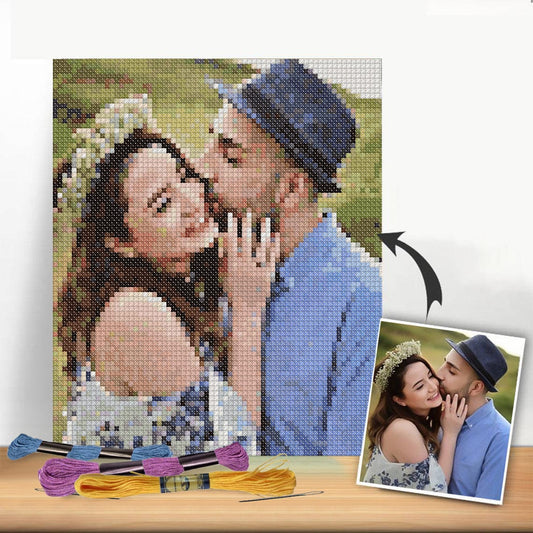
A DMC conversion chart is your go-to reference for matching DMC embroidery floss numbers to their closest counterparts in other brands, like Anchor or Madeira. Think of it as a translator for thread, and this guide is your complete toolkit for converting colors for any cross stitch or embroidery project you can dream up.
Your Essential Guide to DMC Thread Conversion
If you've spent any time with a needle and thread, you know that DMC is the industry standard. But what happens when a pattern calls for a DMC color you don't have, or you simply prefer working with a different brand? That's where a good conversion chart becomes indispensable.
This reference is designed to help you navigate those common situations. We'll cover everything from adapting patterns to different thread brands to translating your physical floss colors into digital Hex and RGB codes for design software.
With these charts, you'll be able to:
- Shop your stash first. Put the threads you already own to good use, saving you a trip to the store.
- Keep your colors consistent. When you have to substitute a floss, you can do it with confidence.
- Design with precision. Make accurate color choices when creating your own custom patterns.
For anyone who loves seeing how these threads come to life, especially in personalized projects, our guide to cross stitch letters and alphabets is a great next stop. The detailed charts and practical advice that follow will make color substitution feel less like guesswork and more like an expert choice.
The Ultimate DMC to Anchor Conversion Chart
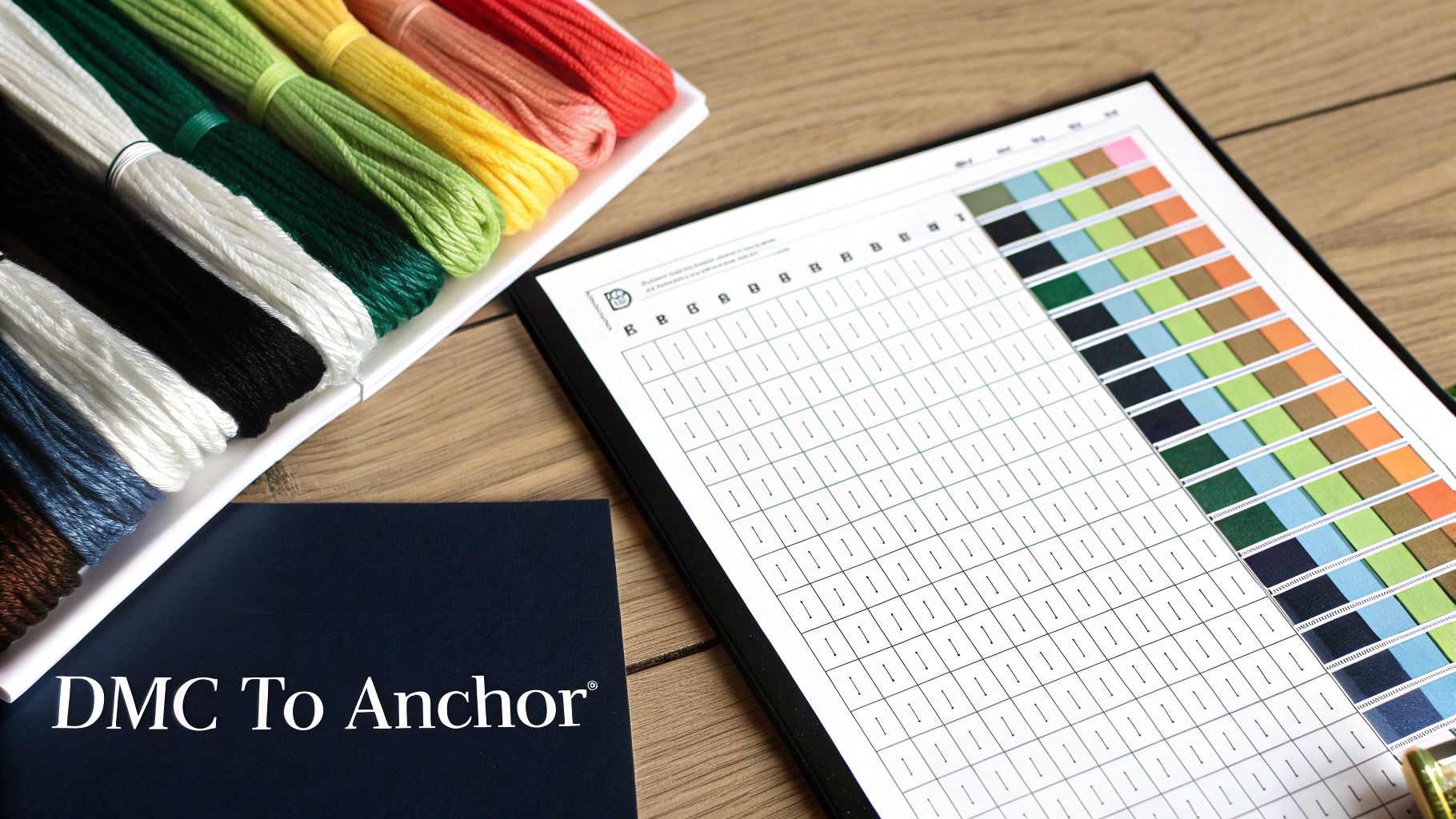
If you've ever found yourself with a pattern calling for DMC thread but an Anchor stash, you know how crucial a good conversion chart is. It’s a foundational tool for any stitcher. This section is designed to be your quick-glance reference, mapping every standard DMC number to its closest Anchor match so you can substitute floss without missing a beat.
Keep in mind that while these conversions are the industry standard and incredibly close, they aren't always a 100% perfect one-to-one match. Different brands have their own unique dyeing processes, which can lead to subtle differences in shade, tone, or even sheen.
This is why having a reliable chart is so important. A classic example is DMC 356, which accurately converts to Anchor 1013. Knowing these specific equivalents is key to maintaining the designer's original color palette and ensuring your project turns out just as you imagined.
Below you'll find a comprehensive, searchable table to make these swaps seamless.
DMC to Anchor Thread Conversion Table
Here is our complete, searchable data table mapping standard DMC floss numbers to their closest Anchor thread equivalents. We've included color swatches and notes on the match quality to help you make the best choice for your project.
| DMC Number | DMC Color Swatch | Anchor Number | Anchor Color Swatch | Match Quality Notes |
|---|---|---|---|---|
| [Data] | [Data] | [Data] | [Data] | [Data] |
| ... | ... | ... | ... | ... |
| DMC 356 | [Swatch] | Anchor 1013 | [Swatch] | Excellent Match |
| ... | ... | ... | ... | ... |
This table is your go-to guide for adapting patterns with ease. For an even wider range of brand comparisons, our full thread color conversion chart will help you explore other options and substitute threads with total confidence.
DMC to Madeira and Other Brands Conversion Charts
While Anchor is probably the most common swap for DMC, your pattern might need a conversion to another great brand like Madeira, Sullivans, or even J&P Coats. Many stitchers are big fans of the Madeira line, which has a fantastic range of vibrant colors, so having a good conversion chart on hand is a must if you want to substitute threads confidently.
It's worth noting, though, that the color matches for these brands can sometimes be a little less exact than what you'd find with Anchor. Different brands use different dyeing processes and their threads can have a slightly different sheen, which makes a simple side-by-side visual check more crucial than ever. It's really the only way to be sure the new thread will play nicely with the rest of your color palette.
Tip: Before you commit to a big section, always stitch a little test patch with the new thread. This gives you a chance to see how the color looks in natural and artificial light and confirm you’re happy with the swap.
Looking for conversions for those beautiful hand-dyed variegated threads? Check out how our Classic Colorworks to DMC chart can help you out.
Translating DMC Threads to Digital RGB and Hex Codes
If you've ever designed your own patterns or used stitching software, you know how crucial it is to get the on-screen colors right. This is where converting physical DMC threads into their digital equivalents—RGB (Red, Green, Blue) and Hex (Hexadecimal) codes—becomes a game-changer.
Think of these codes as the digital DNA for each thread color. They allow pattern-making software to accurately represent how your finished project will look, helping you create precise digital mockups before you even pick up a needle. It's the key to making sure the design you see on your monitor is what you get on your fabric.
For instance, a tool like Pic2Pat relies entirely on these digital values to generate a pattern from an image, as you can see below.
The software matches pixels in your photo to the closest DMC thread by comparing their digital color codes, creating a workable and color-accurate chart.
DMC to Digital Color Code Conversion
To help you with your digital designs, here’s a quick reference table for some of the most common DMC threads and their corresponding digital color codes. This is just a small sample, but it gives you an idea of how the system works.
| DMC Number | DMC Color Swatch | RGB Code | Hex Code |
|---|---|---|---|
| 310 | ⬛️ | 0, 0, 0 | #000000 |
| BLANC | ⬜️ | 255, 255, 255 | #FFFFFF |
| 3865 | ⬜️ | 249, 247, 240 | #F9F7F0 |
| 820 | 🟦 | 1, 35, 100 | #012364 |
| 741 | 🟧 | 247, 126, 41 | #F77E29 |
| 666 | 🟥 | 215, 15, 22 | #D70F16 |
| 907 | 🟩 | 129, 210, 86 | #81D256 |
| 798 | 🟦 | 48, 83, 133 | #305385 |
Keep in mind that digital color representation can vary slightly from one screen to another. However, these codes provide a standardized starting point for any digital cross-stitch project.
For a complete list of over 500 DMC colors with their digital codes, you can download our free DMC thread colour chart. It's an indispensable resource for bridging the gap between your physical thread stash and your digital design canvas.
How to Use Conversion Charts Effectively
A DMC conversion chart is an absolutely indispensable tool for any stitcher, but getting the best results is about more than just matching numbers. Knowing how to use the chart is what really makes the difference. After all, factors like dye lots and the way colours look on your screen can throw a wrench in the works.
Believe it or not, even two skeins of the same brand and colour number can have tiny variations if they come from different dye batches. This is why a physical, in-person comparison is always your best bet for a perfect match.
The most reliable way to check a substitute is to take your original thread and the potential replacement and compare them side-by-side in good, natural light. An overcast day by a window is ideal. This hands-on check lets you see with your own eyes if the new thread’s tone and shade truly work with the other colours in your project.
For a large, single-colour background, a "close enough" match from the chart will probably be perfectly fine. But when you're working on a focal point—like the subtle shading in a portrait's face—precision is everything. In those cases, that extra step of comparing the threads in person is non-negotiable.
This decision tree gives you a great visual guide for how to approach thread conversion depending on your starting point and what you're trying to achieve.
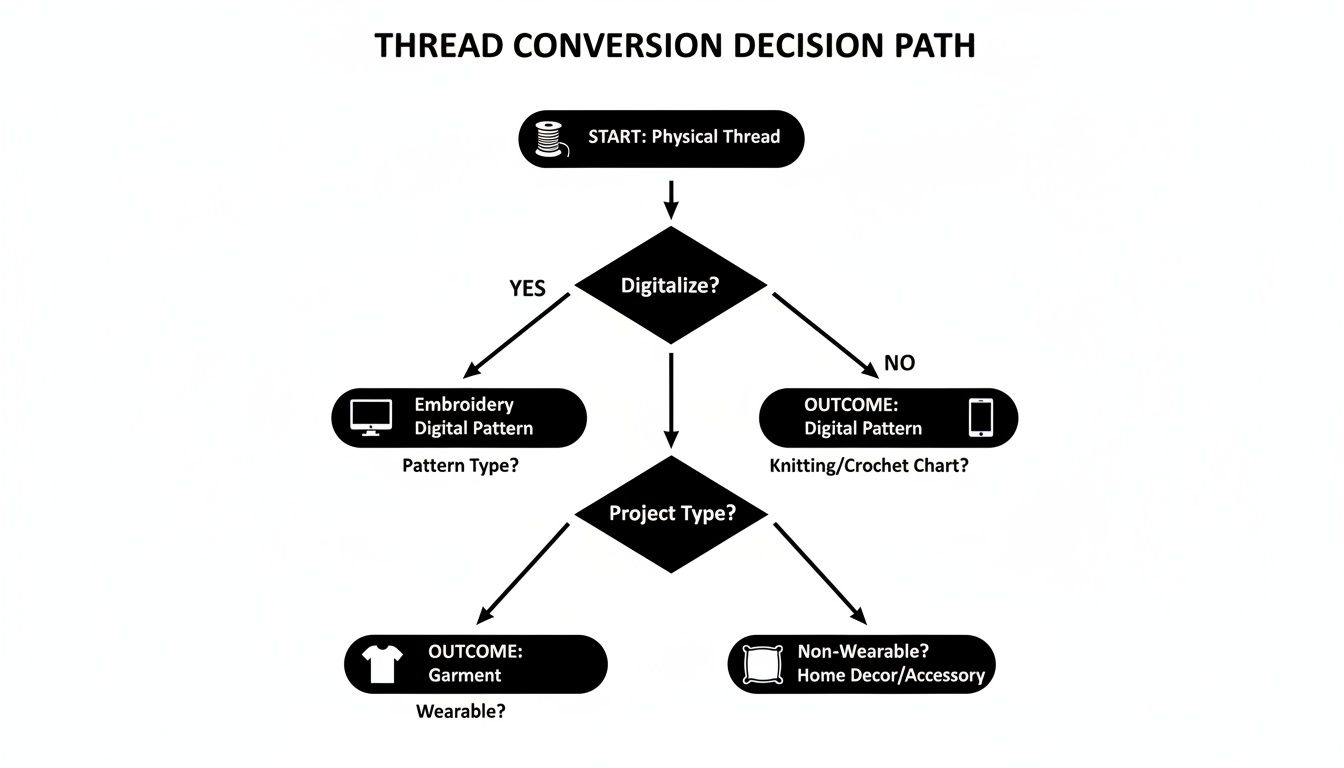
As the flowchart shows, whether you’re starting with a physical skein you need to identify or a digital pattern with a specific thread list, the most trustworthy conversions for physical projects always come back to a hands-on comparison.
Substituting Specialty and Variegated Floss
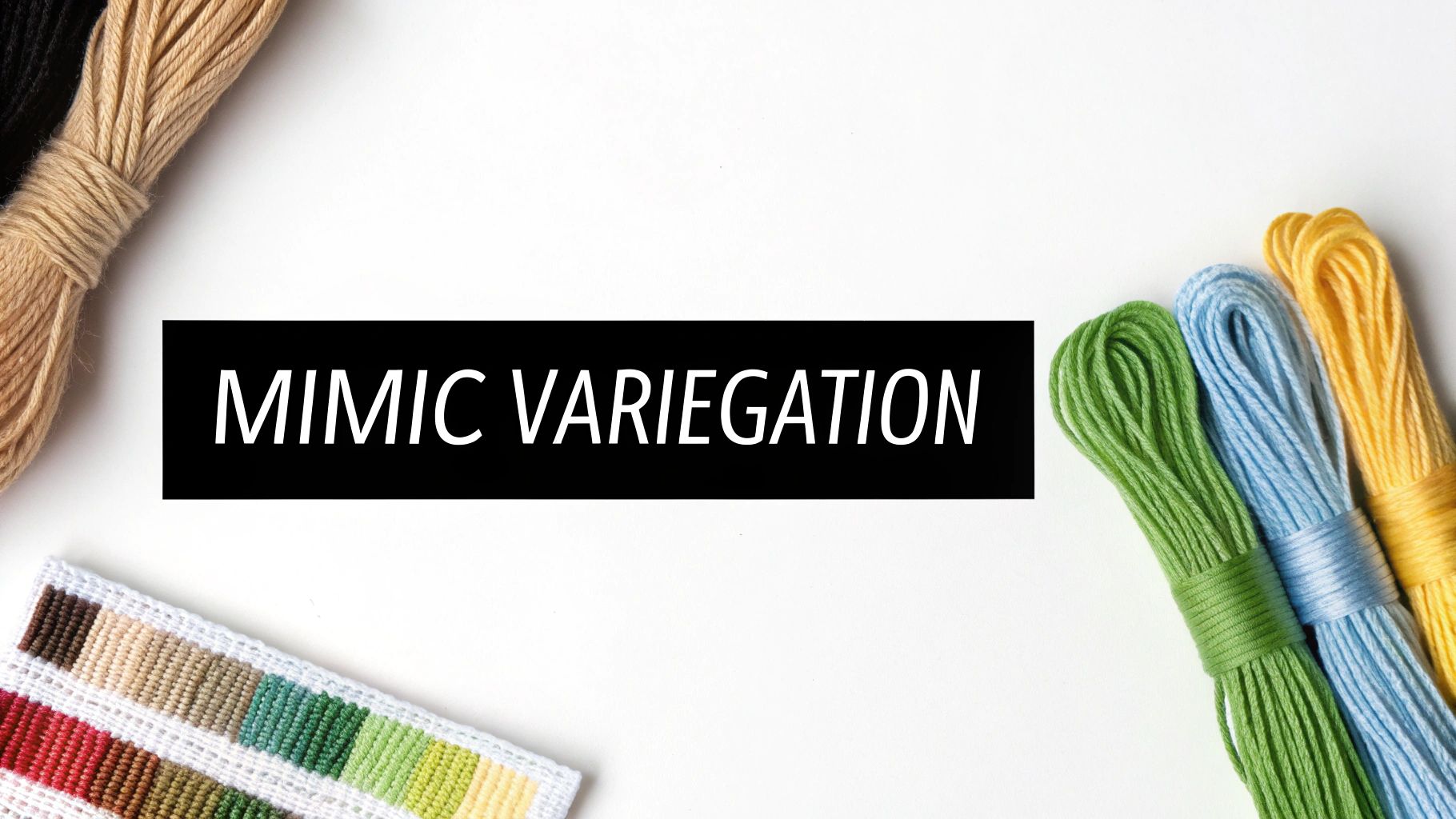
When you run into specialty threads like DMC's Variegated, Coloris, or Light Effects lines, a standard DMC conversion chart won't get you very far. These threads are designed with unique textures and multi-tonal effects, so finding a perfect one-to-one match is practically impossible. Your goal here isn't to find an exact equivalent, but rather a creative workaround that captures the spirit of the original design.
For instance, if you need to replace a variegated floss, a fantastic technique is to blend two or three solid DMC colours. By stitching with one strand of each colour together, you can mimic that multi-tonal look and maintain the artistic feel of the pattern.
DMC has a rich history with these types of threads. Back in 2018, they brought back their much-loved Variation line after stitchers made it clear they wanted them back. The line now features 40 distinct shades. For a deeper dive, check out the history of DMC Variation threads on lordlibidan.com.
When you're trying to replace a metallic thread, like those in the Light Effects range, shift your focus. Instead of hunting for a colour match, look for another brand's metallic that has a similar thickness and sheen.
Converting Hand-Dyed Floss to Standard DMC
Anyone who has worked with hand-dyed threads from brands like Weeks Dye Works knows just how beautiful their subtle, shifting colors are. That unique variegation is something a single, solid-colored floss just can't match. So, when a pattern calls for a specialty thread and you need to use DMC, a simple one-to-one swap from a DMC conversion chart won't cut it.
The secret is to recreate that gorgeous, variegated look by blending multiple shades of DMC together.
The Blending Technique
To get a close match for a single strand of hand-dyed floss, you'll usually want to thread your needle with two or three different DMC colors at the same time. This blending technique is the best way to mimic the rich, nuanced effect of the original overdyed thread.
A classic example is substituting for Weeks Dye Works 'Havana,' a really popular deep brown. A great way to get that look is by blending one strand of DMC 838 with one strand of DMC 3862.
- Original: Weeks Dye Works 'Havana'
- DMC Blend: DMC 838 + DMC 3862
Thankfully, you don't always have to figure these blends out on your own. You can find some fantastic online resources that have done the hard work for you. There are even charts that map specific hand-dyed silks—for instance, matching Belle Soie Silk 104 to a blend of DMC 677 and 3772.
If you're curious to see more of these complex substitutions, a great place to start is this detailed guide on overdyed floss conversions at Starlight Stitch.
Your Top Thread Conversion Questions, Answered
When you start substituting threads, a few questions always pop up. Whether you're trying to shop your stash to save a trip to the store or you're stuck on a tricky pattern, getting the right answers can make all the difference. Let's tackle some of the most common things stitchers ask when using a DMC conversion chart.
Getting a feel for these little details is what will give you the confidence to make smart swaps, so your finished piece turns out just the way you want it. We'll go over everything from near-miss matches to mixing brands in one project.
What Should I Do If a Perfect Color Match Does Not Exist?
When you can't find a perfect, one-to-one match on the chart, the best tool you have is your own judgment. Pick the closest shade you can find from the chart, but then take the extra step of comparing it with the other colors in your project's palette.
Lay the threads out side-by-side in good, natural light. You'll often find that a color that’s a touch lighter or darker but has the right undertone (warm vs. cool) works much better than a shade that seems close but just doesn't vibe with its neighbors. For really important, detailed areas like faces or delicate flower shading, it’s almost always worth tracking down the exact thread the designer called for to keep the original effect intact.
Can I Mix Different Thread Brands in the Same Project?
Yes, you absolutely can! It's incredibly common for stitchers to mix brands like DMC and Anchor in the same piece, and it usually works out just fine. The main thing to keep an eye on is the subtle difference in sheen and thickness between brands.
For instance, DMC's six-strand cotton floss generally has a bit more of a shine to it than Anchor's. While you'd probably never notice this in a finished project, it pays to be a little strategic about where you mix and match.
- Try to avoid mixing brands within the same solid block of color. This will keep the texture and light reflection consistent.
- It's best not to use different brands for blended-needle shading in the same area (like a single flower petal), as the different sheens could interrupt that smooth, seamless gradient you're going for.
How Reliable Are Online Conversion Tools and Apps?
Digital conversion tools and apps are a fantastic starting point, but they definitely come with a few caveats. The best ones are built on actual, side-by-side thread comparisons made by real people, not just algorithms guessing at color values.
Think of a digital tool as a helpful guide, not the final word. Your screen's calibration, its brightness setting, and even the lighting in your room can change how a color looks. Never, ever trust a digital swatch alone for a critical color match—always double-check with physical thread cards if you can.
Why Are Some DMC Numbers Missing From Conversion Charts?
You've probably noticed gaps in conversion charts where certain DMC numbers, often newer or very old ones, are just missing. There are a couple of good reasons for this.
Over the years, DMC has discontinued certain colors. While they usually suggest a replacement, other brands don't always create a direct equivalent for a color that's no longer in production. Also, when DMC releases a new batch of colors, it simply takes time for manufacturers like Anchor or Madeira to catch up, produce their own matching versions, and add them to official charts. If your pattern lists a discontinued number, your best first step is to look up the official DMC-recommended replacement before you try to convert it to another brand.
Ready to turn your favorite photos into timeless keepsakes? At Cross Stitched, our custom kits provide everything you need, including pre-sorted DMC threads and an easy-to-follow pattern, to create a masterpiece. Start your personalized cross-stitch project today!