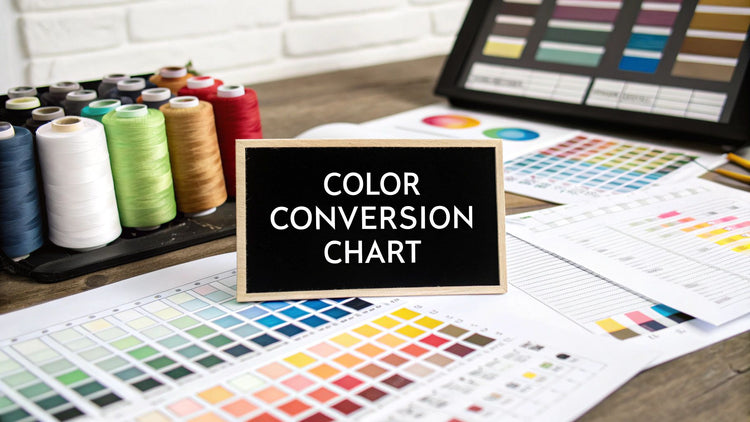
A thread color conversion chart is your secret weapon in the world of embroidery. Think of it as a translator that helps you find the closest color match between different thread brands. It lets you confidently swap a thread from one company, like DMC, for its equivalent in another, such as Anchor or Madeira. This is a lifesaver when a pattern calls for a thread you don't have or can't easily find.
Your Guide to Thread Color Conversion
Ever get excited to start a new cross-stitch project, pull out the pattern, and immediately hit a wall? It calls for a specific brand of thread you don’t own. It's a classic, frustrating moment that can stop a project before it even begins.
A thread color conversion chart is the simple, elegant solution. It acts like a universal translator for your floss collection, lining up the color codes from one manufacturer with the nearest matches from others. This guide is all about making that process painless. Instead of guessing at colors or making extra trips to the craft store, you'll be able to substitute threads with confidence and get right back to what you love—stitching.
Why You Need a Conversion Chart
For any serious stitcher, a reliable chart isn't just nice to have; it's essential. It solves a few common headaches that pop up all the time.
- Pattern Flexibility: You’re no longer locked into the specific brands a designer used. You can adapt any pattern to the threads you actually have.
- Using Your Stash: Get the most out of the threads you've already collected. It saves money and keeps you from buying duplicates you don't really need.
- Handling Discontinued Colors: When a favorite color gets discontinued (and they always do!), a conversion chart is your best bet for finding its closest living relative.
Let's quickly look at some of the most common brands you'll encounter and why you might need to convert their colors.
Popular Thread Brands and Conversion Needs
| Thread Brand | Primary Use | Why Conversion is Necessary |
|---|---|---|
| DMC | Cross-stitch, embroidery, needlepoint | The most common brand in patterns. You'll often need to convert from DMC to another brand if you don't have it. |
| Anchor | Cross-stitch, embroidery, tapestry | A popular alternative to DMC, especially in European patterns. Conversion is crucial for switching between the two. |
| Madeira | Machine and hand embroidery | Known for its silk and rayon threads. You'll need a chart to substitute their specialty threads for standard cotton floss. |
| Sullivans | Cross-stitch, general needlework | A budget-friendly option often sold in kits. Conversion is key when you want to use a higher-quality thread in its place. |
Ultimately, a good thread chart does more than just match numbers. It's about giving you creative freedom, ensuring your projects look beautiful and consistent every single time.
How to Use a Thread Conversion Chart Effectively
At first glance, a thread conversion chart can look a little intimidating. All those columns and numbers! But once you get the hang of it, you'll see it's just a simple reference tool that makes your stitching life a whole lot easier. Think of it as a translator, helping you switch between thread "languages" like DMC and Anchor so your project's colors turn out just right.
Your first step is always to check the pattern's key or legend. Find the brand the designer used (like DMC) and the specific color number they call for (for example, 310 for a classic black). This is your starting point.
Now, take that number and find it in the first column of the conversion chart. Once you've located your original color, just follow that row across to the column of the brand you have on hand, whether it's Anchor, Madeira, or something else. The number you see there is the closest recommended match.
The Three-Step Conversion Process
Breaking it down into a few simple actions makes the process feel much less daunting. You can apply these same steps to any project you work on.
This handy visual guide walks you through the process, from finding the color on your pattern to picking out the right substitute.
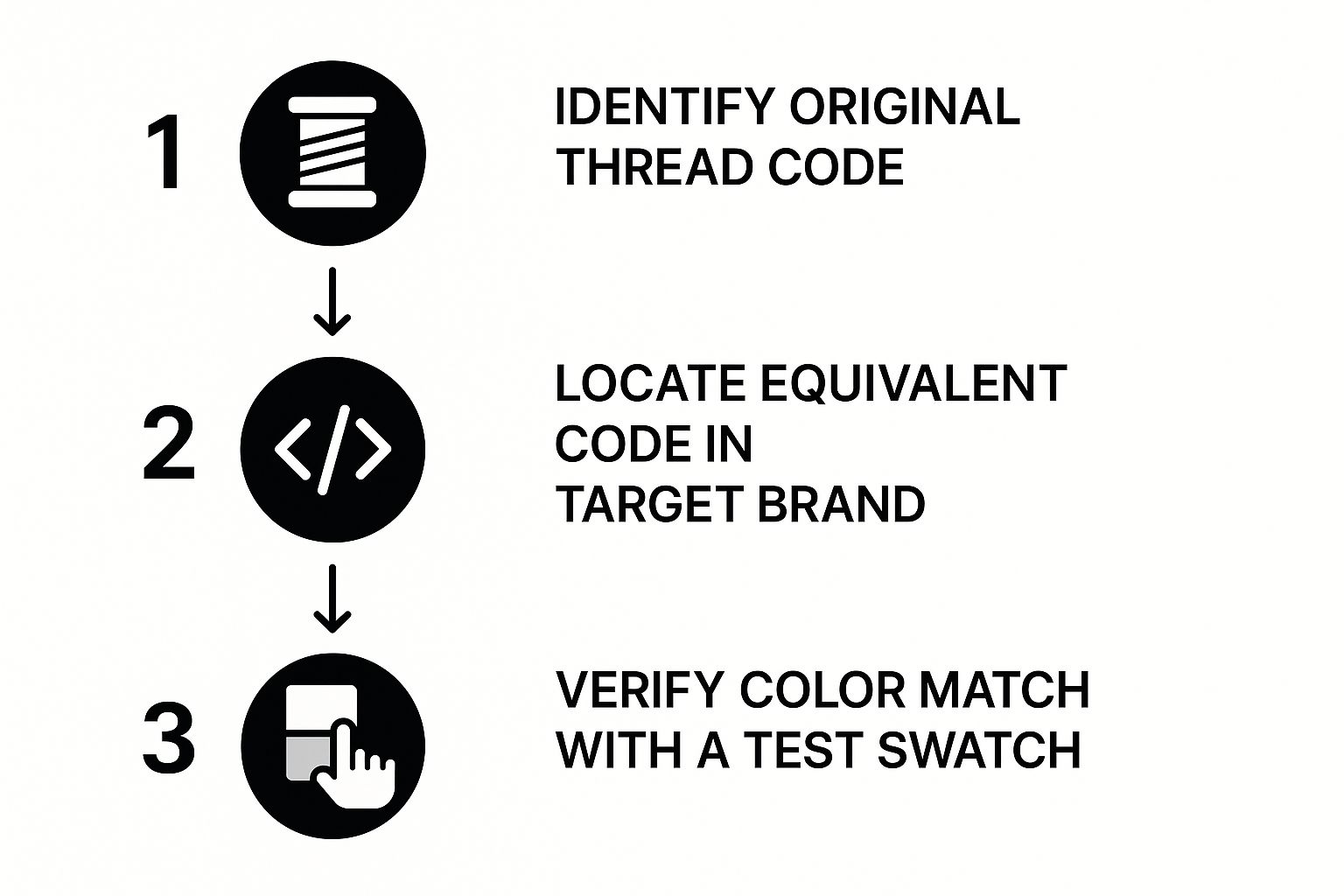
The most important part of this whole process is that last step: always double-check the color with your own eyes. A chart gives you the closest match, but that doesn't always mean it's a perfect match.
Handling Imperfect Matches
So, what do you do when the chart doesn't have an exact one-to-one equivalent? This happens more often than you't think, and it's where your own artistic eye becomes your best tool. Since no two companies use the exact same dye formulas, "closest match" is truly the key phrase here.
When you're weighing your options for a substitution, keep these things in mind:
- Thread Finish: Does the original thread have a high sheen like DMC's satin floss, or is it a more muted, matte finish? Swapping a shiny thread for a matte one (or the other way around) can significantly alter the final look and feel of your piece.
- Overall Color Harmony: Before you commit, lay your potential substitute next to the other floss colors in your project's palette. Does it fit in? Does it maintain the mood the original designer was going for?
- Dye Lot Differences: Even within the same brand and color number, there can be slight variations from one dye lot to the next. It’s always a good idea to buy all the thread you think you'll need for a project at the same time to avoid any noticeable shifts in color.
A thread conversion chart is an amazing guide, but your eyes are the final judge. Always trust your gut and do a visual check in good, natural light before you start stitching with a substituted color.
Building up these little skills is part of the fun. If you're looking to round out your knowledge, brushing up on some general cross-stitch tips for beginners can give you a great foundation for making smart choices about all your materials. In the end, using a chart well is a mix of following directions and trusting your creative intuition—a combination that guarantees your finished work will look fantastic.
DMC to Anchor Thread Color Conversion Reference
If you’ve spent any time with embroidery or cross-stitch, you know that DMC and Anchor are the two giants in the floss world. In the US, DMC is often the go-to, celebrated for its quality and massive palette of over 500 standardized floss colors. Meanwhile, Anchor is a huge favorite across Europe, loved for its tough-wearing threads and deep, vibrant hues. This guide is built to help you switch between these two powerhouse brands without a hitch.
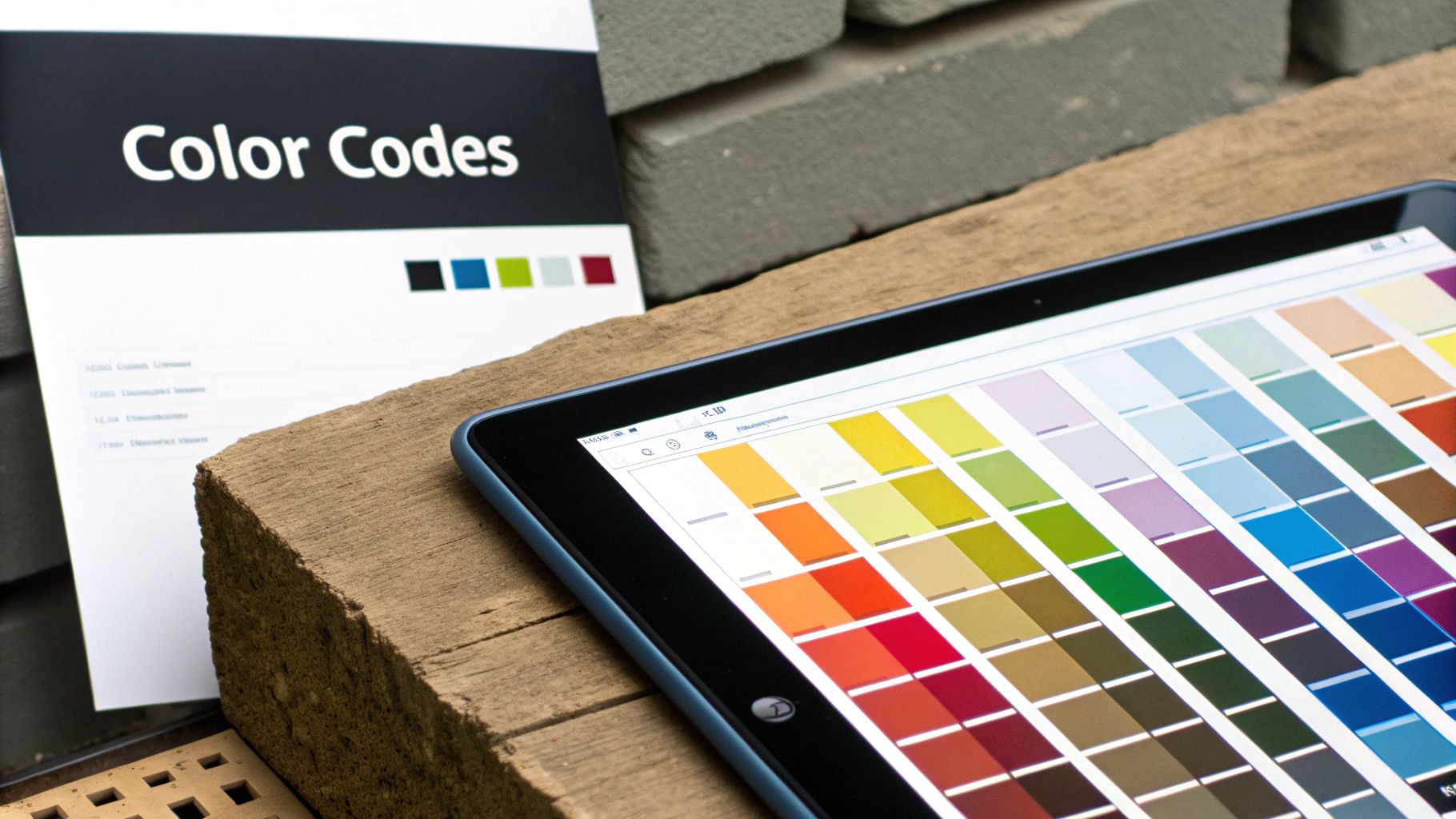
Because each company uses its own unique numbering system, a reliable thread color conversion chart isn't just nice to have—it's essential. It takes the guesswork out of substituting threads, making sure your project’s colors look just as the designer intended, regardless of which brand you're using.
How To Navigate DMC and Anchor Conversions
Using a conversion table is pretty simple. Just locate the DMC number your pattern calls for, then look across the row to find its closest match from Anchor. The key word here, though, is closest.
It’s a reality of working with different dyes and materials that a perfect, 100% identical match is almost impossible to find. My best advice? Always do a visual check. Before you start a single stitch, hold the substitute skein next to the other colors in your project under good, natural light. This will tell you if it truly works.
That quick visual confirmation is the most important step you can take. It lets you spot subtle variations in tone or shine that a chart just can't communicate, ensuring your finished piece turns out exactly how you pictured it.
Being able to cross-reference brands is a fundamental skill in today's global needle arts community. With international companies and increasingly complex patterns, these charts have become a stitcher's best friend. Major brands like DMC, Madeira, and Anchor all offer detailed charts that map out hundreds of their color codes. This system is also a lifesaver for managing inventory, especially when a color is retired or isn't available in your region. You can discover more about these essential tools and find other brand-specific charts to open up even more creative doors.
DMC to Anchor Thread Conversion Data
Here’s a detailed chart to help you convert some of the most popular DMC colors to their closest Anchor counterparts. For instance, if a pattern specifies DMC 310 (the classic black), you can confidently grab Anchor 403. Use the notes to understand any subtle differences.
| DMC Number | DMC Color Name | Anchor Number | Visual Match Notes |
|---|---|---|---|
| 310 | Black | 403 | Excellent match, virtually identical. |
| 725 | Topaz | 304 | Very close, Anchor may be slightly richer. |
| 815 | Garnet Medium Dark | 47 | Good match, Anchor is a tiny bit darker. |
| 995 | Electric Blue Dark | 140 | Strong match, excellent substitute. |
| B5200 | Snow White | 2 | Anchor 2 is a great match for B5200. |
Having a systematic way to convert colors gives you incredible flexibility. You can dive into any project knowing you can adapt it to the floss you already own, all while preserving the designer's original artistic vision.
Converting Madeira, Sulky, and Other Major Brands
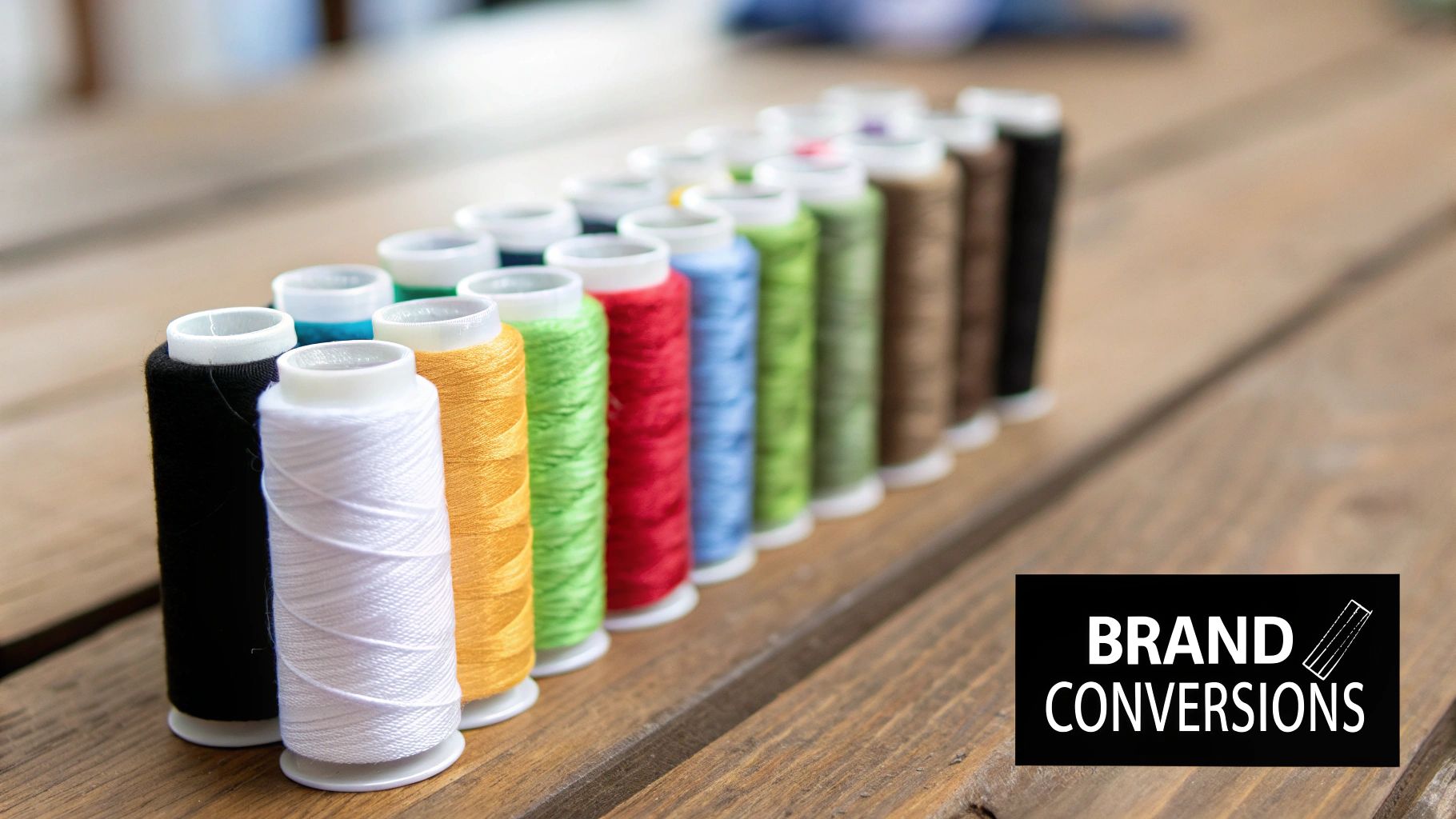
While it's true that DMC and Anchor tend to show up in most patterns, your stitching journey will eventually introduce you to other fantastic brands. Getting familiar with names like Madeira, Sulky, and Gutermann is a smart move. Having a broader thread color conversion chart in your toolkit opens up so many more project possibilities and helps you use the threads you can actually get your hands on.
These brands often go beyond standard cotton, offering unique textures and finishes that can really make your work pop. Madeira, for instance, is well-known for its brilliant rayon and tough polyester threads. They’re a go-to in machine embroidery, but they also give hand embroidery a gorgeous, high-sheen finish. Gutermann is another great example, with a huge selection that includes everything from strong polyester to soft cottons perfect for handwork.
A Quick Word on Different Thread Materials
Swapping colors between brands is one thing, but switching between different types of thread? That requires a little more consideration. Each material plays with light and fabric in its own way, which can totally change the look and feel of your finished project.
When you substitute something like rayon for cotton, you're not just changing the color; you're also swapping out the texture and sheen. A rayon thread is going to catch the light and look much glossier than its matte cotton counterpart. This isn't a bad thing at all—in fact, it's a creative opportunity! Just make sure you're aware of the effect it will have on the design.
This is especially critical if you want to stay true to the original pattern's vision. If a design depends on subtle, flat shading, throwing a high-sheen thread into the mix could disrupt that intended effect.
- Cotton to Rayon: This swap will give your stitches a silky, smooth finish with a noticeable sheen.
- Cotton to Polyester: You'll gain durability and a slight shine. It’s often a great middle-of-the-road option.
- Cotton to Silk: This introduces a rich, natural luster that’s truly in a class of its own.
How to Find Conversion Info for Other Brands
Unlike the well-trodden path between DMC and Anchor, finding one giant chart that covers every single brand is a tall order. Your best bet is often to go straight to the source. Many manufacturers, including Madeira and Sulky, publish their own conversion guides right on their websites.
Madeira, Sulky, and Gutermann Conversion Table
Think of this table as a solid starting point for converting from the ever-present DMC to these other popular brands. A quick tip from experience: whenever you can, double-check the color match with your own eyes before you start stitching.
| DMC Number | Madeira Classic Rayon | Sulky Rayon | Gutermann Creativ |
|---|---|---|---|
| 310 (Black) | 1000 | 1001 | 000 |
| B5200 (White) | 1001 | 1002 | 800 |
| 321 (Red) | 1147 | 1024 | 450 |
| 743 (Yellow Med) | 1068 | 1064 | 142 |
| 906 (Parrot Green Med) | 1170 | 1249 | 919 |
At the end of the day, a good thread color conversion chart is meant to be a flexible tool, not a rigid rulebook. By exploring conversions for brands like Madeira, Sulky, and Gutermann, you’re not just finding substitutes—you're expanding your creative palette so you're never stuck on a project just because one specific thread is out of stock.
Digital Thread Conversion Tools and Apps: Your Pocket Expert
While a printed chart is a trusty companion, we're lucky to be stitching in an age with some incredibly helpful digital tools. Websites and mobile apps have put an interactive thread color conversion chart right in our pockets, and honestly, they can do things a paper chart just can't.
Think about it: instead of manually scanning pages, you can just punch in a color code and instantly see its closest matches across a dozen brands. These tools are more than just a quick lookup; they're designed to help you manage your entire stitching life, from your thread stash to your next big project.
Why Every Stitcher Should Try a Digital Converter
For a modern stitcher, using a digital converter is a game-changer. These tools don't just give you data; they become an active part of your creative process.
- Stash Management: This is a big one. Many apps let you catalog all the threads you currently own. So, when you look up a conversion, the app can flag if you already have the suggested color on hand. No more buying duplicates!
- Photo-to-Palette Magic: Some of the more sophisticated apps have a feature where you can upload a photo, and it will generate a palette of corresponding thread colors. This is a lifesaver when you want to turn a favorite picture into a cross-stitch pattern and need a starting point for your colors.
- Project Palettes: You can create and save specific color lists for each project. This makes it so much easier to track substitutions and make sure your chosen colors look great together.
Of course, with all this convenience comes one major caveat.
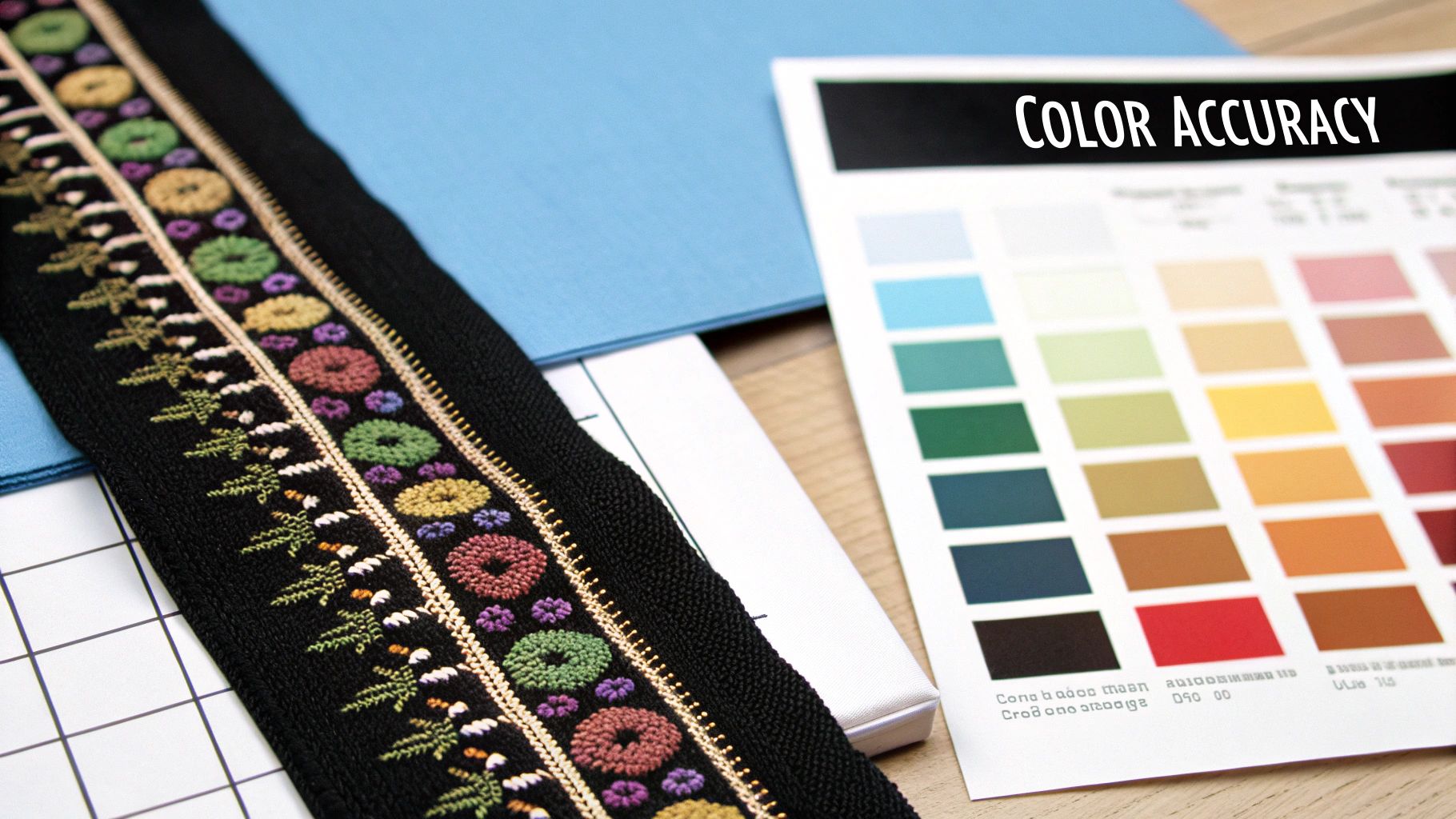
The biggest catch with any digital chart is color accuracy. How a color looks on your phone or computer screen is entirely dependent on your device's calibration, brightness, and even the lighting in your room.
A digital swatch is a fantastic guide, but it's never going to be a perfect replacement for seeing the thread in real life. There's a reason professional operations still rely on physical color cards. For example, a company like Gunold USA offers downloadable charts that reference Pantone standards, but they also provide physical cards because they know how critical it is to avoid errors from screen distortion, especially for large-scale embroidery.
My advice? Use a hybrid approach. Lean on digital tools for their speed, stash management, and handy features. But when it comes down to making that final color decision, always try to verify it with the actual thread if you can. It's the best way to guarantee your finished project looks exactly as you imagined.
Troubleshooting Common Thread Conversion Issues
Even with the most comprehensive thread color conversion chart on hand, you'll eventually run into a color that just doesn't have a perfect substitute. It happens to all of us. Don't think of this as a roadblock; instead, see it as a fantastic opportunity to use your own artistic judgment to make the project uniquely yours.
When your chart gives you a "close enough" option, the first thing to do is a simple visual check. Take the substitute skein and lay it next to your fabric and the other threads in your project. Always do this in good, natural light if you can—what looks right under a yellow lamp might look completely wrong in the daylight. You might find that a slightly different shade actually creates a more beautiful effect than the "official" replacement would have.
When No Single Thread Works
So what happens if you can't find a single floss that looks right? This is where you can get really creative by blending threads. By taking one strand from two similar colors and stitching with them together, you can create a completely new, custom shade that hits that sweet spot perfectly. This trick is a lifesaver for creating subtle gradients or when a color just needs to be a touch warmer or cooler.
It's also crucial to think beyond just the color. The physical characteristics of the thread can make a huge difference in how your finished piece looks and feels.
- Sheen and Texture: Is the new thread glossier or more matte than the one you're replacing? A shiny, silky thread like a DMC floss will really pop next to a duller, more cottony one. Some budget threads can also get a bit fuzzy after washing, while higher-quality brands tend to keep their smooth finish.
- Colorfastness: Before you commit a substitute thread to your masterpiece, it’s always a good idea to do a quick bleed test. Just snip a small piece of the thread, get it damp, and press it firmly onto a scrap of white fabric. This quick check ensures the dye won't run and ruin all your hard work when you wash it later.
At the end of the day, the most important thing is to trust your own eyes. A conversion chart is an amazing guide, but you are the artist. If a color feels right to you and works with the overall look of the project, then it is the right choice.
Learning to handle these little hiccups is part of the craft, and it’s what makes every cross-stitch project a personal creation.
Frequently Asked Questions About Thread Conversion
Even with the best charts, you're bound to run into some specific questions when you're in the middle of a project. It happens to all of us! This section tackles the most common queries I hear from fellow stitchers, giving you quick, clear answers to help you get back to stitching with confidence.
Are Converted Colors a Perfect Match?
This is probably the number one question people have, and the honest answer is no, not usually. A thread color conversion chart is designed to give you the closest available match, but it's rarely a perfect, one-to-one swap.
Think of it as a sibling, not an identical twin. Subtle differences in dye lots, the manufacturing process, and even the thread's material (like cotton vs. rayon) will always create slight variations in both color and sheen. If a specific shade is absolutely critical to your design, the best move is always to see the substitute thread in person before you commit.
What if My Thread Is Discontinued or Isn't on the Chart?
It's a moment every stitcher dreads: you're ready to start a new pattern, only to find it calls for a thread color that's been discontinued for years. Don't panic! This is exactly where a good conversion chart shines. Just look up the old color number, and the chart will point you to the closest modern equivalent from the same brand or a competitor.
But what happens if a brand isn't listed on your chart at all?
The only truly reliable way to handle an unlisted brand is to do a direct visual comparison. Thread color numbers are unique to each company, so trying to guess based on the number alone is just asking for a color mismatch. Your best bet is to take a sample of your thread to the store and physically match it against the other brand's skeins, preferably under good, natural light.
How Do I Choose Between Two Very Close Color Matches?
Sometimes a chart will suggest two options that seem nearly identical. When this happens, the key is to look at the bigger picture. Hold both potential threads next to the other colors you're using in your project. Which one creates the most pleasing and harmonious palette?
Also, pay attention to the thread's finish. A shinier thread might pop more, while a matte finish will blend in. Developing this eye for color is just as important as mastering the final steps, like knowing the right cross-stitch finishing techniques to give your work a polished look.
At Cross Stitched, we make creating beautiful, personalized art simple. Turn your favorite photos into stunning keepsakes with our all-in-one custom cross-stitch kits, complete with high-quality DMC threads and everything you need to start stitching. Preserve your memories today at https://cross-stitched.com.