So, you've mastered Aida and are ready for the next step in your cross-stitching journey. Let me introduce you to evenweave. Think of it as the fabric that bridges the gap between the blocky grid of Aida and the freeform elegance of linen, making it a fantastic choice for more detailed and intricate projects.
What Is Evenweave Fabric and Why Stitchers Love It
 embroidery hoop for crafting.">
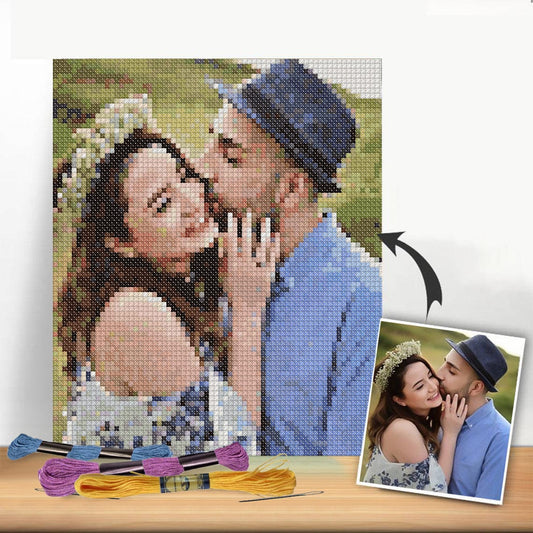
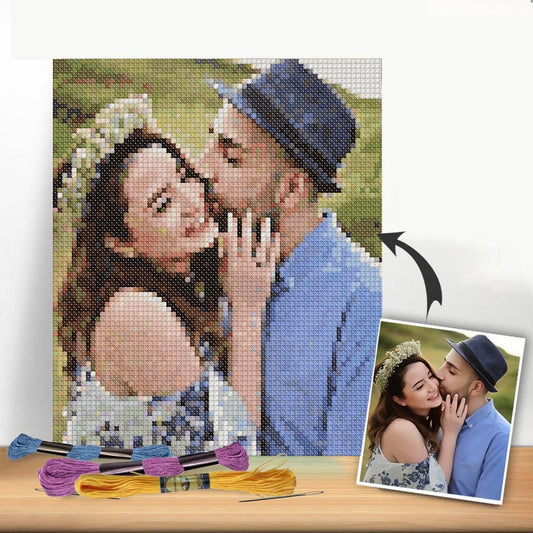
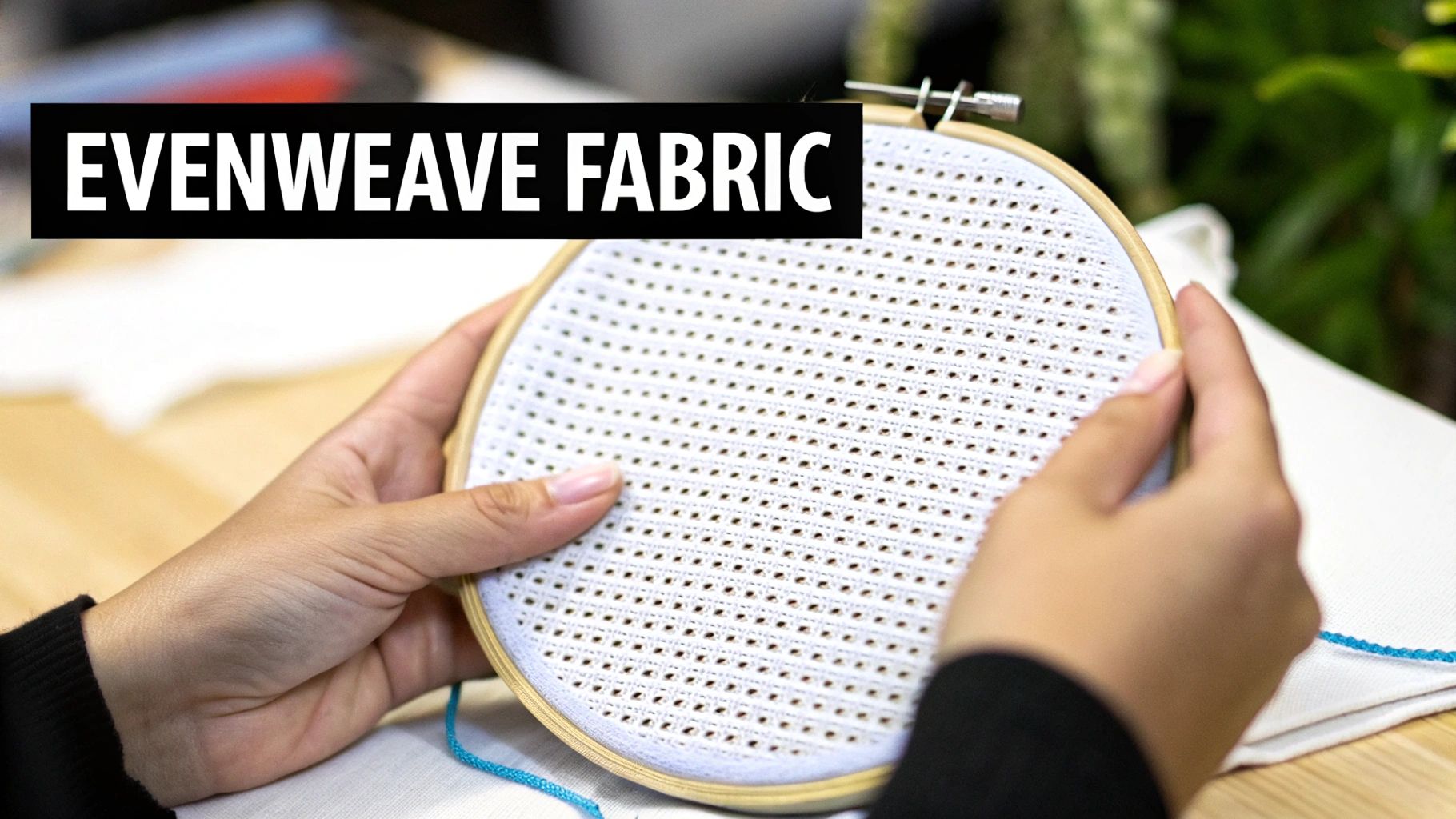
If Aida is like stitching on graph paper, then evenweave is like moving up to a smooth, high-quality artist's canvas. There are no pre-made holes or obvious blocks. Instead, you have a beautifully smooth fabric that lets your stitching take center stage. This is exactly why it's a go-to for custom photo patterns—the background simply melts away, leaving your detailed image to shine.
The name "evenweave" gives you the biggest clue to what it is: the fabric has an equal number of threads woven horizontally and vertically per inch. This precision weave is what makes it so special. It guarantees that every single one of your stitches will be perfectly square and uniform. You'll typically find evenweave in counts ranging from 18 to 32 threads per inch.
The Magic of Stitching Over Two Threads
Here’s the trick that makes evenweave so accessible: you stitch "over two threads." Instead of going from one hole to the next like on Aida, you simply count over two threads for each part of your "X."
This little change makes a huge difference:
- It gives your floss room to breathe, resulting in stitches that look much rounder and fuller.
- It makes the math easy! Stitching over two on a 28-count evenweave gives you the exact same finished size as stitching on 14-count Aida. It’s a seamless transition.
By stitching over two, you get the best of both worlds. You're still working on a grid, so your counting is precise, but the finished piece has the elegant, solid look of a woven tapestry. For photo-to-pattern projects, this is crucial because you don't want the fabric's grid distracting from the image itself.
Here’s a quick rundown of what makes evenweave a great choice.
Evenweave Fabric At a Glance
| Characteristic | Description |
|---|---|
| Weave | A single thread woven over and under a single thread, creating a smooth surface. |
| Stitching Style | Typically stitched "over two" threads, but can also be stitched "over one" for tiny detail. |
| Material | Usually a blend of cotton and rayon (like Lugana) or cotton and modal (like Jobelan). |
| Feel | Very soft and pliable with a beautiful drape, making it easier on the hands. |
| Best For | Detailed projects, photo patterns, designs with fractional stitches, and heirlooms. |
These characteristics make it a fantastic upgrade from Aida.
Popular choices like Lugana and Jobelan are fan-favorites because they feel incredibly soft and are resistant to wrinkling. They're perfect for everything from framed art to cushions and table runners.
If you’re ready to dive deeper and see how evenweave stacks up against other materials, exploring the different types of cross stitch fabric is the perfect next step. It's an easy way to elevate your work and achieve that polished, professional look you've been aiming for.
Evenweave vs. Aida vs. Linen: Choosing Your Canvas
Choosing the right fabric for your cross-stitch project is a lot like an artist choosing a canvas. It’s the foundation for your work, and your choice can dramatically change the final look and feel of your masterpiece. The three main players in the cross-stitch world are Aida, linen, and evenweave. Each one has its own personality, so let's break down how they stack up.
Think of Aida as the trusty training wheels of the stitching world. It's woven into a very distinct grid of little squares with big, obvious holes at each corner. This makes it a dream for beginners because you can see exactly where your needle needs to go. While it's fantastic for learning and simpler patterns, that blocky texture can sometimes make the fabric itself a bit too noticeable, especially in highly detailed pieces.
Then you have linen, the elegant, old-world choice. It has a gorgeous, organic look and a wonderfully soft drape that feels amazing in your hands. But here’s the catch: linen is made from natural flax fibers, which have slight variations in thickness (often called "slubs"). This means the grid for your stitches isn't perfectly uniform, making it a bit of a challenge to get every stitch looking identical. It’s beautiful, but it definitely takes some practice.
Evenweave: The Perfect Middle Ground
This is where evenweave fabric makes its grand entrance. It gives you that sophisticated, smooth finish of linen but without the quirky inconsistencies. The threads are specially milled to a uniform thickness, creating a perfectly symmetrical grid for your stitches. You get a beautiful, seamless backdrop without the prominent holes you see in Aida.
For projects like the custom photo-to-pattern kits from Cross Stitched, evenweave is hands-down the best choice. It creates a flawless, uninterrupted background that lets the tiny details and subtle color shifts in your photograph really shine. The fabric steps back and lets your artwork be the star.
To make things even clearer, let's look at a side-by-side comparison.
Fabric Comparison Chart: Aida vs. Evenweave vs. Linen
This chart breaks down the key differences to help you visualize which fabric is the best fit for your next project.
| Feature | Aida | Evenweave | Linen |
|---|---|---|---|
| Weave Structure | Blocks with visible holes | Smooth, single-thread weave | Natural, uneven single threads |
| Best For | Beginners, simple patterns | Detailed designs, photo patterns | Heirloom, traditional projects |
| Feel & Drape | Stiff, holds its shape | Soft, pliable, and flexible | Very soft, fluid drape |
| Stitching Ease | Easiest; holes are obvious | Intermediate; requires counting | Advanced; requires skill |
So, what's the verdict?
Aida is your go-to for learning the ropes or for projects where you want a clear, easy-to-see grid. Linen is the beautiful, rustic choice for when you’re ready for a challenge and want a truly traditional, heirloom finish.
But for most stitchers looking to take their projects to the next level, evenweave hits that sweet spot right in the middle. It delivers a professional, high-end look with the reliable consistency of a perfectly woven grid, making it a beautiful and dependable foundation for any project you plan to treasure.
How to Choose the Right Evenweave Count
Think of picking an evenweave fabric like choosing the resolution for a digital photo. The fabric’s “count”—how many threads are woven into each inch—determines the size of your stitches and the overall detail of your finished piece. A higher count packs more threads into that inch, which means your stitches will be smaller and more refined.
This is especially important when you’re turning a treasured photo into a cross-stitch pattern. For a portrait filled with subtle color changes and fine details, a high-count fabric is your best friend. But if you're working on a bold, graphic design, a lower-count fabric with its bigger, chunkier stitches can make a real impact.
Understanding Stitch Size and Project Scale
The real magic of evenweave happens when you stitch “over two” threads. This simple technique is what sets it apart and completely changes how you calculate your project’s final size. When you stitch over two threads on 28-count evenweave, your finished piece will be the exact same size as if you'd stitched on 14-count Aida. This 2-to-1 ratio is the secret that makes moving from Aida to the smoother finish of evenweave so easy.
Evenweave typically comes in counts like 25, 28, and 32, with these being the most popular choices you'll find anywhere. Because stitching over two threads effectively halves the count, a 28-count evenweave behaves just like a 14-count Aida—a handy fact that kit designers like us rely on to get our sizing perfect.
If you’re ever stuck, this decision tree can point you in the right direction, helping you decide if Aida, evenweave, or linen is the best fit for what you have in mind.
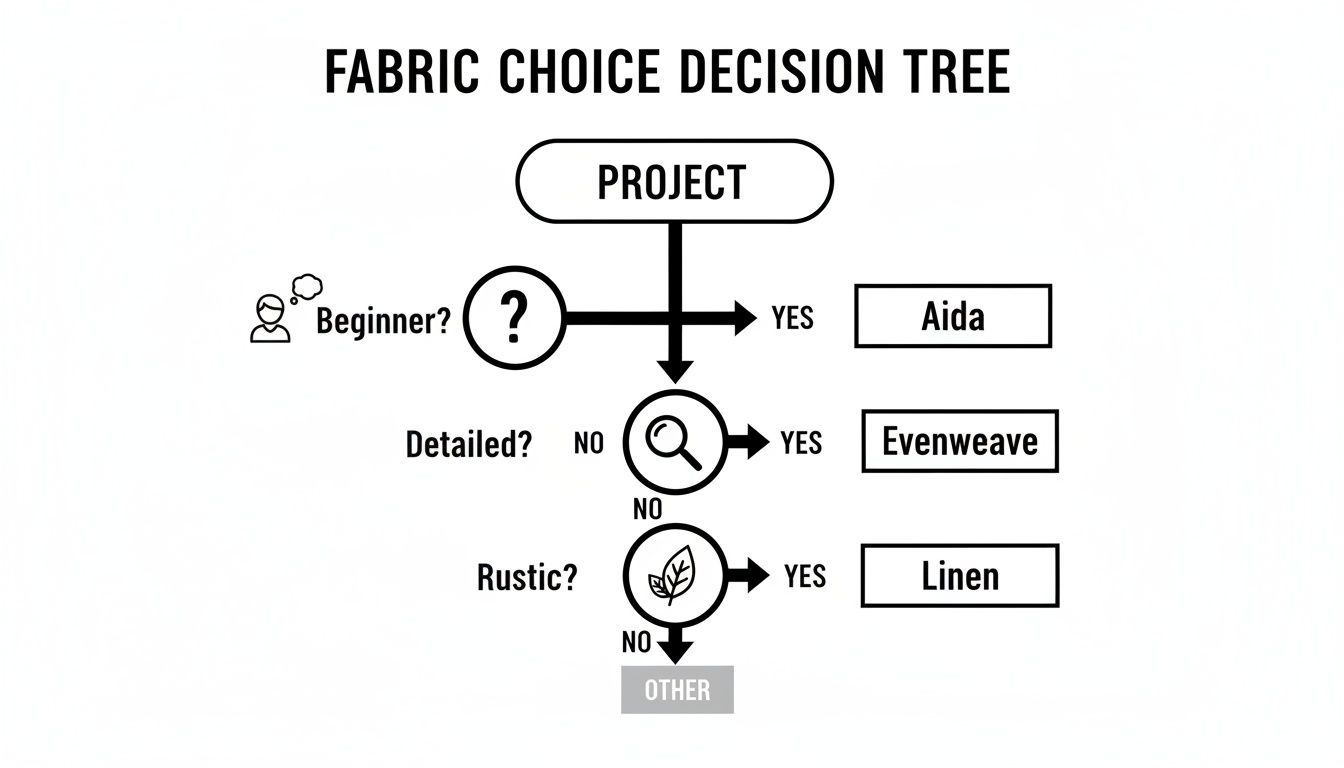
As you can see, evenweave really shines when you need that smooth, un-gridded background to let your detailed stitching take center stage.
Matching Count to Your Project Type
So, how do you know which count is right for your Cross Stitched custom kit? It all comes down to the look you're going for.
-
For Bold and Clear Designs: A lower count like 25-count evenweave is a fantastic choice. It creates stitches equivalent to 12.5-count Aida, so they're larger and easier to see. This makes it a great entry point if you're new to evenweave or for pieces that need to be seen from across the room.
-
For Highly Detailed Photo Patterns: This is where a higher count, like 32-count evenweave, truly excels. It stitches up like 16-count Aida, and those smaller stitches allow for incredible detail and silky-smooth color blending—absolutely essential for capturing the realism in a photograph.
The rule of thumb is pretty straightforward: the more detail packed into your pattern, the higher the fabric count should be. This ensures every last bit of your design comes through crisply, resulting in a beautiful, heirloom-quality piece you can be proud of.
Once you get the hang of fabric counts, you can confidently choose the perfect foundation for your project. To dig even deeper into this, have a look at our complete guide on cross stitch fabric counts.
Essential Tips for Stitching on Evenweave Fabric
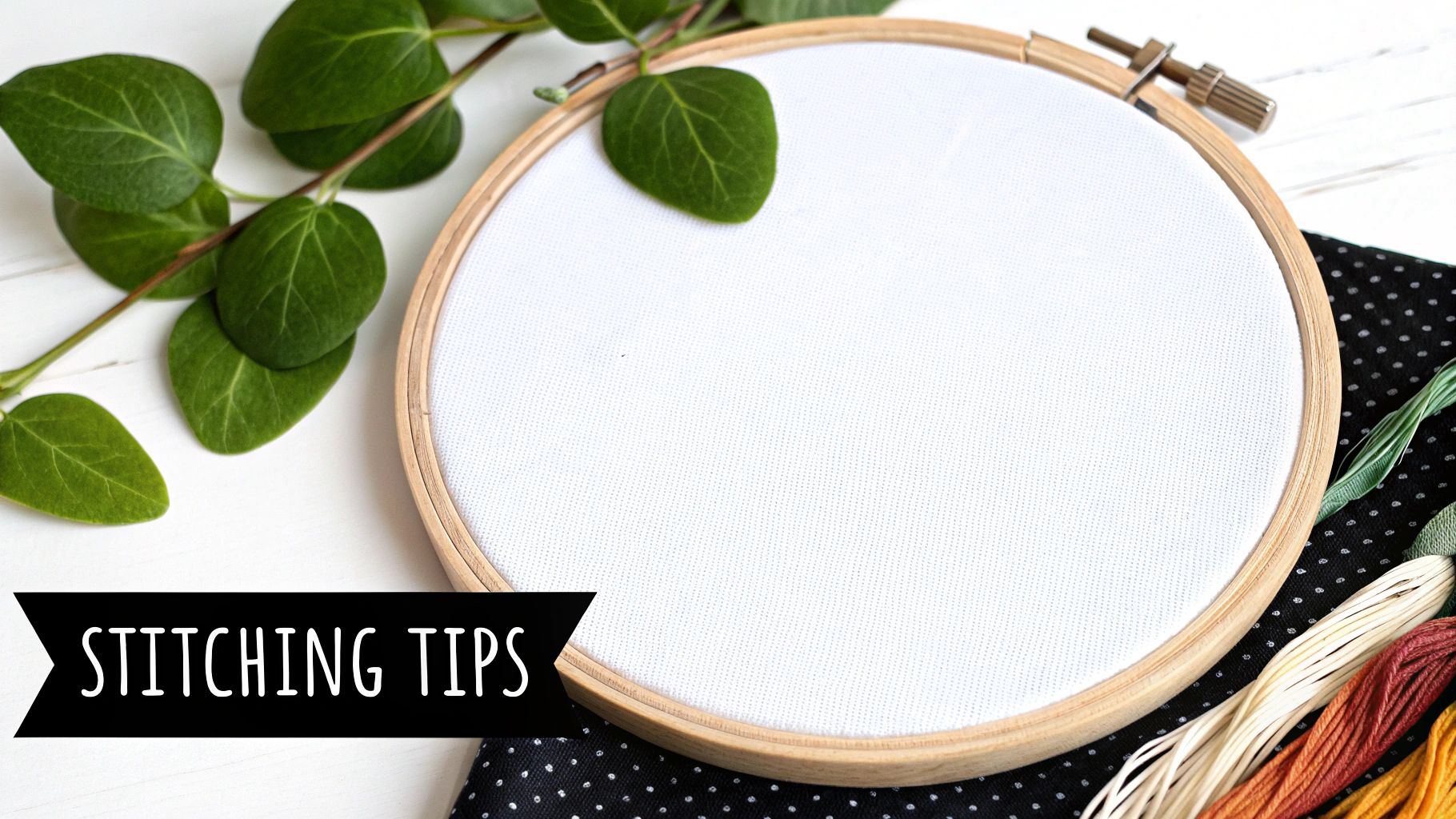
So, you're ready to dive into your first project with cross stitch fabric evenweave—that's fantastic! A little bit of prep work and a few good habits are all it takes to make the whole process a total joy, from that first stitch to the last. Let's walk through the simple steps that will help you create a piece you’ll be truly proud of.
Your stitching adventure actually starts before you even thread your needle. First up: prepping the fabric. Since most evenweaves are blends, they can shrink a tiny bit. It's always a good idea to pre-wash it in cool water and let it air dry. Once it’s dry, a quick press with an iron will give you a beautifully smooth canvas to work on.
To stop the edges from fraying while you work—which can be incredibly annoying—you'll want to secure them. You could use a serger or a simple zig-zag stitch on your sewing machine. If you don't have a machine, no worries! A bit of masking tape around the edges works just as well for a quick fix. This tiny step saves a world of frustration down the road.
Setting Up for Stitching Success
With your fabric prepped and ready, it's time to gather the right tools. The needle and thread you choose can make a huge difference, both in how much you enjoy the process and how your finished project looks.
-
Needle Selection: A tapestry needle is your best friend when working with evenweave. These needles have a nice blunt tip that slips easily between the fabric's threads instead of piercing them, which protects the integrity of the weave. For common 28-count to 32-count evenweave, a size 24 or 26 tapestry needle is usually the sweet spot.
-
Floss Count: How many strands of floss should you use? This determines how full and lush your stitches look. On 28-count or 32-count evenweave, stitching over two threads with two strands of floss gives you beautiful, solid coverage without making the stitches look bulky or crammed.
-
Hoops and Frames: I always recommend using an embroidery hoop or a frame. It keeps the fabric taut, which is the secret to maintaining even tension and preventing your fabric from puckering. A word of caution: don't stretch the fabric drum-tight, as this can distort the weave and your stitches along with it.
Mastering Your Stitching Technique
Stitching on evenweave is really about getting into a comfortable rhythm. Once you find your flow, you’ll realize just how lovely and forgiving this fabric is. The single most important thing to get a feel for is your thread tension.
The goal is to lay the thread smoothly on top of the fabric, not to pull it tight. Think of your stitches as just gently resting on the surface. If you pull too hard, the fabric will pucker. If they're too loose, they'll look a bit floppy and might snag.
Finding that "just right" Goldilocks tension is something that comes with a bit of practice. You're aiming for stitches that look uniform and have a slight bit of loft to them. Keeping a consistent, relaxed tension will make sure your finished piece lays perfectly flat and looks flawless. This is especially crucial for the detailed custom kits from Cross Stitched, where every single stitch comes together to create the final image. By focusing on these fundamentals, you’ll be stitching with confidence in no time.
Understanding Popular Types of Evenweave
Stepping into the world of evenweave is a bit like discovering a specialty coffee shop after years of drinking instant. You suddenly realize there’s a whole spectrum of quality and flavor out there. While "evenweave" is the general category, the specific brand names and material blends offer completely different textures and stitching experiences.
When you start looking at high-end designer patterns or premium kits, you'll often see them recommend fabrics from well-established European mills. These companies have spent generations perfecting their craft, creating the soft, consistent, and durable evenweaves that have become the gold standard among serious stitchers.
Spotlight on Industry Favorites
Two names that pop up constantly are Lugana and Jobelan. Think of them not as generic fabrics, but as specific, trusted blends that stitchers ask for by name because they know exactly what they’re getting.
-
Lugana: This is probably the most popular evenweave out there, beloved for its incredibly soft hand-feel and lovely drape. It's a blended fabric that feels luxurious to work with and, thankfully, is much less prone to stubborn wrinkles than pure cotton or linen.
-
Jobelan: Very similar to Lugana, Jobelan is another top-shelf blend that stitchers love for its softness and durability. It has a subtle, elegant sheen and is remarkably resistant to creasing, which makes it a fantastic choice for projects that will be handled a lot, like pillows or throw blankets.
Using fabrics like these provides that smooth, flawless background that lets detailed work—like the custom patterns from Cross Stitched—really shine.
Choosing a premium fabric like Lugana or Jobelan is what elevates a finished piece from a craft project to an heirloom. Their superior quality ensures the time and love you pour into your work is preserved for decades, giving it a professional finish that cheaper fabrics just can't replicate.
The Brands Behind the Fabric
Most of the high-quality evenweave you'll find comes from just a handful of legendary European manufacturers. Industry giants like Zweigart, Wichelt, and DMC are the main suppliers for stitchers across the globe, and their names are synonymous with quality and consistency.
For instance, Zweigart’s flagship evenweave is their Lugana line, which comes in over 50 different colors across various counts. It’s made from their signature 52% cotton and 48% viscose blend, giving it that sought-after softness without the price tag of pure linen. You can learn more about these foundational cross stitch fabrics to get a better sense of the full range of options.
By sticking with a well-known brand, you’re not just buying fabric; you're investing in quality. Their massive color palettes and reliable counts open up a world of creative possibilities, letting you think beyond a single kit and envision a whole collection of future projects on beautiful, dependable fabric.
Caring For and Finishing Your Evenweave Project
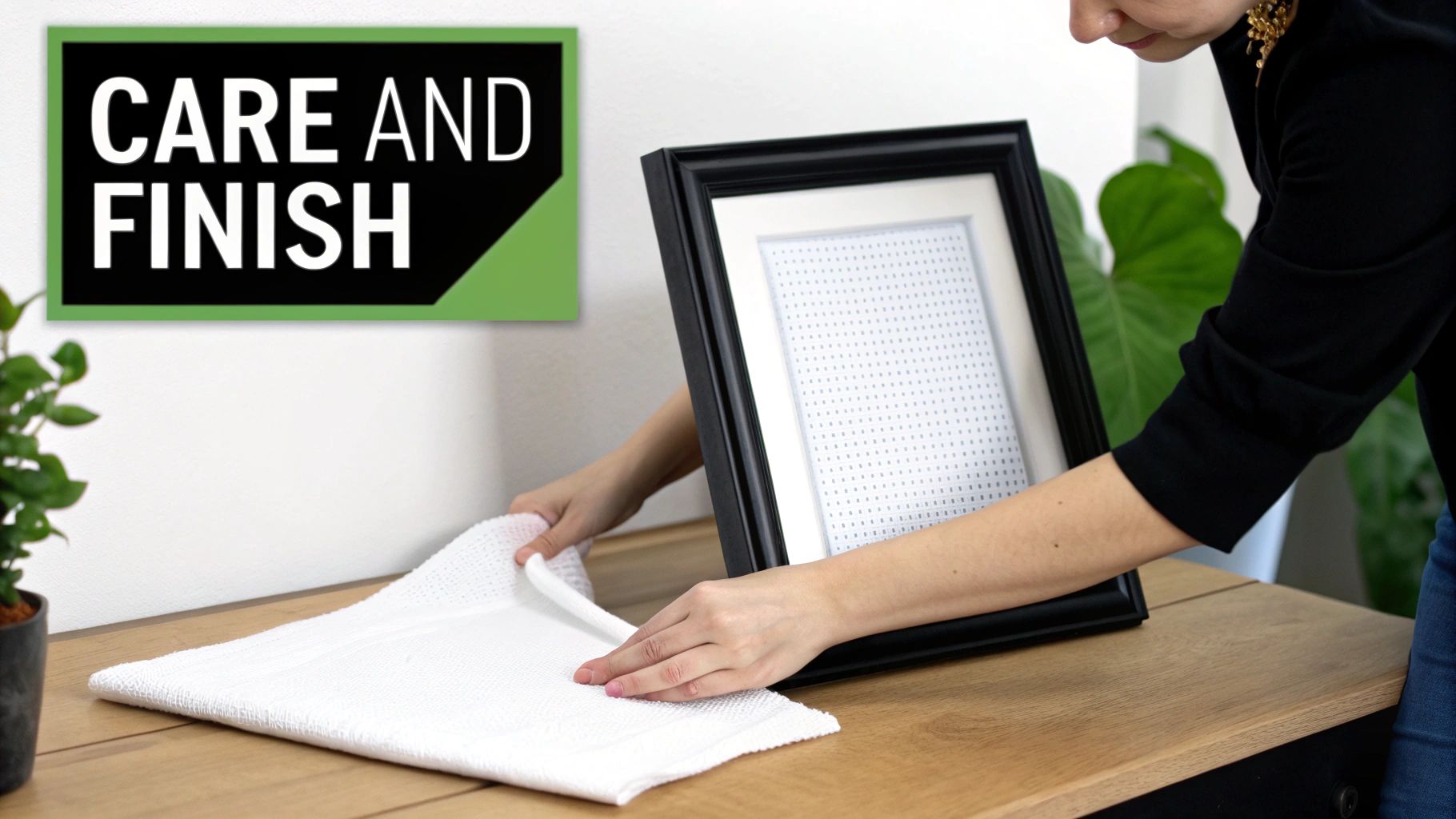
You’ve placed the final stitch, and it looks amazing. But the journey isn’t quite over yet! This last part—the finishing—is what turns your beautiful work into a true heirloom. A little care now will make sure your project looks polished and professional for decades to come.
First things first, let's give it a gentle bath. Even with the cleanest hands, oils and dust can build up over hours of stitching. A quick wash erases any stubborn hoop marks and makes the fabric look bright and fresh again.
The Gentle Cleaning Process
Find a clean sink or basin and fill it with lukewarm water. Add just a tiny drop of a mild, clear soap or a special textile wash. Gently place your cross stitch fabric evenweave piece into the water and let it soak for about 15 minutes.
Swish it around softly now and then, but don't scrub or wring it out. That kind of rough handling can easily distort your stitches.
Once it's soaked, drain the soapy water and rinse the fabric under cool, running water until it’s completely clear of suds. Next, lay the piece flat on a clean, thick towel. Roll the towel up like a jelly roll and give it a gentle squeeze to soak up the extra water. Whatever you do, don't wring it!
Pressing and Framing Your Masterpiece
While your piece is still damp, it's time for a quick press. Place it face down on a fresh, fluffy towel and press the back of the fabric with your iron on a medium setting. The towel protects your stitches from getting flattened, so they keep their lovely, plump texture.
Now that your project is clean and perfectly flat, you can get it ready for its grand debut. The soft, elegant drape of evenweave looks incredible in a classic frame, but don't feel limited to that. Smaller projects are perfect for turning into things like decorative pillows, unique book covers, or even custom patches for a tote bag.
A well-finished project is a testament to the care you’ve taken from start to finish. Taking these final steps ensures your personalized photo-to-pattern masterpiece becomes a cherished keepsake you can proudly display.
For a deeper dive, check out our complete guide on how to finish a cross stitch project. And if you're feeling inspired to get your space in order for the next masterpiece, you might find some great tips on how to organize craft supplies.
Common Questions About Evenweave Fabric
Even after you've stitched a project or two, you might still have a few questions about evenweave. Let's tackle some of the most common ones so you can stitch with complete confidence.
Do I Have to Stitch Over Two Threads on Evenweave?
Nope, you don't have to, but stitching "over two" is the standard for a good reason. It’s what makes a 28-count evenweave stitch up to the same size as a 14-count Aida, giving you that classic, beautifully full stitch coverage.
You can definitely stitch "over one," though! This technique creates incredibly tiny, detailed stitches—think of it as micro-stitching. It's fantastic for miniatures or designs where you need fine detail. Essentially, stitching over one on 28-count evenweave is like working on a tiny 28-count Aida. For most projects, and especially for photo-to-pattern conversions, sticking with the over-two method will give you the look you’re going for.
Is Evenweave Fabric a Good Choice for Beginners?
Absolutely! While most of us start our stitching journey with Aida, a lower-count evenweave like a 25-count is surprisingly beginner-friendly. The only new muscle you need to build is counting threads instead of just finding the next hole.
Once you get the hang of counting, you'll notice how much smoother and more professional your finished piece looks without the grid-like background. Many beginners find this incredibly rewarding. It’s the perfect fabric to try right after you've conquered your first Aida project.
Evenweave might look a little intimidating at first, but it’s really just a different kind of canvas. After the first few stitches, you'll find the rhythm of counting becomes second nature, unlocking a whole new level of polish in your work.
How Do I Find the Center of My Evenweave Fabric?
Finding the center of cross stitch fabric evenweave is just as easy as it is with Aida. The method is exactly the same.
- Fold your fabric in half lengthwise and pinch a light crease along the fold with your fingers.
- Now, fold it in half the other way (widthwise) and make another gentle crease.
- The spot where those two creases intersect is the dead center of your fabric.
I usually pop a pin in that spot or use a loop start with a contrasting thread to mark it. This way, you know your beautiful design will be perfectly centered right from the get-go.
Ready to turn a cherished photo into a timeless stitched memory? At Cross Stitched, our custom kits come with everything you need, including high-quality evenweave fabric, to create your own personal masterpiece. Start your custom cross stitch project today!