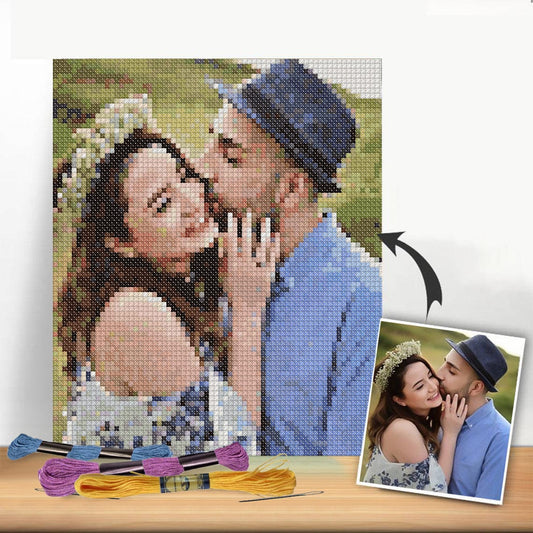
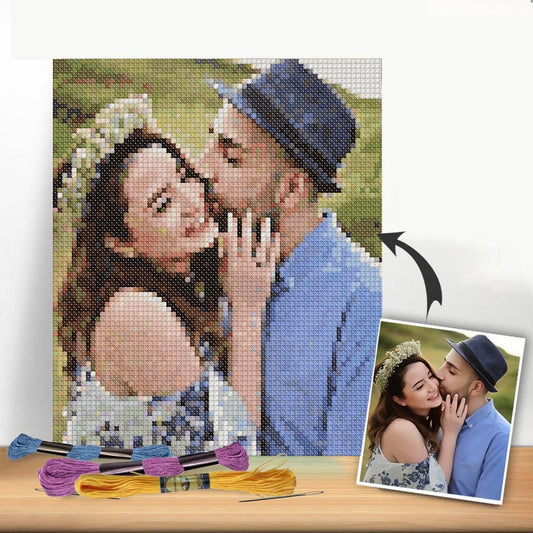
Dipping your toes into a new craft like cross stitch can feel a little overwhelming, but getting the right gear makes all the difference. Honestly, you only need a handful of things to get going: fabric, floss, a needle, scissors, and a hoop. That's it. With just these five essentials, you’re ready to start making something beautiful.
Building Your Essential Cross Stitch Toolkit
Getting started with any new hobby is all about gathering the right tools. Think of it like a chef getting their mise en place ready—when everything is laid out, the actual cooking (or in our case, stitching) is a pure joy. If you try to wing it without the basics, you're just setting yourself up for a frustrating time before you've even made a single stitch.
The great news? You don’t need a mountain of supplies. The core set of cross stitch accessories is surprisingly small and won't break the bank. Each tool has a specific job, and together, they turn that blank piece of fabric into a little work of art.
The Foundation: Your Fabric and Floss
Every cross stitch project boils down to two things: fabric and floss. For anyone just starting, Aida cloth is the hands-down winner. Its grid-like, even weave creates obvious holes, showing you exactly where to put your needle. It’s like stitching with a built-in guide, making it a breeze to form those neat little "X" stitches right from the get-go.
Embroidery floss is your paint. It comes in little bundles called "skeins" and is actually made up of six tiny strands twisted together. For most projects, you'll separate these and use just two strands at a time. This gives you great stitch coverage without making your work look bulky. For a deeper dive into picking your first supplies, check out our complete guide on what you need for cross stitch.
The Tools of the Trade: Needles, Hoops, and Scissors
Once you have your canvas and paint, you need your brushes and easel. In the world of cross stitch, that means needles, hoops, and scissors.
- Tapestry Needles: These aren't your typical sewing needles. Tapestry needles have a blunt tip and a much larger eye. That's on purpose! The blunt end glides smoothly through the holes in your Aida fabric without splitting the threads, while the big eye makes threading your floss much less of a headache.
- Embroidery Hoops: A hoop is your fabric's best friend. It keeps the material pulled tight and perfectly flat, which is the secret to getting nice, even stitches. Without one, your fabric can bunch up, making your stitches look loose and messy. A simple 6-inch wooden hoop is the perfect place to start.
- Embroidery Scissors: Sure, any pair of scissors can cut thread, but a small, sharp pair just for your craft project is a total game-changer. The fine, pointed tips let you snip threads right up against the fabric without any danger of accidentally cutting your beautiful stitches—a common (and heartbreaking) mistake with clumsy kitchen scissors.
This hobby is more popular than ever. The global cross-stitch market is expected to hit USD 0.22 billion by 2033, all thanks to a growing love for creative kits and tools. It just goes to show how accessible and beloved cross stitching has become. You can read more about this trend over at Business Research Insights.
A well-curated toolkit isn't about having the most expensive cross stitch accessories; it's about having the right ones. Each essential tool is designed to solve a specific problem, making your stitching experience more precise, comfortable, and ultimately, more rewarding.
With just these five things—Aida fabric, floss, a tapestry needle, a hoop, and a good pair of scissors—you’re all set. This simple kit takes the guesswork out of starting and lets you focus on the calm, meditative rhythm of stitching. Down the road, you can always add more specialized gear, but this core group will see you through tons of projects.
Essential vs. Nice-to-Have Accessories
When you're starting out, it's easy to get overwhelmed by all the gadgets you could buy. This little table breaks down what you absolutely need versus what can wait until you're a bit more hooked.
| Accessory Category | Essential for Beginners | Nice-to-Have Upgrade |
|---|---|---|
| Fabric Tension | Basic wooden or plastic hoop | Q-Snap or scroll frame |
| Needles | A pack of tapestry needles (size 24) | Multiple sizes for different fabrics |
| Thread Storage | Keeping floss in its original skeins | Bobbins, floss boxes, or drop organizers |
| Lighting | A well-lit room or desk lamp | Dedicated craft light or neck lamp |
| Magnification | Good eyesight or reading glasses | Clip-on or floor-standing magnifier |
| Cutting Tools | Small pair of embroidery scissors | A high-quality thread snip or stork scissors |
Think of the "essentials" as your starter pack. They get the job done perfectly well. The "nice-to-have" items are quality-of-life upgrades that make the process even smoother once you know this is a hobby you'll stick with.
Choosing Your Hoops, Frames, and Stands
The secret to stitches that look truly professional? It all comes down to how you hold your fabric. Getting the tension just right is the absolute key to making uniform, neat stitches that lay flat and look gorgeous. Of all the cross stitch accessories out there, the tool you use to hold your fabric is one of the most critical for a polished final piece.
Think of it like a painter's easel. An easel holds the canvas perfectly still and taut, and that’s exactly what a hoop, frame, or stand does for your cross-stitch fabric. This stability frees up both of your hands, gives you pinpoint control over your needle, and helps you keep the tension consistent from the first stitch to the last.
The Classic Embroidery Hoop
Most of us start our stitching journey with a classic embroidery hoop. They're usually made of wood or plastic and have two rings that nest together. You just lay your fabric over the inner ring, pop the outer ring on top, and tighten a little screw to pull the fabric taut.
A simple wooden hoop is the cross-stitcher's sketchbook. It's perfect for smaller projects, you can toss it in a bag and take it anywhere, and it's incredibly straightforward for a beginner to get the hang of. They come in all sorts of sizes, from little 3-inch hoops for making ornaments to bigger 12-inch ones for more involved designs. It's a fantastic, low-cost way to get started.
Moving Beyond the Hoop with Q-Snaps
After you’ve got a project or two under your belt, you might start wondering what the next step up is. That's where Q-Snaps come in. A Q-Snap is a square or rectangular frame made of lightweight plastic tubes, with clamps that literally "snap" over the fabric to hold it in place.
These frames are like moving from a sketchbook to a sturdy drafting table. They give you amazing, even tension across your entire working area, and they don't leave behind those stubborn "hoop rings" that can be a real pain to iron out later. Since the clamps grip the fabric along the whole side instead of just at one point, you won't have to stop and re-tighten your fabric nearly as often. This makes them a dream for medium-sized projects.
If there's one thing that drives stitchers crazy, it's fabric that goes slack in the middle of a session. Hoops and Q-Snaps both fix this, but Q-Snaps offer more of a "set it and forget it" solution, keeping your fabric drum-tight for much longer.
So, hoop or Q-snap? It really boils down to personal preference and what you're working on.
- Embroidery Hoops: Best for beginners, small-to-medium projects, and anyone who loves the traditional feel.
- Q-Snaps: Ideal for stitchers who can't stand hoop marks and want super-tight, consistent tension for medium-to-large pieces.
The Ultimate Setup: Scroll Frames and Stands
For the truly dedicated stitcher—the one tackling a massive, complex masterpiece—a scroll frame and stand is the full-blown studio setup. A scroll frame has two rollers (one at the top, one at the bottom) connected by sidebars. You attach your fabric to the rollers and simply scroll through the project as you stitch, which keeps the parts you aren't working on rolled up, clean, and out of the way.
This system is a lifesaver for those huge, full-coverage pieces that can take months, or even years, to finish. The fabric never gets creased or folded, and the tension stays perfectly even across the whole length. Pair it with a lap or floor stand, and you've got a completely hands-free stitching setup. This not only does wonders for your posture (goodbye, neck cramp!), but it also lets you stitch with both hands, which is a faster and more ergonomic way to work.
2. The Stitcher's Trio: Needles, Thread, and Scissors
When you get right down to it, three little tools do all the real work in cross-stitch: the needle, the thread, and the scissors. While hoops and frames keep your project still, these are the accessories you’ll have in your hand for every single stitch. Getting a feel for how they work together is what separates a good stitcher from a great one.
Think of it like a chef's core kit. You need the right knife for the job, the best ingredients, and a clean way to prep them. For us, that means having the right needle for our fabric, the perfect thread for the design, and sharp scissors for a tidy finish.
Needles: It's All About the Tip (and the Eye)
First up, let's talk about the needle. In cross-stitch, we use a special kind called a tapestry needle. Unlike a sharp sewing needle, these have a blunt, rounded tip and a big, long eye. This isn't an accident—that dull tip is designed to slip neatly through the holes in your Aida fabric without shredding the threads.
The sizing numbers—like size 24 or 26—can be a bit backward at first. Just remember this: the higher the number, the smaller the needle. It's crucial to match your needle size to your fabric count. A needle that's too big will stretch out the holes and make your work look messy. One that's too small will be a pain to thread and can get lost in the fabric's weave.
Want to dive deeper? We've got a whole guide on cross stitch needle sizes that breaks it all down.
A good rule of thumb: The needle should glide through the fabric with a gentle pop, not a forceful tug. If you're really having to pull, your needle is too big for your fabric.
To make picking the right needle even easier, here’s a quick-reference chart. It’s a great starting point for matching your needle to the most common Aida fabric counts.
Needle Size and Aida Count Compatibility
| Aida Fabric Count | Recommended Tapestry Needle Size | Common Use Case |
|---|---|---|
| 11 Count | Size 22 | Beginner projects, kids' crafts, designs with thicker yarn |
| 14 Count | Size 24 | The most common combination for kits and patterns |
| 16 Count | Size 26 | Detailed designs, offering more coverage than 14 count |
| 18 Count | Size 26 or 28 | Fine, detailed work with a smooth, professional finish |
| 28+ Count | Size 28 | Advanced stitching, petit point, and intricate patterns |
Matching your needle and fabric correctly ensures your stitches lay flat and your fabric holes don't get distorted, giving you a much cleaner result.
Thread: The Colors of Your Creation
Next up is the thread, also called floss. This is what brings the color and personality to your piece. The absolute workhorse of the cross-stitch world is standard six-strand cotton embroidery floss. It's tough, comes in a dizzying array of colors, and is easy to use once you learn how to separate the strands.
But standard cotton is just where the fun begins. If you really want to add some flair, you can play with specialty threads. Think of them as the secret spice in your favorite recipe—they add that little something extra that makes people say "wow!"
- Metallic Threads: These are perfect for adding shimmer and sparkle. Think holiday ornaments, magical creatures, or just a little bit of glitz.
- Silk Threads: For a project that just feels and looks luxurious, you can't beat silk. It has an incredible sheen and glides through the fabric like a dream.
- Variegated Floss: This thread is a game-changer. It changes color along a single strand, creating beautiful, subtle gradients. It’s amazing for things like skies, water, or fields, giving you depth without constantly changing your thread.
To get started, you'll need a good supply. You can explore a variety of threads online to find the perfect shades and textures for whatever you're dreaming up.
Scissors: The Final, Clean Cut
Last but not least, let's talk scissors. It’s so tempting to just grab the pair from your junk drawer, but please don't! Using dull, clunky scissors on your project is like trying to give a haircut with garden shears—it's a recipe for disaster.
A small, sharp pair of embroidery scissors is one of the best investments you can make. Their tiny, pointed tips are designed for one thing: precision. They let you snip your thread tails right up against the back of your fabric without any risk of cutting your stitches or the fabric itself. A clean snip means no fuzzy ends, which helps keep the back of your work as neat as the front—a true mark of a skilled stitcher.
Organizing Your Stash with Smart Storage
Let's be honest, an organized stitching corner is a happy stitching corner. As you dive deeper into cross-stitch, your collection of colorful floss, fabrics, and other cross stitch accessories will explode. What starts as an inspiring palette can quickly become a tangled, chaotic mess. Getting that creative chaos under control means you can spend more time actually stitching and less time on a frantic search for that one perfect shade of blue.
Think of your floss collection like a personal library of color. Each skein is a book, and if they're all piled on the floor, you'll never find the one you need. A good storage system does more than just keep things looking neat—it also protects your precious materials from dust and sunlight, keeping those colors bright for years.
Taming the Thread Rainbow
The biggest challenge for most stitchers? Managing the sheer volume of floss. We're talking dozens, sometimes hundreds, of skeins. Just tossing them in a bag is a one-way ticket to a knotted, unusable nightmare. Thankfully, stitchers have come up with some clever ways to keep everything in its place.
One of the most popular and time-tested solutions is the classic plastic floss box paired with cardboard or plastic bobbins. You just wind each skein of floss onto a bobbin, slap a label with the color number on it, and file it away. This method is amazing because you can see your entire color inventory in one quick glance.
Another fantastic option is using floss drops. These are small tags with a hole where you loop your floss, and they're usually kept together on a metal ring. This system is a lifesaver when you're gathering threads for a new project—it’s like a custom key ring that holds only the colors you need right now.
Looking for creative ways to store everything? Sometimes the best inspiration comes from outside the craft world. Exploring different closet organization ideas can spark some brilliant ways to arrange your personal stitchy stash.
Beyond Floss: Project Bags and Binders
Great organization doesn't stop with your thread. You also need a plan for your works-in-progress (or WIPs, as we call them). Project bags are a stitcher’s best friend, giving your current piece a safe home along with its pattern and all the necessary floss. They're perfect for protecting your fabric from spills, pet hair, and snags, especially if you like to stitch on the go.
If you’re a pattern collector (and who isn't?), a simple binder system can change your life. Slip your printed charts into clear sheet protectors and file them away. It makes browsing your collection a joy. Some stitchers even create a "project card" for each pattern, noting the recommended fabric and all the floss colors, which makes starting that next project a total breeze.
A well-organized stash does more than just look pretty—it reduces the friction in your creative process. When you can grab exactly what you need in seconds, you're far more likely to sit down and stitch, turning that spark of inspiration into beautiful, finished work.
Just as you organize your supplies, don't forget to match the right tools to the right materials. This handy little guide shows you how to pick the perfect needle size for the most common Aida fabric counts.

As you can see, the higher the fabric count, the smaller the needle you'll need. Using the right size prevents you from stretching out the holes in the fabric weave, which is a key part of getting those neat, professional-looking stitches we all strive for. The right storage, just like the right needle, makes the whole process smoother and so much more fun.
Level Up with Advanced Stitching Accessories
https://www.youtube.com/embed/QBQ_a0WrE3Y
Once you've got the hang of the basics, a whole new world of specialty cross stitch accessories is waiting for you. These aren't just clever gadgets; they're smart solutions to the little frustrations every stitcher faces. They’re designed to make your work more precise, more comfortable, and frankly, more beautiful.
Think of it like graduating from a simple toolkit to a fully-stocked workshop. Each one of these advanced tools has a specific job that makes the entire creative process feel smoother and way more fun.
These accessories are the secret weapons experienced stitchers use to tackle bigger, more ambitious projects. Whether you're working on high-count fabric for the first time or trying to keep a massive white Aida project clean for months, these tools let you focus on your art, not the annoyances.
Seeing Your Stitches in a New Light
The more you stitch, the more you'll be drawn to patterns with incredible detail. That often means working on higher-count fabrics, like 18-count Aida or even fine linens. Suddenly, your stitches are tiny, and telling one thread from another becomes a real challenge—especially on dark fabric. That's when you'll thank yourself for investing in good lighting and magnification.
A powerful craft light is a game-changer. It’s like having a portable window of pure daylight right at your stitching station, no matter the time of day. Many are designed to mimic natural sunlight, so you can see the true colors of your floss without any weird yellow or blue tints. This is absolutely critical for patterns with subtle shading.
In the same way, a good magnifier is like a jeweler's loupe for your fabric. They come in all shapes and sizes, from lamps with a built-in magnifying lens to hands-free versions you can wear around your neck. Using one dramatically reduces eye strain, letting you stitch longer and with far greater accuracy.
When you put a craft light and a magnifier together, it completely transforms your stitching experience on detailed projects. You stop guessing, you make fewer mistakes, and working on those tiny stitches becomes a pleasure instead of a pain.
Keeping Your Workspace Clean and Tidy
A project that takes months to complete can become a magnet for dust, oils from your hands, and pet hair. To protect your masterpiece-in-progress, stitchers have come up with some brilliant, simple tools to keep your fabric in pristine condition.
- Grime Guards: These are just stretchy fabric covers that fit snugly around your hoop or Q-snap frame. They tuck away all that extra fabric and keep it clean, preventing it from getting grubby as you handle it over weeks or months.
- Needle Minders: Easily one of the most beloved cross stitch accessories out there. A needle minder is a small, decorative charm with two magnets. One sits on top of your fabric and the other goes underneath, creating a secure little spot to "park" your needle when you take a break. No more lost needles in the couch cushions!
- Ort Catchers: What do you do with all those tiny clipped thread ends, or "orts"? An ort catcher is a small cup or bag that sits beside you, giving you a dedicated place to toss the scraps. It’s a simple thing, but it keeps your workspace tidy and stops little bits of floss from getting everywhere.
Enhancing Comfort and Efficiency
Beyond keeping things clean and visible, other tools are all about making the act of stitching more comfortable and efficient. Take a lap stand or floor stand, for instance. It holds your hoop or frame for you, freeing up both of your hands. This allows you to stitch using two hands—one above and one below the fabric—which many stitchers find much faster and more rhythmic.
These stands are also a lifesaver for your posture. Instead of hunching over your work for hours, you can lean back comfortably in your chair, which makes a huge difference for your neck and back. For anyone who loves to settle in for a long stitching session, a stand is truly a must-have.
Ultimately, these advanced accessories are all about removing the little roadblocks so you can lose yourself in the craft you love.
Finishing and Displaying Your Masterpiece
Placing that final stitch is an incredible feeling, isn't it? But your creative journey isn't quite over. The next step—finishing your work—is what turns that stitched fabric into a true piece of art. Think of it like a painter framing their canvas; it’s the final touch that elevates the work and protects it for years to come.
Properly finishing your cross stitch ensures it looks its absolute best. This means cleaning, pressing, and mounting your work so it’s perfectly flat, clean, and ready to shine. Skipping these steps can leave your beautiful piece looking a little... well, a little less than it deserves.
Preparing Your Project for Display
Before you show off your masterpiece, it needs a little spa day. Over the weeks (or months!) you’ve been stitching, oils from your hands, dust, and even hoop marks can build up. A gentle wash is the perfect way to refresh the fabric and make those floss colors pop.
- Hand Wash Gently: Fill a clean basin with lukewarm water and a tiny drop of a mild, clear soap. Swish your project around gently and then let it soak for about 15 minutes.
- Rinse Thoroughly: Drain the soapy water and rinse your piece under cool, running water until every last sud is gone. Whatever you do, don't wring or twist the fabric—that's a surefire way to distort your stitches.
- Press with Care: Place the damp project face down on a clean, fluffy towel. Lay another towel on top and gently press down to soak up the excess water. Then, with your iron on a low setting, press the back of the piece until it's completely dry and smooth.
This simple cleaning process makes a world of difference and sets your project up for a flawless finish.
Think of the finishing process as the final act of creation. It's the thoughtful presentation that honors the hours of work you've poured into every single stitch and ensures your art remains a treasured keepsake.
For a more detailed walkthrough, you can explore our guide on how to finish a cross stitch project, which covers everything from washing to lacing your piece for framing. These techniques are essential for turning your hard work into something truly spectacular.
Choosing Your Display Method
Once your piece is clean and pressed, the real fun begins: deciding how to show it off! Framing is a classic choice, but there are so many other creative ways to showcase your work. The right cross stitch accessories for finishing can turn your project into something both functional and beautiful.
You could mount your piece on an acid-free mounting board, which is absolutely vital if you want to preserve it long-term. Acidic materials can cause discoloration and yellowing over time, and this is the standard for professional framing for a reason.
But don't feel boxed in by a traditional frame! You can also turn your finished stitch into unique items that add a personal touch to your home or make for incredibly heartfelt gifts.
- Pillows: A small stitched design can become a beautiful accent pillow for a couch or bed.
- Ornaments: Tiny projects are perfect for creating custom holiday ornaments that your family will cherish for years.
- Bags and Pouches: If you stitch on sturdy fabric, you can create one-of-a-kind tote bags or small zipper pouches.
- Bookmarks: A narrow, long design makes for a beautiful and practical bookmark for any avid reader in your life.
No matter which method you choose, taking the time to finish your project properly is what truly makes it a masterpiece.
Got Questions About Cross-Stitch Gear? We've Got Answers.
As you get more into cross-stitching, you'll naturally start wondering which tools are really worth it. Let's tackle some of the most common questions stitchers ask. My goal here is to cut through the noise and give you clear, practical advice so you can get back to what you love—stitching.
Think of this as a quick chat with a seasoned stitcher, helping you pick the right gear for a smoother, more enjoyable time with your needle and thread.
What Do I Absolutely Need to Start?
If you're a complete beginner, what are the bare-bones essentials?
Getting started is surprisingly simple and doesn't require a huge shopping trip. You really only need five things:
- Fabric: A piece of 14-count Aida cloth is the perfect canvas for your first project.
- Thread: A few colors of standard cotton embroidery floss.
- Needle: A size 24 tapestry needle is the ideal match for 14-count Aida.
- Scissors: Any small, sharp pair will do for snipping threads.
- Hoop: A 6-inch wooden embroidery hoop is a great size—easy to hold and manage.
That's it! With these five items, you're ready to make your first stitch.
Are Needle Minders Actually Useful?
Seriously, do I really need a needle minder?
Okay, so you don't technically need one to complete a project. But I can't tell you how many stitchers (myself included!) consider them a game-changer. It's a tiny magnetic pin that sits on your fabric and gives your needle a secure parking spot when you step away.
No more lost needles in the sofa cushions or the carpet! It also stops you from poking the needle through your fabric to hold it, which can leave a permanent hole. For a small price, it solves one of the most common and frustrating little problems in stitching.
A needle minder is the perfect example of a non-essential accessory that dramatically improves the stitching process. It solves a small but constant annoyance, letting you focus entirely on the rhythm of your craft.
How Should I Take Care of My Tools?
What’s the best way to look after my hoops and scissors so they last?
A little bit of care goes a long way in making your tools last a lifetime. For wooden hoops, the biggest thing is to avoid over-tightening the screw. Cranking it too hard can strip the threads or even crack the wood. Also, always store them somewhere dry to keep them from warping out of shape.
When it comes to your embroidery scissors, there's one golden rule: only use them for cutting thread. Cutting paper, fabric, or anything else will dull those fine blades in a heartbeat. Popping them in a small case or using a point protector will keep the tips sharp and prevent any accidental pokes.
Ready to turn your favorite photos into a work of art? Explore the custom kits and beautiful patterns at Cross Stitched and find everything you need to start your next creative project. Begin your stitching journey today!