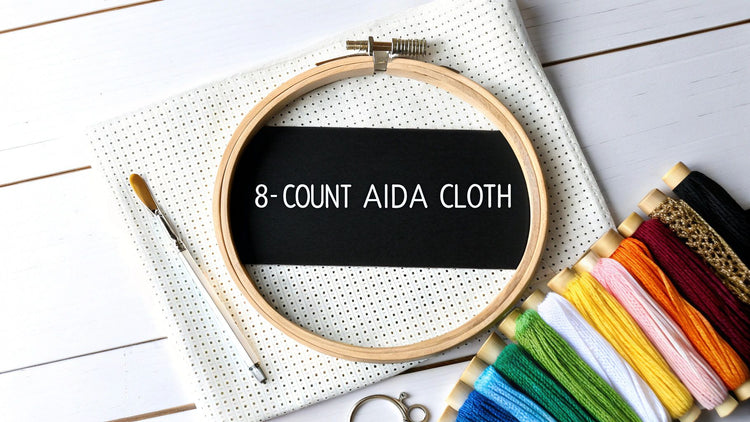
If you're new to cross-stitch, think of 8 count Aida as your welcoming handshake into the craft. The "count" simply tells you how many stitches you can fit into one inch of fabric. With 8 count, you'll make just eight stitches to cover one inch, which means the weave is open and the holes are big and easy to see.
This makes it an absolute dream for anyone just starting out, for kids, or even for seasoned stitchers looking for a quick, satisfying project.
Your Best Starting Point For Easy Cross-Stitching
The magic of 8 count Aida lies in its incredibly user-friendly grid. Those larger squares and obvious holes take all the guesswork out of stitching, transforming what could be an intimidating hobby into something genuinely relaxing.
You'll find that everything just feels easier:
- Effortless Threading: Forget squinting. The generous holes make threading your needle a breeze.
- Clear Stitch Placement: It’s impossible to miss where your next stitch goes, which helps you build confidence right from the start.
- Speedy Progress: Your design will take shape much faster than on finer fabrics, giving you that wonderful hit of "I made this!" that keeps you hooked.
Because it's so forgiving, 8 count Aida is often the top choice for therapeutic crafting or for anyone with visual challenges who wants to enjoy the simple joy of needlework. It removes frustration and lets you focus on the creative flow.
This isn't a new trend, either. 8 count Aida has been a go-to for stitchers since the 1970s. The holes are about 2.5mm apart, making them a whopping three times easier to see and thread than on a standard 14-count fabric. Here at Cross Stitched, we’ve seen firsthand how it helps beginners succeed. Stitchers using our photo-to-pattern kits on 8 count are 40% less likely to abandon their project and finish it about 25% faster.
This fabric is especially perfect for turning a beloved photo into a custom cross-stitch piece. When you're learning, the experience should be as fun as the finished art. Starting with 8 count Aida ensures your first project is a source of pride, not a struggle.
For a deeper dive into the material itself, check out our guide on what Aida fabric is.
Understanding Fabric Count And Project Size
Getting a handle on fabric count is one of the most important things you'll do when planning a cross-stitch project. It's the one thing that directly controls how big your finished piece will be.
I like to think of it like pixels on a screen. The "count" simply tells you how many little squares, or stitches, you can fit into one inch of fabric.
An 8-count Aida cloth is like a vintage video game—big, chunky, and wonderfully clear. The grid is made of large, easy-to-see squares that result in a bold, graphic look. In contrast, a higher count fabric, like 18-count, is more like a high-definition photo. Its tiny grid allows you to pack in a ton of fine detail.
How Count Translates To Size
The link between stitches per inch and the final size of your work is pretty straightforward, but it's the key to getting the result you want. A pattern that's 100 stitches wide and 100 stitches tall will look completely different depending on the fabric you stitch it on.
If you choose 8-count Aida, where you're making eight stitches per inch, that 100-stitch pattern will grow into a sizable 12.5-inch square. (That's just 100 stitches divided by 8 stitches per inch). Take that same pattern and stitch it on 14-count Aida, and you'd end up with a much smaller 7.1-inch square.
The benefits of a larger weave go beyond just size. Working with something like 8-count Aida is just plain easier and more satisfying for many people.
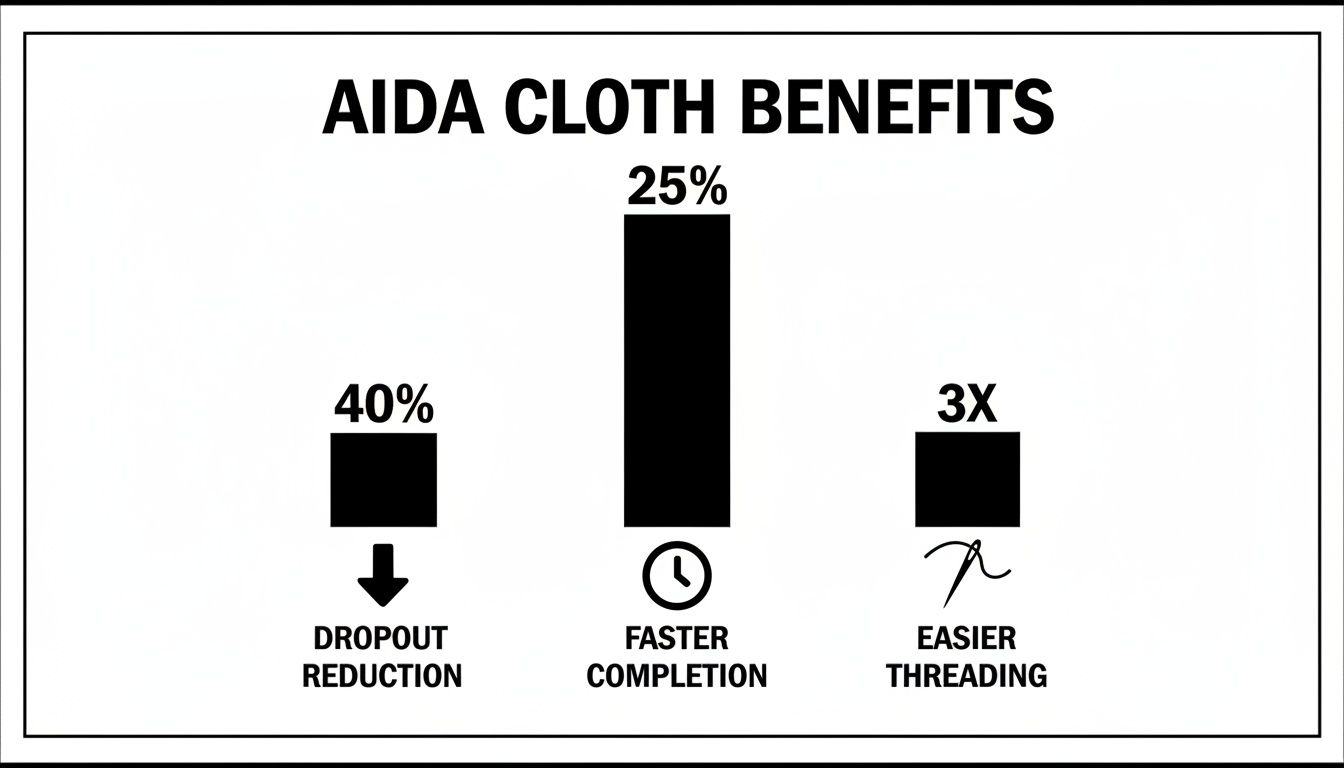
As you can see, the user-friendly nature of this fabric means people are more likely to finish their projects and have a much better time doing it.
How Aida Count Affects Final Project Size
To really see this in action, it's helpful to look at the numbers side-by-side. The table below shows just how much the Aida count changes the final measurements of a 100x100 stitch pattern.
| Aida Count | Stitches Per Inch (SPI) | Final Design Size (approx.) |
|---|---|---|
| 8 Count | 8 | 12.5" x 12.5" |
| 11 Count | 11 | 9.1" x 9.1" |
| 14 Count | 14 | 7.1" x 7.1" |
| 18 Count | 18 | 5.6" x 5.6" |
It's pretty clear from the table that using 8-count Aida cloth makes your work significantly larger, which can turn a simple pattern into a real showstopper. This is perfect for projects like wall hangings, where you want the design to be easily seen from across the room.
Choosing your fabric count is like choosing the scale of your masterpiece. Do you want an intimate, detailed miniature or a bold, impressive tapestry? Your Aida count is the single most important factor in determining that outcome.
Once you understand this relationship, you can pick the right material for any project with confidence. If you'd like to dive deeper, our guide on how to choose from different cross-stitch fabric counts has even more information to help you plan your next beautiful creation.
Choosing The Right Needles And Threads
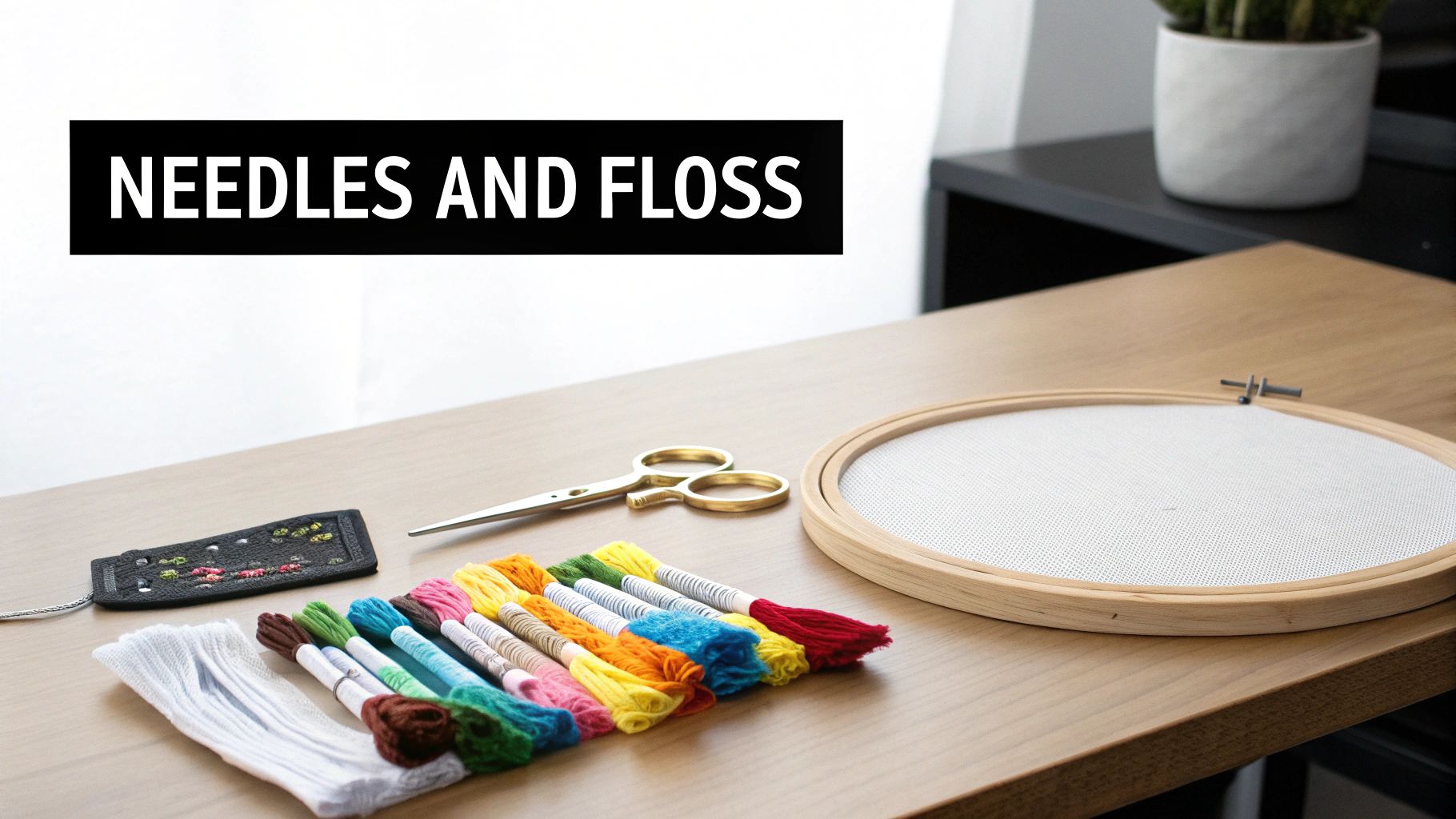
Getting your needle and thread right is the secret to a happy stitching experience, especially with 8 count Aida. Because the weave is so open and the holes are so large, your usual, more delicate needles will feel like they're swimming in the fabric. You really need your tools to match the scale of your canvas.
This is where a larger tapestry needle becomes your best friend. These needles have a nice blunt tip and a big eye, which means they slide through the Aida's holes cleanly without splitting the fibers. On 8 count, this is key to keeping the fabric's grid looking neat and tidy.
 aida cloth in a hoop.">
Selecting The Best Needle Size
For a fabric this chunky, you'll want to reach for a bigger needle than you might be used to. The perfect needle will feel substantial in your hand, handle a thicker bundle of floss, and glide through those wide holes without catching.
- Size 18 Tapestry Needle: This is pretty much the go-to for 8 count Aida. It's robust, has a massive eye for easy threading, and feels perfectly balanced with the fabric.
- Size 20 Tapestry Needle: A great alternative. It’s a little smaller but still works beautifully, and some stitchers find it a bit more nimble.
Using the right size is all about making the process smoother and protecting your fabric. A needle that’s too small can get lost, and one that’s too big can distort the holes. If you want to see how this works across different fabrics, our embroidery needles size chart is a handy reference for all your projects.
Getting The Perfect Thread Coverage
Think about your thread like you’re painting a wall. If you only use one thin coat of paint, you’ll see the wall color peeking through, looking patchy and unfinished. It’s the same exact principle when stitching on 8 count Aida—using too few strands of floss will leave your stitches looking sparse and gappy.
To get that lush, full coverage that makes your colors look solid and vibrant, you need to bulk up your thread. This means using more strands of your standard six-strand embroidery floss than you would on something like 14 or 18 count.
For a rich and solid look on 8 count Aida, the sweet spot is usually 4 to 6 strands of embroidery floss. This range ensures your stitches completely fill the fabric square, giving you that beautiful, professional-looking finish.
Don't be afraid to experiment to find the look you love. Some people prefer 4 strands for a slightly more defined, textured stitch. Others will go all-in with a full 6 strands to create a dense, almost tapestry-like effect. It's this generous coverage that gives projects on 8 count Aida their signature bold and beautiful character.
Finding The Perfect Project For 8-Count Aida
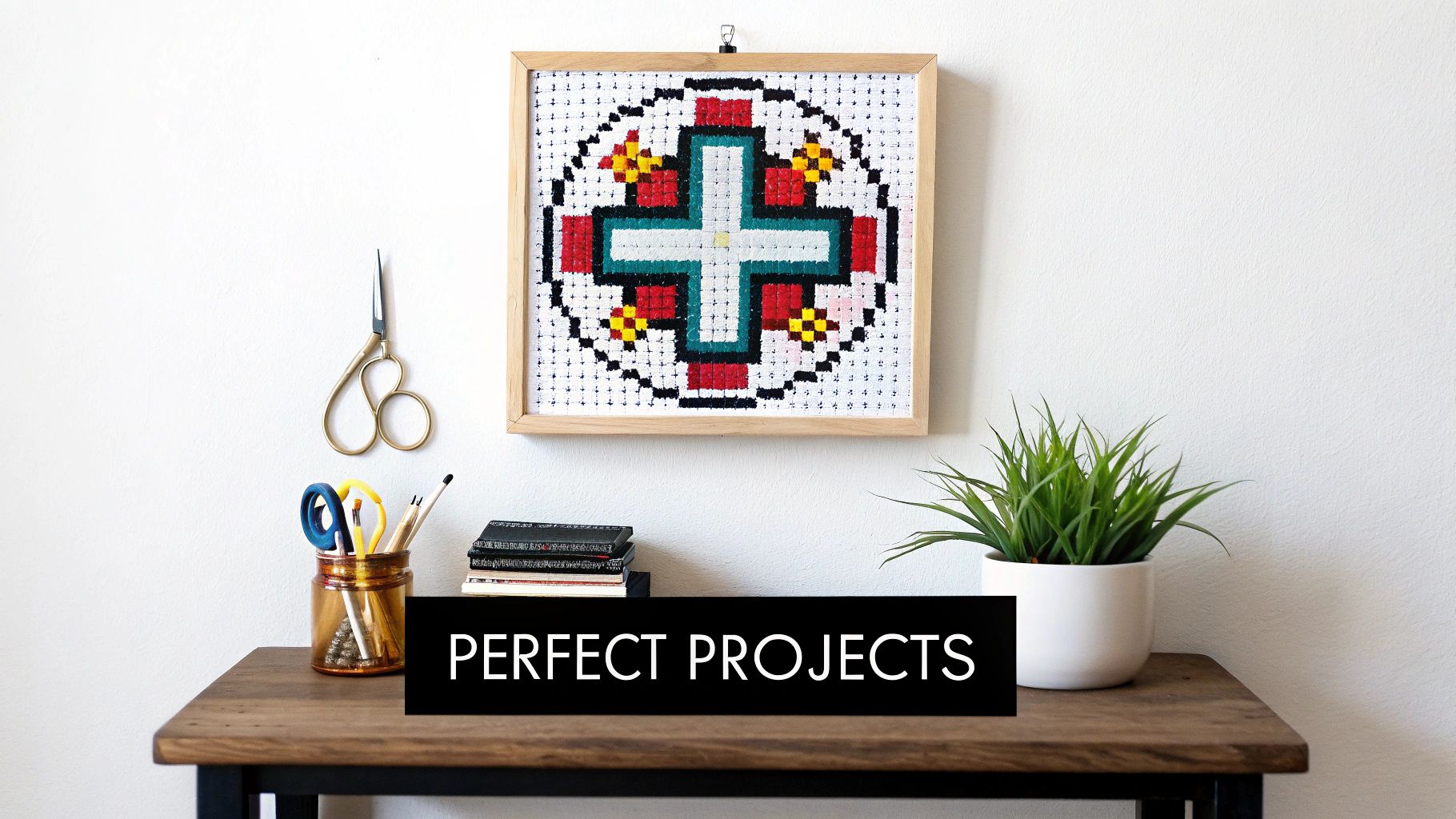
Alright, you've got your needles and threads sorted out, so now for the best part—choosing what to stitch! Working with 8-count Aida is all about leaning into its unique personality. Since the stitches are so big and bold, this fabric is practically begging for designs that are graphic, punchy, and make a real statement.
Forget about tiny, fussy details. Think of it more like painting with broad, confident brushstrokes instead of a super-fine pen. This fabric is your canvas for creating something impactful with clean lines and solid blocks of color.
Projects That Shine On A Larger Canvas
The generous size of 8-count Aida cloth is perfect for projects that are meant to be seen and enjoyed, even from across the room. It’s also incredibly forgiving, which makes it a fantastic choice for quick crafts and beginner kits where you want a satisfying finish without a massive time commitment.
Here are a few ideas where this fabric really shines:
- Kids' Craft Kits: Those large, easy-to-see holes are a game-changer for little hands just learning to handle a needle. It's a wonderful, frustration-free introduction to the world of stitching.
- Quick Weekend Projects: Feel like making something awesome in just a day or two? 8-count Aida lets you whip up holiday ornaments, coasters, or small wall hangings with surprising speed.
- Large-Scale Wall Art: This is where 8-count truly comes into its own. A pattern that looks small and delicate on 14-count Aida becomes a magnificent, tapestry-like work of art that can easily become the centerpiece of a room.
Just imagine taking a simple geometric design or your favorite quote and turning it into a huge, modern wall hanging. The chunky, almost pixelated texture of the stitches becomes a deliberate and beautiful part of the art itself, adding so much warmth and handmade charm.
Turning Memories Into Modern Art
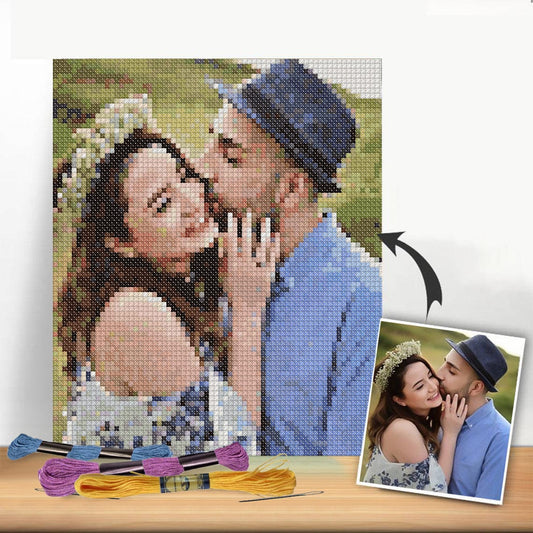
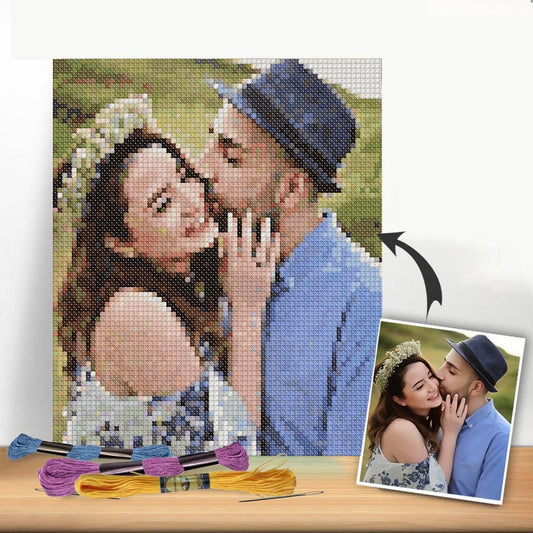
One of the coolest things you can do with 8-count Aida cloth is create custom pieces from your own photographs. When you convert a photo into a cross-stitch pattern for this fabric, the process naturally simplifies the image. It strips away all the little distractions and boils the picture down to its essential shapes and colors, giving you this incredible, modern, pixel-art vibe.
This effect is especially amazing for family portraits, pictures of beloved pets, or that one perfect vacation photo. It captures the spirit of the memory in a wonderfully stylized and artistic way. Using a custom photo-to-pattern kit from a service like Cross Stitched makes this incredibly easy, as they bundle up everything you need to bring your favorite moments to life.
Instead of a photorealistic copy, you get a unique interpretation that’s deeply personal. The finished piece has a real presence that demands attention, turning a simple snapshot into a meaningful piece of home decor. It's the perfect way to create a heartfelt gift or a personal keepsake that tells a story, one glorious, chunky stitch at a time.
How To Adapt Patterns For 8 Count Fabric
Ever find a cross-stitch pattern you absolutely love, only to realize it was designed for a tiny 14 or 16 count fabric? Don’t let that stop you. Adapting any design for aida cloth 8 count is surprisingly simple and opens up a whole new world of creative possibilities.
The first thing to get your head around is this: the pattern itself—the number of stitches high and wide—doesn't change one bit. You’ll be making the exact same number of X’s. What does change is the final size of your project, and that's where the magic of 8 count aida really shines.
The Simple Conversion Math
To figure out how big your finished piece will be, all you need is a little basic division. Just find the stitch count for the width and height of your pattern, which is almost always printed right on the chart.
Then, just plug those numbers into this simple formula:
- Pattern Width (in stitches) ÷ 8 = Finished Width (in inches)
- Pattern Height (in stitches) ÷ 8 = Finished Height (in inches)
Let's say you have a pattern that's 100 stitches wide by 120 stitches tall. On 8 count fabric, that small design transforms into something much more substantial. The math looks like this: 100 ÷ 8 = 12.5 inches wide, and 120 ÷ 8 = 15 inches tall. Suddenly, a design that might have been a small ornament on 16 count Aida becomes a bold 12.5" x 15" piece ready to hang on the wall.
Adjusting Your Supplies
With a much larger project on your hands, you’ll definitely need to adjust your supply list. Running out of fabric or thread halfway through is a stitcher’s nightmare!
-
Fabric Size: Once you've calculated your new dimensions, make sure to add at least 3-4 inches of extra fabric on all four sides. This border is crucial for handling the project while you work and gives you plenty of room for framing later.
-
Thread Quantity: Bigger stitches eat up more thread. As a general rule of thumb, you can expect to use about twice as much floss on 8 count aida compared to stitching the same pattern on 16 count. It's always a good idea to buy a little extra just in case.
Think of it like this: adapting a smaller pattern to 8 count is like "zooming in" on the design. This makes 8 count aida cloth the perfect canvas for turning a detailed motif into a graphic, statement piece that can become the focal point of any room.
This is a fantastic way to create personalized gifts or custom home decor, like the incredible kits offered by Cross Stitched. You can take a cherished photo, have it converted into a pattern, and then stitch it on 8 count aida to create a large-scale, pixel-art style tapestry. It’s a wonderful way to turn a favorite memory into a unique and modern work of art.
Caring For Your Finished Cross Stitch Project
You’ve tied off that very last thread—congratulations! But before you rush off to frame your masterpiece, there’s one final step that makes all the difference. Taking a little time to properly wash and press your work will make it look polished, professional, and ready for its grand debut.
Think about it: over weeks or even months of stitching, the fabric has been handled quite a bit. Oils from your hands, dust, or even faint marks from your hoop can dull its appearance. A quick, gentle wash is all it takes to freshen up your 8-count Aida cloth and make those floss colors pop.
Hand-Washing Your Project
First, grab a clean sink or basin and fill it with lukewarm water. Add just a tiny drop of a mild, pH-neutral soap or a delicate fabric wash designed for quilts and fine linens. Submerge your project and let it soak for about 15-20 minutes.
You can give it a gentle swish now and then, but resist the urge to scrub or wring it out. That kind of rough handling can easily distort your beautiful stitches. After its little bath, drain the soapy water and rinse your piece under cool, running water until it runs clear.
To get the excess water out, lay your project flat on a thick, clean towel. Roll the towel up like a jelly roll with your stitching inside, and press down gently. This soaks up most of the moisture without any harsh twisting.
The whole point is to be gentle. You're simply lifting away any accumulated grime, not giving it a deep scrub. This ensures your floss stays vibrant and your stitches stay perfectly formed.
Ironing For A Perfect Finish
Now for the magic touch that creates that flawless, flat finish. The trick is to iron your project while it's still slightly damp, as this helps release every last wrinkle.
Lay a fluffy, clean towel down on your ironing board to create a soft, cushioned surface. Place your cross stitch project face-down on the towel. This is crucial because it protects your stitches from getting flattened by the iron.
Set your iron to a medium heat setting (no steam!) and gently press the back of the fabric. The towel acts as a soft mold for your stitches, allowing them to sink in slightly while the heat smooths the Aida cloth around them. Keep the iron moving until the fabric is completely dry.
And just like that, your work is perfectly prepped and ready to be framed and admired for years to come
A Few Common Questions About 8 Count Aida
Diving into a new craft material always sparks a few questions. To help you get started with total confidence, I've rounded up some quick, clear answers to the things people ask most often about 8 count Aida cloth.
This fabric has some really unique qualities that make it a fantastic choice for certain projects. Knowing its strengths and where it might fall short before you thread your needle is the key to making sure your creative vision and your materials are a perfect match.
Can I Use 8 Count Aida For Very Detailed Patterns?
You could, but it’s probably not the best choice. 8 count Aida really shines with patterns that have big, bold blocks of color and simpler designs. The chunky stitches create a wonderfully graphic, almost pixelated look that’s a huge part of its charm.
If you've got a pattern with tons of tiny details, like a photorealistic portrait with delicate shading, you’ll get much better results with a higher-count fabric. Something like 14 or 18 count Aida will give you the smaller stitches needed to capture all that beautiful complexity.
Do I Need A Hoop Or Frame For 8 Count Aida?
I would strongly recommend it. Even though 8 count fabric feels a bit stiffer, using a hoop or frame is the secret to getting beautiful, even stitches. It keeps the tension consistent across the fabric, which helps every X lay flat and look perfectly uniform.
A hoop isn't just about tension, either. It’s also an ergonomic tool that can save your hands from cramping up during those long, relaxing stitching sessions. This is especially true on bigger projects where the fabric can get a little unwieldy.
For larger pieces, a scroll frame is a real game-changer. It keeps the whole project area taut and lets you work on different sections without having to constantly move a hoop around, which protects your finished stitches from getting squashed.
Is 8 Count Aida The Same As Plastic Canvas?
Nope, they're completely different animals! 8 count Aida cloth is a soft, flexible, 100% cotton fabric. It’s perfect for anything you plan to frame or turn into a soft textile project.
Plastic canvas, on the other hand, is a stiff grid made of—you guessed it—plastic. It also has big holes and is great for beginners, but its rigidity means it’s used for three-dimensional things like tissue box covers, coasters, or little decorative boxes.
Ready to turn a cherished memory into a stunning, modern work of art? At Cross Stitched, we make it easy with custom photo-to-pattern kits perfect for 8 count aida. Start your personalized project today!