Diving into embroidery for the first time feels a bit like standing in front of a giant wall of paint swatches. The sheer number of colors can be overwhelming! But there's a secret code that brings order to all that beautiful chaos: the DMC embroidery floss numbering system. It's the universal language that stitchers all over the world use to talk about color.
Think of it as your roadmap. Once you get the hang of it, you'll be able to navigate any pattern with total confidence.
Why DMC Floss Numbers Are Your Best Friend
That little number printed on the paper band of a DMC skein might just look like a random set of digits, but it's the key to making your projects turn out just right. It’s what turns a confusing-looking chart into a clear, stitch-by-stitch guide, ensuring your finished piece looks exactly the way the designer imagined it.
This numbering system is the foundation for almost every cross-stitch pattern you'll ever find, whether it's a printed booklet or a PDF you downloaded online. Without these numbers, we'd all be stuck trying to guess which of the twenty shades of green we're supposed to use. It would be a mess!
The Language of Color Consistency
The real magic of the DMC system is its consistency. You can buy a skein of DMC 310 (Black) in a tiny shop in Paris or a big box store in Ohio, and it will be the exact same color. This is a lifesaver for bigger projects where you inevitably run out of a color halfway through and need to buy more.
Think of a DMC floss number as the unique "address" for a specific color. Just like a street address gets you to one exact house, a DMC number points you to the one exact shade you need. No more guesswork, no more "close enough."
DMC has been around since the 18th century, so they've had a long time to perfect this system. Today, their catalog boasts over 500 distinct, numbered shades, which is why it's the gold standard for pattern designers everywhere. You can learn more about DMC's fascinating history and its influence on the stitching world over at Needle 'n Thread.
Ultimately, getting comfortable with these numbers is a game-changer. It empowers you to:
- Follow any cross-stitch or embroidery pattern with complete accuracy.
- Organize your thread stash so you can find what you need in seconds.
- Pick substitute colors with confidence if your local shop is out of stock.
- Spend less time stressing and more time stitching.
How to Read the Language of DMC Colors
At first glance, the numbers on a DMC skein can look like a totally random jumble of digits. But there’s a secret language hidden in there, a clever system that's a lot like a library's card catalog for color. Once you learn to read it, you'll unlock a whole new level of confidence and creativity in your stitching.
The heart of the DMC collection is its standard cotton floss, which covers the main numerical range from 1 to 3866. This is the workhorse of the cross-stitch world and what you'll find in the vast majority of patterns. These numbers aren't random at all; they’re intentionally grouped into color families, making it surprisingly easy to find similar shades for blending or creating beautiful gradients.
Decoding the Basic Numbering System
A good rule of thumb is that numbers close to each other are probably in the same color family. For instance, if you look at the 300s, you'll find a sea of blues and greens. Hop over to the 700s, and you'll be greeted by a spectrum of bright, vibrant greens. It’s all organized on purpose, so you can start to see relationships between colors just by looking at their numbers.
This visual guide breaks down the basics of a DMC skein, from its six-strand construction to how the numbers sort that massive color palette into logical groups.
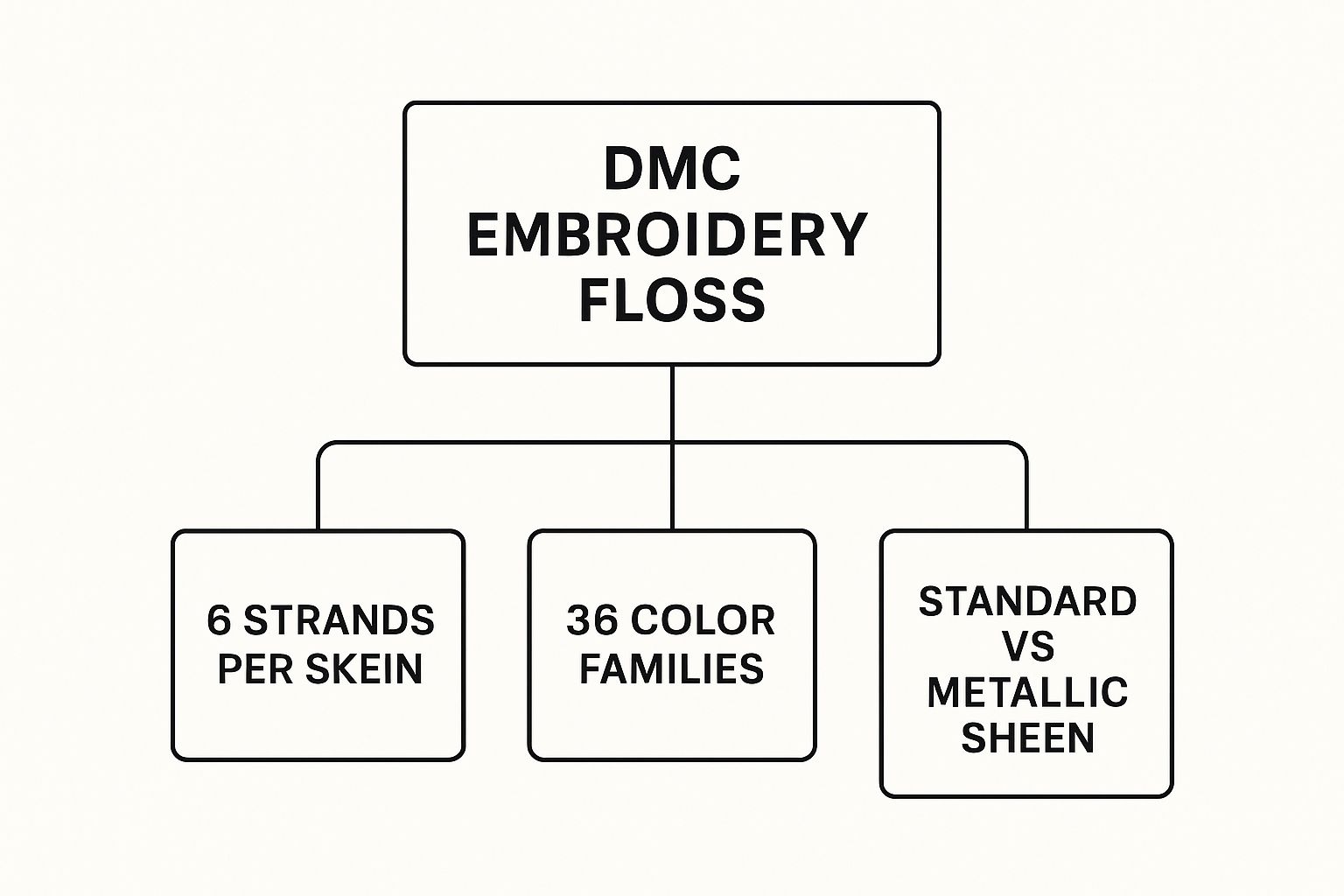
As you can see, every skein has those same six strands, but it’s the number that gives it a unique identity within the vast world of DMC colors.
Understanding Specialty Thread Prefixes
Things get really interesting when you see letters pop up in front of the numbers. Those little prefixes are your signal that you’re dealing with a specialty thread, which almost always means you’ll need to handle it a bit differently than your standard cotton.
Think of a letter prefix on a DMC number as a quick heads-up. It's telling you about the thread's texture, shine, and unique properties so you can grab the right needle and adjust your technique before you even make the first stitch.
Here’s a quick rundown of what those letters mean when you see them on a pattern or in the store:
- "S" Prefix (like S321): This means you've got Satin Floss. It’s made from rayon and has a gorgeous, silky sheen that's perfect for adding highlights. Just be aware—it can be a bit slippery to work with!
- "E" Prefix (like E980): This stands for Light Effects. This is where the fun stuff lives: metallics, neons, and even glow-in-the-dark threads. They add a serious wow factor to any project.
- "C" Prefix (like C310): While you might not see this on the skein itself, "C" often appears on color cards or patterns to indicate a Variegated floss. These threads blend several colors into one strand to create a lovely, mottled look with every stitch.
To make this even clearer, here’s a table you can use to quickly identify the different types of DMC floss you might encounter.
A Quick Guide to DMC Floss Types
Use this table to quickly identify different types of DMC floss based on their number, prefix, and what they're best used for in your projects.
| Number Range or Prefix | Type of Floss | Key Characteristics |
|---|---|---|
| 1-3866 | Standard 6-Strand Cotton | The core collection. Divisible, 100% cotton, and used in most patterns. |
| S### | Satin Floss | Rayon-based with a high-gloss, silky finish. Great for highlights but can be slippery. |
| E### | Light Effects | Includes metallics, glow-in-the-dark, and neons for dazzling special effects. |
| C### | Variegated Cotton | A single strand with multiple coordinating colors for a subtle, blended look. |
| 1-35 (New) | Étoile Thread | Cotton floss with a delicate sparkle woven in. Adds a subtle shimmer. |
| 310M | Metallic Floss | A different line of metallic thread, often used for bold, shiny details. |
Knowing these prefixes takes the guesswork out of reading a pattern’s supply list. It transforms what looks like a confusing code into a clear set of instructions, helping you prepare for the unique feel of each thread and ensuring your stitching comes out beautifully every time.
Navigating Color Families for Perfect Shading
The real magic in cross-stitch often happens in the subtle shifts between colors. It's the shading and gradients that give a piece depth and life, and understanding DMC's color families is your secret weapon for achieving that. Once you crack the code of the DMC embroidery floss numbers, you'll see they're not just random labels—they're a built-in map to creating beautiful, realistic color transitions.
Think of it like looking at paint swatches at the hardware store. All the blues are grouped together, from sky blue to deep navy. DMC does the same thing. For instance, numbers within the same hundred-group, like the 700s, are almost always part of the same color family. In this case, it’s a whole range of gorgeous, leafy greens.
How Number Sequences Create Gradients
This is where the system gets really clever. When you look at the numbers in order, you can literally see a color gradient unfold. A sequence like DMC 741, 742, 743, and 744 gives you a perfect progression of warm, pumpkin-y oranges, moving smoothly from dark to light. Spotting these sequences is a total game-changer.
This image from DMC's website really drives the point home, showing the incredible variety of colors arranged in their logical groups.
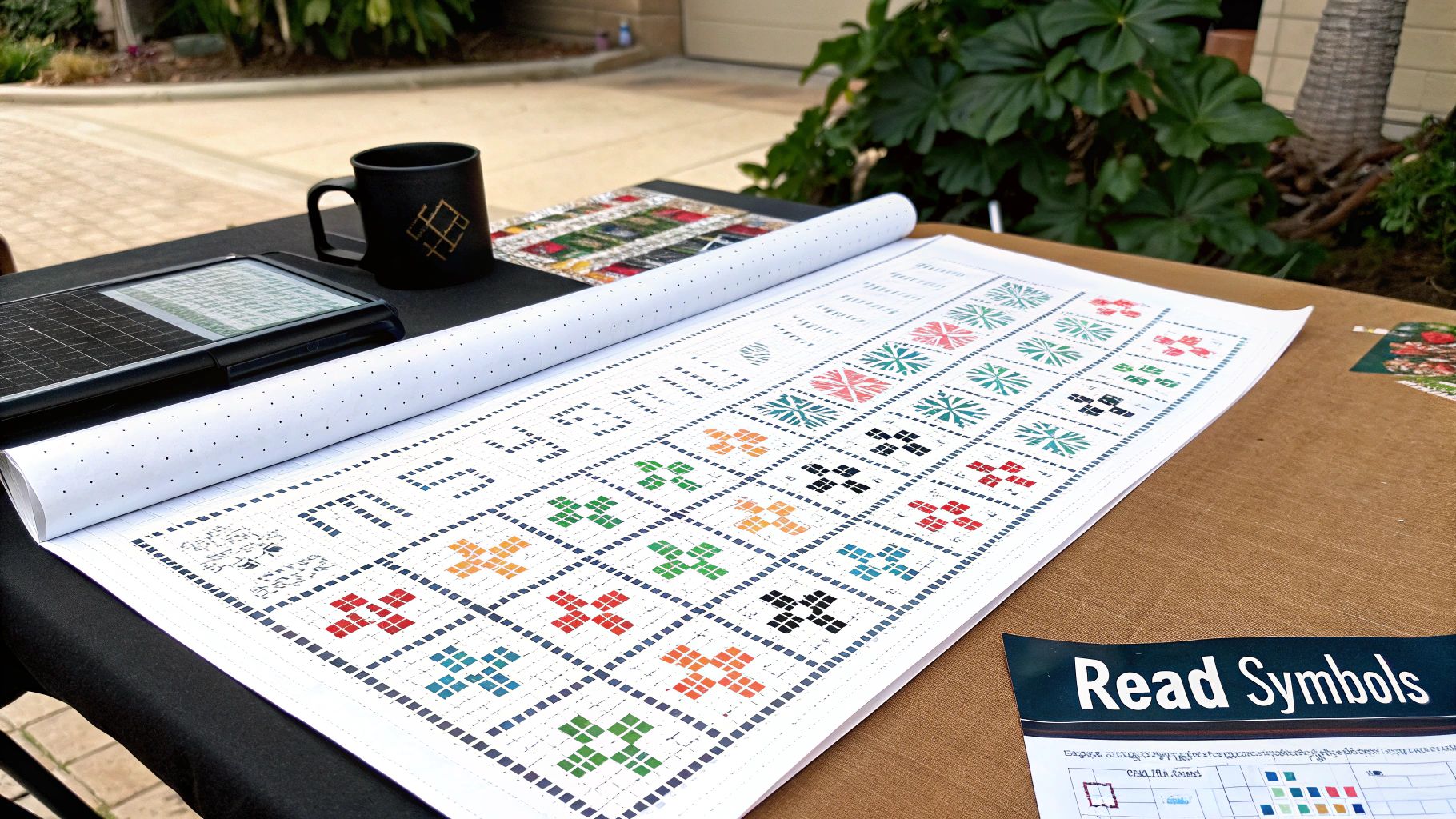
You can see right away that the colors aren't just thrown together. They flow into one another, making it so much easier for us to pick out the perfect shades for blending.
This built-in logic is incredibly freeing. It means you don't have to just blindly follow a pattern. You can start making your own creative choices, whether that’s swapping out colors in a design or finding a quick substitute when you run out of a specific floss. If a pattern calls for DMC 931, a lovely medium dusty blue, but your bobbin is empty, you can confidently grab 930 (a shade darker) or 932 (a shade lighter) and know you've got a great match.
By learning to see the relationships between numbers, you transform from someone who follows instructions into a true color artist. You can predict how colors will interact and confidently build palettes that bring your projects to life.
Practical Tips for Using Color Families
So, how do you put this into practice? Here are a few ways this knowledge will immediately improve your stitching:
- Creating Depth: To make something look rounded or three-dimensional, use consecutive numbers from a single color family. Use the darkest number (like 930) for shadows, the mid-tone (931) for the main color, and the lightest one (932) for highlights. It's that simple.
- Finding Substitutes: Ran out of a color? Just look at the numbers right next to it. Checking the floss number above and below the one you need is often way more accurate than just eyeballing a match under store lighting.
- Designing Your Own Palettes: When you're ready to create your own color schemes, start by picking a mid-tone you absolutely love. From there, you can easily build out a palette by grabbing the lighter and darker shades right next to it in the DMC embroidery floss numbers.
Getting comfortable with these shading techniques is a fantastic way to make your work pop. For anyone ready to take their skills even further, our guide on advanced cross-stitch techniques is packed with more tips for adding incredible dimension and texture to your projects.
Finding Thread Substitutes and Using Conversion Charts
Every stitcher hits this snag eventually. You’re all fired up to start a new project, you've got your fabric ready, and then you realize you’re missing one of the DMC embroidery floss numbers listed in the pattern. Don’t panic! Before you make a special trip to the craft store, learning how to find a good substitute is a skill that will save you time and keep your creative flow uninterrupted.
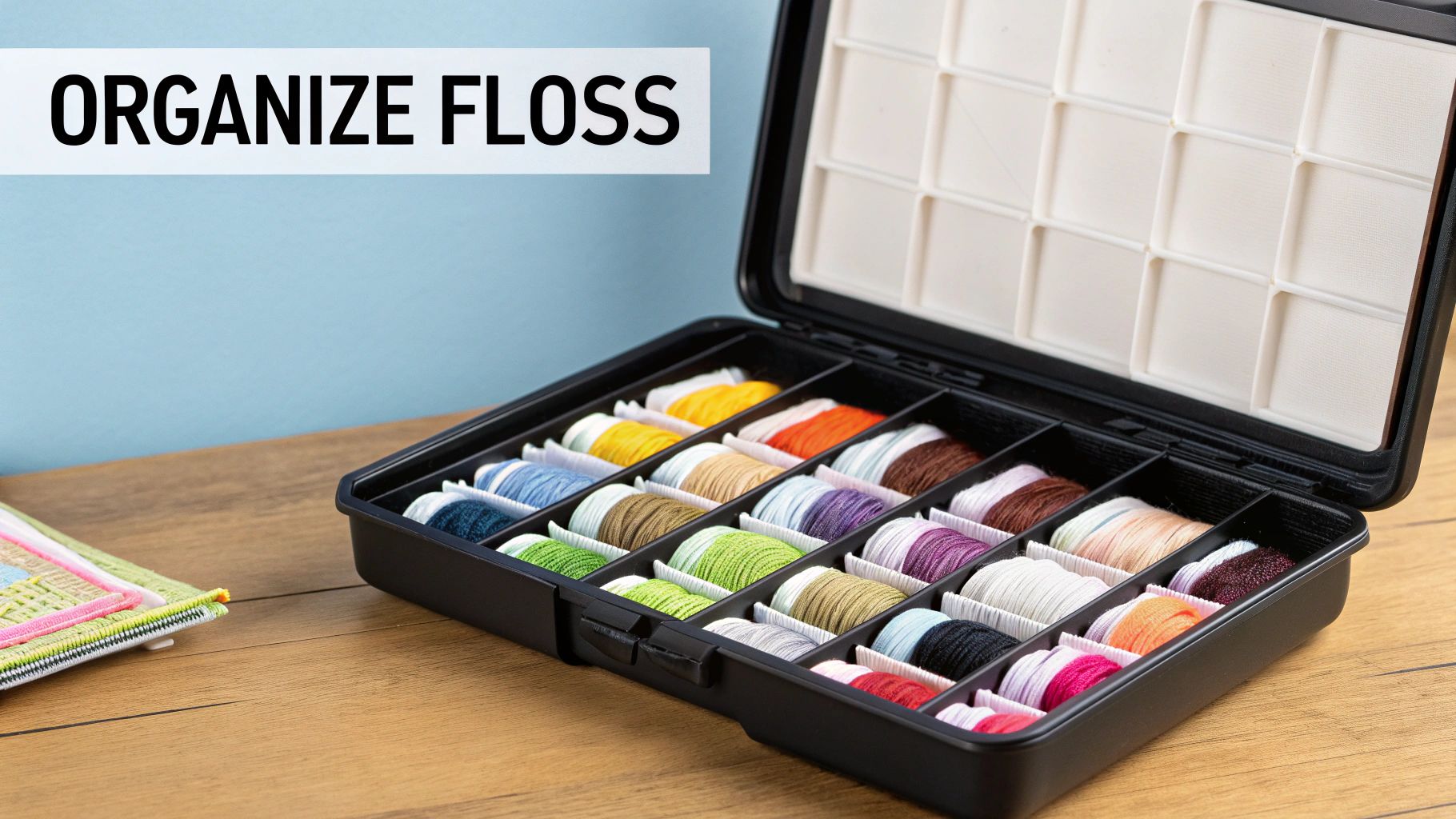
The simplest place to start is within the DMC line itself. Remember how the color families work? Just look at the numbers right next to the one you need. If your pattern calls for DMC 826 (a nice medium blue), there's a very good chance that 825 (a touch darker) or 827 (a touch lighter) will blend in perfectly without throwing off the entire design.
Switching Between Floss Brands
But what if you need to swap a DMC color for a thread from a different brand, like Anchor or J&P Coats? This is where a good conversion chart becomes your best friend. Think of these charts as a Rosetta Stone for floss, matching DMC numbers to their closest cousins in other thread lines.
A little word of warning, though. While conversion charts are a fantastic guide, they aren't always a perfect science. Here’s what you need to be aware of:
- Dye Lot Drama: Just like with DMC, colors from any brand can have slight variations from one dye lot to the next.
- Screen vs. Reality: Digital charts are super handy, but the color you see on your phone or computer screen can look different from the actual thread.
- Material Matters: Different brands might use slightly different cotton or dyes, which can change the thread's sheen and even its texture.
If you need a reliable starting point, our own thread color conversion chart is a great resource for making confident swaps between the major brands.
The Art of a Good Substitution
At the end of the day, the goal is simple: find a substitute that honors the original look and feel of the design. If the color you’re missing is just for a few stitches in a tiny detail, a "close enough" match will be totally fine. No one will ever notice. But if it's a primary color used in a large, solid area, you'll want to find a much closer match.
The absolute best way to choose a substitute is to compare threads in person, ideally under natural daylight. Hold the potential replacement next to the other colors in your project's palette. Does it look right? Does it harmonize? Trust your eyes.
This skill is becoming more valuable all the time. The global embroidery thread market was valued at about USD 3.5 billion in 2024 and is expected to keep growing, which just shows how much people all over the world love needlecrafts. Knowing how to adapt and substitute threads means you can work with any brand you have on hand and keep your projects moving forward without a hitch.
Smart Ways to Organize Your Floss Collection
If you've been stitching for any length of time, you know the feeling. What started as a few skeins for a small kit has exploded into a chaotic jumble of color. An organized floss collection isn't just about aesthetics; it’s a total game-changer that saves you time, cuts down on frustration, and lets you get back to what you love—stitching.
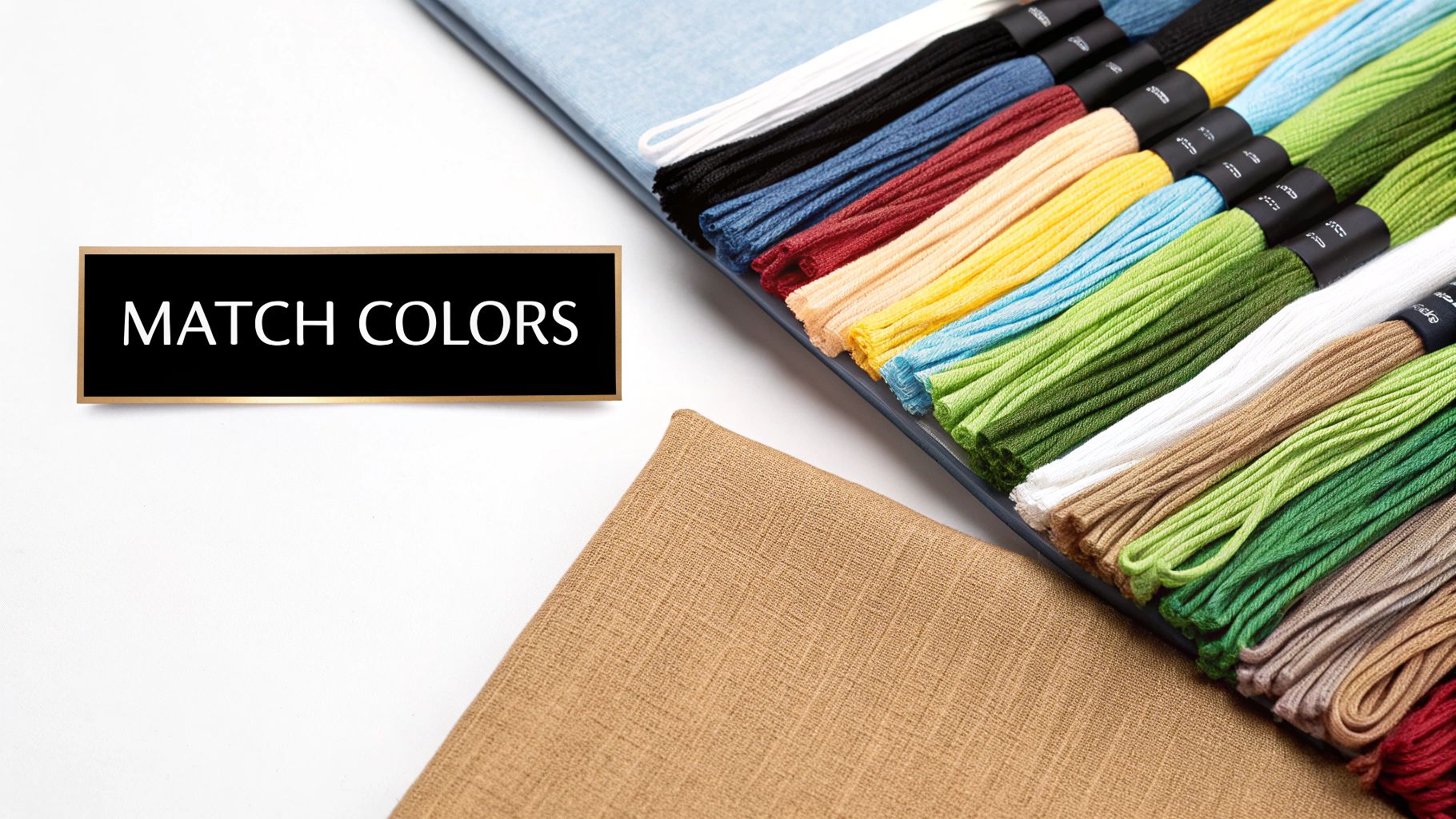
The single best way to tame the thread beast is to organize your floss by its DMC embroidery floss numbers. There's a reason this numerical system is the gold standard. When your threads are sorted in order, you can grab the exact shade a pattern calls for in a heartbeat. No more squinting and holding ten shades of blue up to the light.
Choosing Your Organization Method
Every stitcher has their go-to system, and what works for you will really depend on your space and how you like to work. The two most popular camps are bobbins and floss drops.
- Plastic Bobbins: This is the classic method for a reason. You wind each skein onto a small plastic or cardboard bobbin, then write the DMC number on top. They file away perfectly in storage boxes, keeping everything neat, tidy, and tangle-free.
- Floss Drops: For those who dread winding bobbins, floss drops are a fantastic alternative. These are basically tags with a hole where you loop the entire skein. You can then group them on a large metal ring. It's much faster and keeps the skein in its original form, which some people prefer.
No matter which path you take, the real secret is consistency. A well-ordered collection lets you see what you have at a glance, get a feel for your color palette, and pull what you need for a new project without any fuss.
Managing Your Inventory
Keeping tabs on your growing stash is just as important as organizing it. The global embroidery supply market was valued at around USD 1.18 billion in 2024, and as you invest in your own little corner of that market, you'll want to know what you own. It stops you from buying duplicates and makes sure you have what you need when inspiration strikes. You can see more details on the embroidery floss market trends over on growthmarketreports.com.
There are all sorts of simple ways to track your inventory, from mobile apps to printable checklists where you can mark off the DMC embroidery floss numbers you have. Taking this one small step transforms a random pile of thread into your own personal, functional library of color. To learn more about the threads themselves, our guide on the different types of embroidery floss is a great place to start.
Common Questions About DMC Floss Numbers
Even after stitching for years, I still run into little quirks with the DMC embroidery floss numbers. The system is incredibly reliable, but with specialty threads, discontinued colors, and new releases popping up, it's easy to get stumped. Let's tackle some of the most common questions so you can navigate your stash with total confidence.
Think of this as your go-to guide for those little "hang on a minute..." moments. Getting a handle on these details doesn't just solve problems—it makes you a more knowledgeable and resourceful stitcher.
Why Do Some DMC Numbers Have Letters?
Ever look at a pattern and see a number like S798 or E168? That little letter in front is a prefix, and it's DMC's way of telling you that you're dealing with a specialty thread, not your standard six-strand cotton.
Each letter signals a different type of floss:
- S Prefix: This is for Satin Floss. Made from rayon, these threads have an incredible, silky sheen that really makes a design pop. Just be aware, they can be a bit more slippery to work with than cotton.
- E Prefix: This one stands for the Light Effects line. This is where the real fun begins—metallics, glow-in-the-dark, pearlescent, and even fluorescent threads. They're fantastic for adding a touch of magic, but a good tip is to use shorter lengths of thread to keep them from tangling.
- C Prefix: You won't usually find this on the skein itself, but you might see a "C" on a printed color card. It just identifies a Variegated color, where multiple shades are blended along a single strand for a beautiful, mottled effect.
What Happens If a DMC Color Is Discontinued?
It’s pretty rare for DMC to stop making a color from its main 1-3866 cotton line, but it has happened. If your pattern calls for a number you just can't find, don't panic. The official DMC website is your first stop; they often list the best substitute.
If you come up empty there, online stitching groups on places like Facebook or Reddit are a goldmine. Fellow stitchers are always happy to share what worked for them when they ran into the same problem.
But here’s the best trick I've learned: use your knowledge of the color families. Look at the DMC numbers right before and after the discontinued one. Those neighbors are almost always your closest match and will blend into the original design perfectly.
For instance, if a pattern needed the discontinued DMC 504 (a light green), you could easily grab 503 (a touch darker) or another shade in the low 500s and get a fantastic result.
Can I Trust the Number on the Skein?
Absolutely. The number on that little paper band is the ultimate identifier for the color. But there's another number on there you should know about: the dye lot.
DMC produces floss in massive batches, and each batch gets its own dye lot number. While their color consistency is legendary, tiny variations can happen from one dye lot to the next. For most projects, you'd never, ever notice.
The only time it really matters is if you're working on a huge area of solid color, like a background. In that case, it's a smart move to buy all the skeins you need for that color at once. This ensures they all come from the same dye lot, giving you a perfectly uniform finish.
How Does DMC Add New Colors to the System?
When DMC decides to bless us with new colors, they do it in a way that doesn't mess up the system we all know and love. They don't try to cram new shades into the existing families. Instead, they assign them a completely new range of numbers.
A great example is the batch of 35 new colors they released back in 2017. They were simply numbered 01 through 35. This keeps the established logic intact—we all know the 700s are greens and the 930s are dusty blues, and that's not going to change.
DMC always announces new color releases on their website and through needlework shops. They usually release updated printed color cards around the same time, so you can see the new shades for yourself.
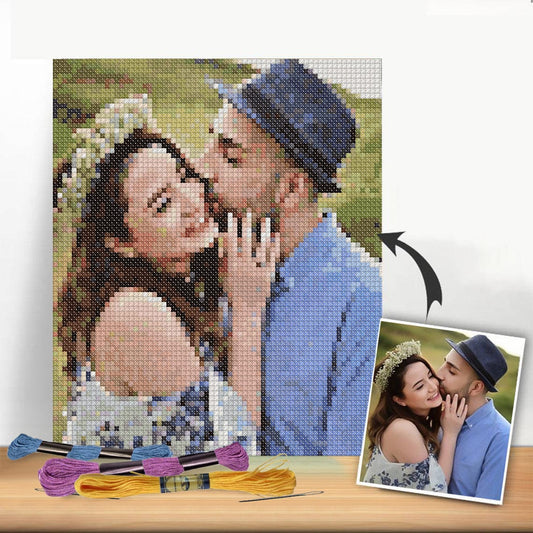
Ready to turn your most cherished memories into timeless works of art? At Cross Stitched, we make it easy with our custom photo-to-pattern kits, complete with everything you need to start stitching.
Create your personalized cross-stitch kit today!