Quick answer: Cross stitch is considered one of the easiest needlecrafts to learn: the fundamental stitch — two diagonal threads forming an X — takes minutes to master. Beginners can complete a small design in a single session, though larger counted patterns require patience and careful chart-reading.
Frequently asked questions
Is cross stitch easy for absolute beginners?
Yes. The basic cross stitch requires only two diagonal stitches and can be learned in minutes. Most beginners start with a small kit on 14-count Aida fabric, which has clearly visible holes that guide the needle placement.
How hard is it to learn cross stitch?
The core technique is simple, but larger projects introduce challenges such as reading multi-colour charts, managing thread tension, and counting accurately. These skills develop naturally with practice over several projects.
What is the easiest cross stitch fabric for beginners?
14-count Aida cloth is the standard recommendation for beginners. Its woven grid creates obvious holes spaced far enough apart to work comfortably, reducing counting errors compared to higher-count fabrics.
How long does a beginner cross stitch project take?
A small beginner design of around 50×50 stitches typically takes 3–6 hours. Time varies significantly by stitch count, colour changes, and the stitcher's pace.
Here's how I'd put it: is cross stitch actually easy to learn?
The short answer is a resounding yes. Honestly, if you're looking for a new craft that won't leave you frustrated, cross stitch is one of the friendliest entry points you can find. It’s less like trying to master freehand drawing and more like paint-by-numbers, but with a needle and thread.
The secret is in its structure. You’re not guessing where to put your needle; a gridded fabric guides every single stitch. All you have to do is make a simple 'X' over and over again.
The Gentle Learning Curve
What makes cross stitch so approachable is that it eliminates most of the guesswork. You don't need any sewing experience to create something you'll be proud of. If you can count and hold a needle, you're already halfway there.
The whole process is built to be both meditative and methodical. You just follow a chart (called a pattern), match up your thread colors, and build your picture one 'X' at a time. The materials are even designed to set you up for success. For example, most beginners start with Aida fabric, which has a built-in grid of tiny, visible holes. This makes creating neat, uniform stitches practically effortless.
What Makes It So Simple?
When people ask, "is cross stitch easy?" the answer really comes down to two things working in perfect harmony:
- One Easy Stitch: You only need to master one stitch to complete an entire project: the cross stitch. No complex knots, no confusing techniques—just a simple 'X'.
- A Built-In Map: Your pattern and the gridded fabric are your roadmap. Each symbol on the chart shows you exactly which square on the fabric gets which color.
This simple, guided system is what makes cross stitch so uniquely accessible. Let's take a quick look at why these elements make it the perfect craft for anyone to try.
Why Cross Stitch Is Perfect for Beginners
This table gives a quick look at the core reasons that make cross stitch an incredibly accessible craft for anyone to learn.
| Core Element | How It Helps You Succeed |
|---|---|
| Simple 'X' Stitch | You only need to learn one basic movement. This removes the pressure of mastering dozens of complex stitches. |
| Gridded Fabric | The fabric has built-in squares that show you exactly where to place your needle for perfectly even stitches. |
| Pattern 'Map' | The chart is a clear, visual guide. Just match the symbol to the thread color and stitch in the right square. |
| Low-Cost Start | You only need a few basic supplies (fabric, thread, needle, hoop) to get started on your first project. |
Ultimately, this straightforward approach is why cross stitch has stood the test of time as a beloved craft.
The combination of a single, repeatable stitch and a counted pattern system is the magic formula. It breaks down what looks like a complicated art form into a series of simple, achievable steps. It's a design that, as you can learn more about on Wikipedia, was made to be easy to follow.
How Does Cross Stitch Actually Work?
Before you thread your first needle, let's pull back the curtain on how this all comes together. At its heart, cross stitch is a form of counted embroidery. Don't let the term intimidate you—it just means that instead of drawing a design on the fabric, you count squares on a grid to figure out where each stitch goes.
Think of it like building with LEGOs or creating pixel art. Every little "X" you make is like a single colored pixel. On its own, it’s just a tiny cross. But when you follow the plan and place hundreds of them together, a detailed, beautiful picture starts to emerge. This methodical process is a big reason why the answer to is cross stitch easy for newcomers is a resounding yes.
Your Pattern and Fabric Work in Tandem
The real magic happens because two key elements—the pattern and the fabric—are designed to work together perfectly. They create a simple system that takes all the guesswork out of stitching.
- The Pattern is Your Blueprint: Your pattern is essentially a chart, a grid filled with different symbols. Each symbol tells you two things: which color of thread to use and exactly where to place that stitch on your fabric. It’s your map to a finished piece.
- The Fabric is Your Foundation: You’ll be working on a special material called Aida cloth. It’s woven with a very obvious grid of holes, making it easy to see exactly where your needle needs to go. These holes ensure every stitch you make is the same size and perfectly spaced.
By simply matching the symbol on your chart to a square on your fabric, you break a complex design down into simple, manageable steps. You’re never left wondering what to do next; you're just making one "X" at a time.
This foundation is what makes cross stitch so incredibly accessible. You don't need to be a natural-born artist to create something you're proud of—you just need to follow the blueprint. Once you grasp this simple "why," the "how" feels completely intuitive, even if you’ve never picked up a needle and thread in your life.
Your Essential Beginner Toolkit
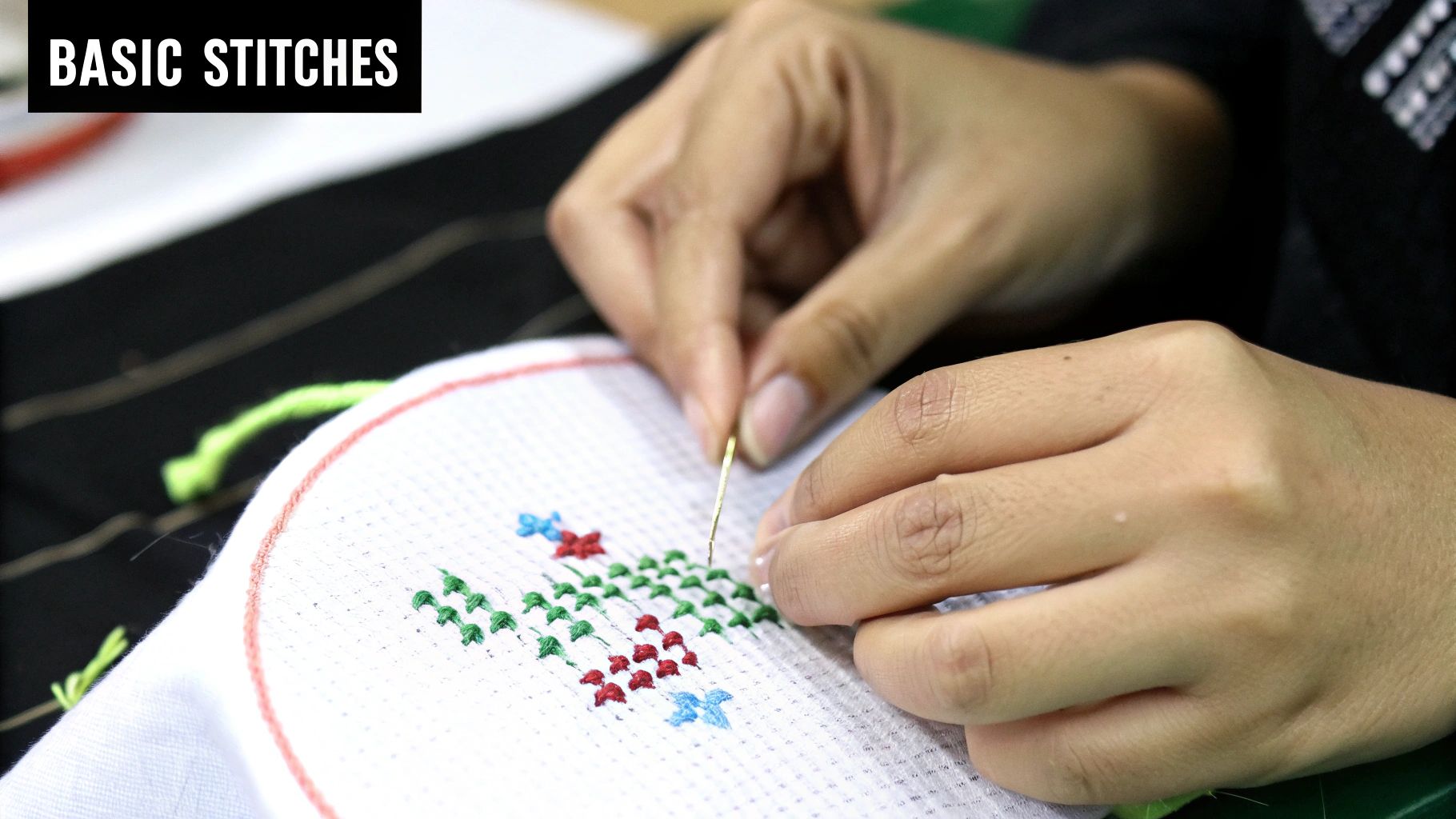
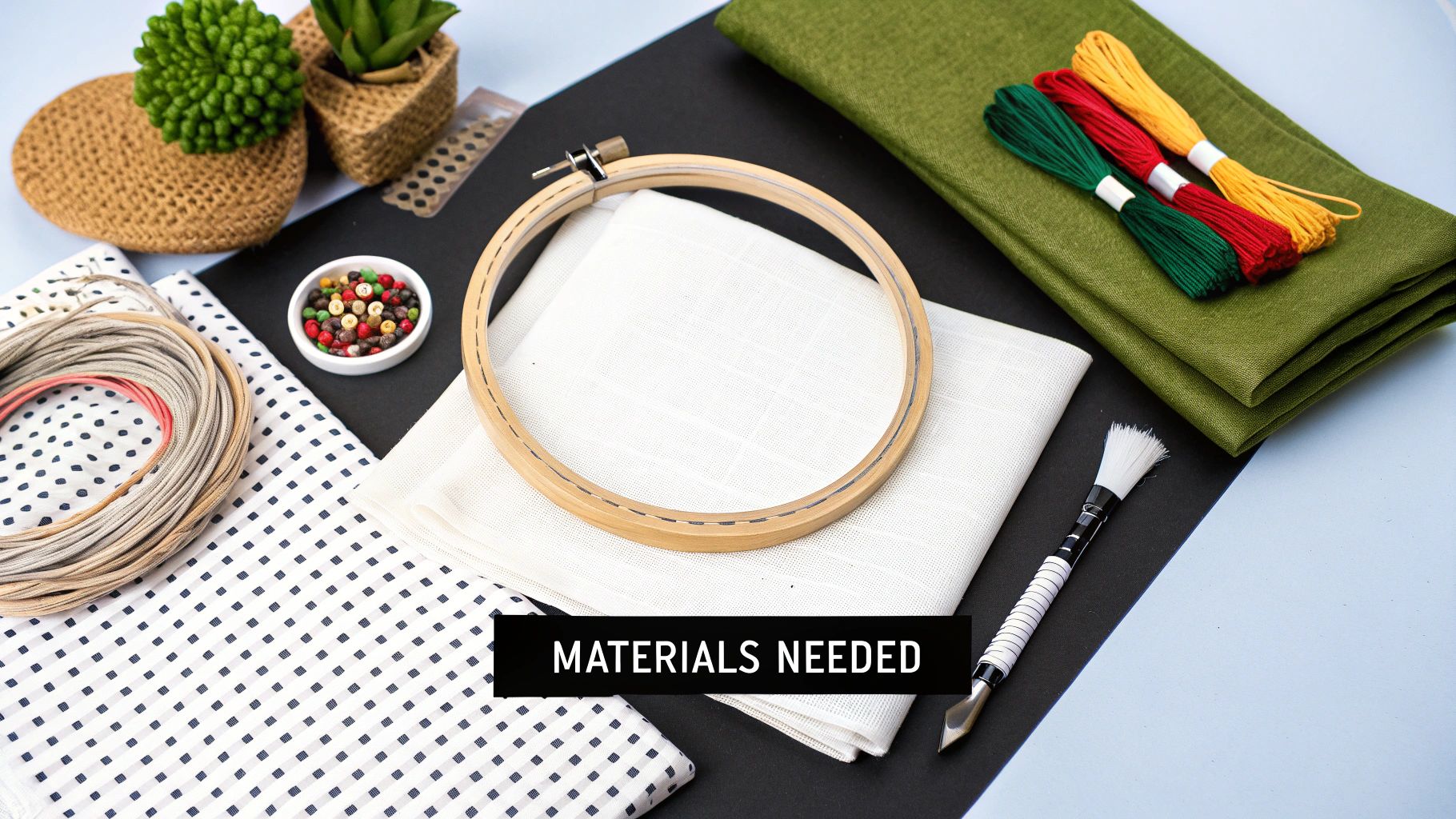
One of the best things about jumping into cross stitch is that you don't need a mountain of expensive gear. Your starter toolkit is actually pretty simple and affordable, boiling down to just four essentials that will set you up for success.
These tools are your creative foundation. Each one has a job to do, and together they make the whole process feel smooth and manageable. It's a big part of why the answer to "is cross stitch easy" is a resounding "yes!" You can hunt these down individually or grab a curated cross stitch kit for beginners that has everything ready to go.
The Core Four Supplies
To get started, you really only need to get familiar with these four items. They're intentionally straightforward, designed to help you build confidence from that very first stitch.
-
Aida Fabric: This is the special grid-like fabric you'll be stitching on, and it’s a total game-changer for beginners. It has a built-in grid of holes that shows you exactly where your needle goes. For a first project, 14-count Aida is the sweet spot—it’s easy to see and work with.
-
Embroidery Floss: This is the colorful thread that makes your design pop. It comes in a mind-boggling array of colors, but a good kit will give you the exact shades you need, often pre-cut to the right length.
-
Tapestry Needle: Don't grab a regular sewing needle! A tapestry needle has a blunt tip and a bigger eye. That blunt end is key, as it glides right through the Aida holes without splitting the fabric threads.
-
Embroidery Hoop: Think of this as a helpful extra hand. It clamps your fabric, holding it tight so you can make neat, even stitches. This simple tool is the secret to avoiding puckered fabric and getting that polished, professional look.
Here’s a quick shopping list to help you gather your supplies. This checklist covers the essentials for your first project, explaining what they do and what to look for.
Your First Cross Stitch Shopping List
| Supply | Its Purpose | Beginner's Best Bet |
|---|---|---|
| Aida Fabric | A woven fabric with a natural grid to guide your stitches. | 14-count Aida in a light color like white or cream. |
| Embroidery Floss | The colored thread used to create the "X" stitches. | A pre-selected set of colors from a kit or pattern. |
| Tapestry Needle | A blunt-tipped needle that passes through fabric holes easily. | Size 24 is a great all-rounder for 14-count Aida. |
| Embroidery Hoop | A frame that holds the fabric taut for even stitching. | A 5- or 6-inch wooden or plastic hoop. |
That's it! With these four items, you have everything you need to start creating.
The beauty of cross stitch lies in its simplicity. No complicated machines, no huge upfront cost—just a few simple tools that let you dive right in and start making something beautiful. It’s one of the most welcoming and accessible hobbies out there.
Making Your First Perfect Stitch
Alright, you've got your tools ready, so let's get to the fun part—turning that blank fabric into something beautiful.The whole art of cross-stitch really comes down to one simple, repeatable motion: the cross. Once you nail this single stitch, you've cracked the code. Seriously, every pattern, no matter how intimidating it looks, is built from this one little 'X'.
Think of it like learning the alphabet. First, you learn the letters, then you can write any word you can imagine. It’s the same with cross-stitch. Master the 'X', and you can stitch any picture. The process is designed to be straightforward, helping you build muscle memory fast and feel that amazing sense of accomplishment from your very first stitch.
The Two-Step Stitching Motion
Making a perfect cross-stitch is a simple two-part move. You'll create one diagonal line and then a second one right over it to form the 'X'. The secret to making your work look amazing is just being consistent.
-
The First Leg: Bring your needle up through a hole from the back of the fabric, then go down diagonally into the hole at the opposite corner. That’s your first half-stitch! If you're doing a whole row, a great trick is to do all the first legs at once, so you have a line of slashes like this: ////.
-
Crossing the Stitch: Now, just work your way back across the row, completing each 'X'. Come up from the bottom corner and go down into the top corner, crossing over your first stitch. Doing it this way makes all your top stitches face the same direction (\\), which gives your project a smooth, professional sheen.
To see how this all fits together, the image below breaks down the three core stages of any project.
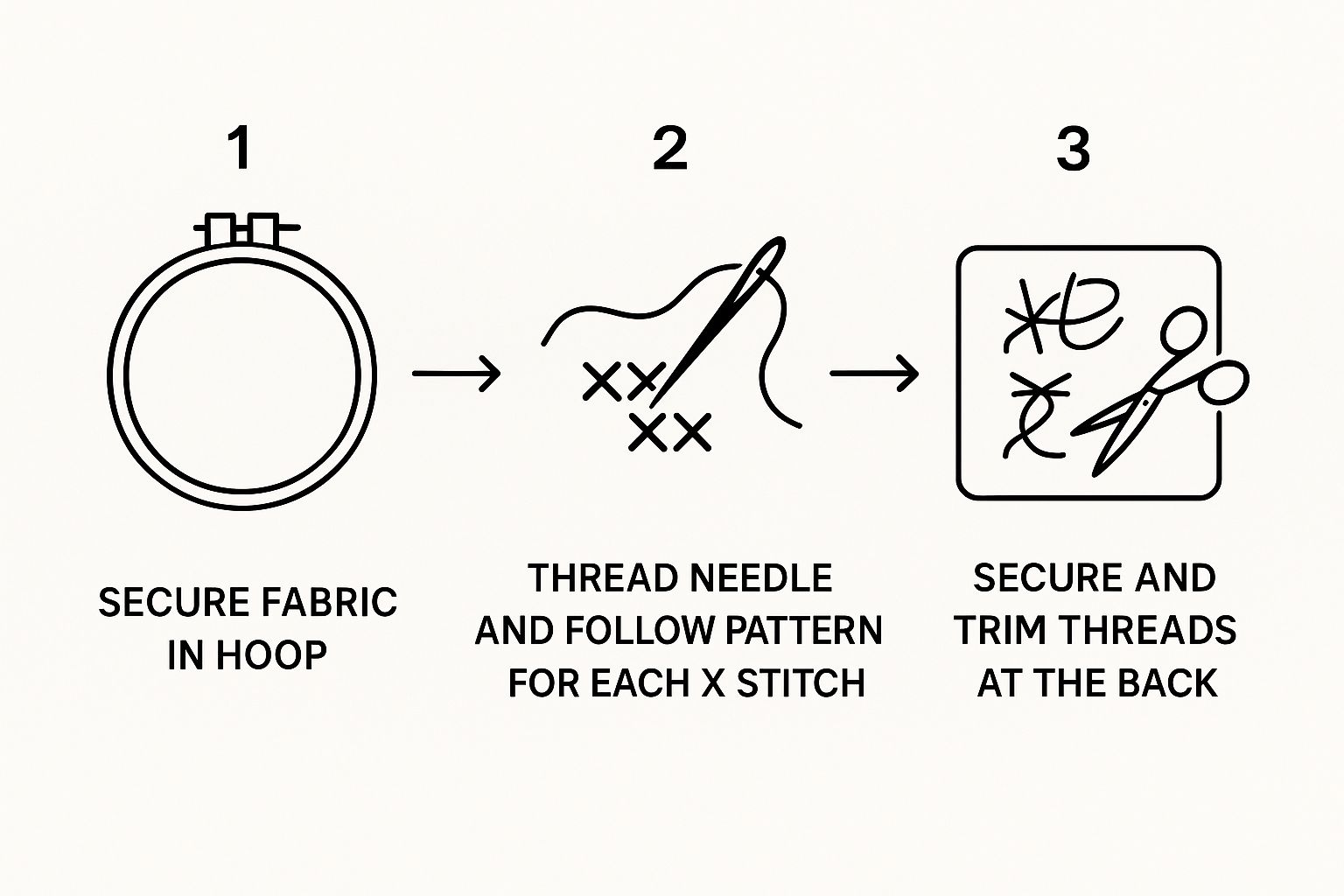
As you can see, it’s just a sequence of simple, manageable actions from the moment you set up to that final, satisfying stitch.
Securing Your Thread Neatly
One of the best habits you can form right from the start is securing your threads without using bulky knots. Knots create little bumps on the back that can actually show through on the front of your work. Nobody wants that!
Instead, when you start a new thread, just leave a small tail—about one inch is perfect—on the back of your fabric. As you make your first few stitches, just make sure you’re stitching right over that tail. This anchors it flat against the fabric, no knot needed.
When you're ready to end a thread, simply run your needle under the last three or four stitches on the back before snipping the thread close. It's that easy.
This knotless method is a total game-changer for beginners. It helps keep the back of your project almost as neat as the front and makes sure your finished piece will lie perfectly flat when it’s time to frame it. You can build even more confidence by diving deeper into our guide on basic cross stitch stitches.
What Makes a Project More Challenging
While the humble "X" stitch is beautifully simple, the real magic of cross-stitch is how it lets you grow. Once you've got the hang of the basics, you'll naturally start looking for your next challenge. Knowing what makes a project trickier isn't meant to be a warning—it’s more like a roadmap for your stitching journey.
Think of it like leveling up in a video game. You wouldn’t jump straight to the final boss, right? You start on an easier setting and work your way up. In cross-stitch, that "difficulty setting" is determined by a few key things that build on the skills you already have.
The biggest jumps in difficulty usually come down to three things: the fabric you use, how complex the pattern is, and the variety of stitches involved. Getting comfortable with these is what turns a simple hobby into a way to create truly stunning art.
One of the first things you'll run into is fabric count. This number just tells you how many stitches you can fit into one inch of fabric. Most beginners start with a friendly 14-count Aida cloth, but moving to an 18-count or even a 28-count linen makes your stitches much smaller and finer. It's a fantastic way to get more detail, but it definitely demands more precision.
Navigating More Intricate Designs
Beyond the fabric itself, the pattern is the other big piece of the puzzle. As you start eyeing more advanced charts, you’ll notice a few things that signal a more involved project. They aren't necessarily harder in a technical sense, but they do require more focus and patience.
- Lots of Color Changes: A design that calls for dozens of colors means you'll be stopping, changing your thread, and starting again far more often.
- "Confetti" Stitches: Picture single, isolated stitches of one color scattered around like sprinkles. These little guys require very careful counting and can really slow down your flow.
- Specialty Stitches: Many patterns go beyond the standard "X" to add texture and detail. Learning how to make French knots for tiny eyes or using backstitching to create sharp outlines are common next steps for any stitcher.
Once you know what to look for, you can size up a pattern's difficulty at a glance. This helps you skip the frustration and pick complex cross stitch patterns that are the perfect next step for your skills.
Why This Simple Hobby Is So Rewarding
There's something incredibly soothing about the simple, repetitive motion of making tiny 'X's. In a world that's constantly buzzing with notifications and distractions, cross-stitch is a quiet rebellion. The gentle rhythm of pulling thread through fabric is a form of active mindfulness—it gives your hands something to do, which in turn helps calm a busy mind and melt away stress.
But it’s more than just a way to relax. There's a deep, genuine satisfaction that comes from creating something beautiful and tangible with your own two hands. You’re not just mindlessly following a chart; you're bringing a piece of art to life, whether it's a classic floral pattern or a witty quote that makes you laugh.
A Craft for Personal Expression
Let's be clear: this isn't your grandmother's hobby anymore (unless your grandma was way ahead of her time). Cross-stitch has exploded with fresh, modern designs that cover every imaginable interest and personality.
This isn't just a feeling, either—the numbers back it up. Between 2015 and 2017, needlecraft participation among women jumped by 12%, and big retailers expanded their cross-stitch selections by 25% just to keep up. It's a craft that's found its place in the modern world, as you can see from a closer look at how popular cross stitch has become.
Cross stitch has become a vibrant way to express yourself. It’s a simple, affordable escape from the digital noise, letting you reconnect with your own creativity, one stitch at a time.
It's that unique blend of relaxation and creative freedom that makes this hobby so special. You get to de-stress while making something that is one hundred percent you.
A Few Common Questions From New Stitchers
Even with a craft as welcoming as cross stitch, a few questions always seem to pop up for newcomers. Getting these sorted out early can make that first project feel so much more enjoyable and a lot less intimidating.
Let's clear up some of the common hurdles so you can start stitching with total confidence.
What’s the Difference Between Cross Stitch and Embroidery?
This is a classic! Think of it like this: all cross stitch is a type of embroidery, but not all embroidery is cross stitch. It's like how a square is a rectangle, but not all rectangles are squares.
The key difference is that cross stitch almost always uses just one type of stitch—a little ‘X’—repeated over a special gridded fabric. This creates images that look a bit like pixel art. General embroidery, on the other hand, is a whole world of different stitches (satin stitch, French knots, chain stitch, you name it!) used on all kinds of fabric to create flowing lines, solid fills, and interesting textures. Most people find cross stitch easier to start with because you only really need to learn that one simple stitch.
Cross stitch is basically a specialized, structured form of embroidery. Its reliance on a single stitch and a gridded canvas takes a lot of the guesswork out, making it a perfect first step into the world of needlecraft.
How Do I Choose My First Cross Stitch Kit?
When you're just starting out, keep it simple! Look for kits specifically labeled "Beginner" or "Easy." A good first kit will have a relatively small design and won't overwhelm you with a ton of different thread colors—somewhere under 10-15 colors is a great starting point.
Pay attention to the fabric, too. Look for kits that include 14-count Aida fabric. The count number refers to how many squares there are per inch, and 14 is a fantastic size for beginners because the holes are large and easy to see. The best part is that these kits come with everything you need—the fabric, all the thread, a needle, and the pattern—so you can just open the box and get started.
What Is the Most Common Beginner Mistake?
By far, the most common slip-up is getting your stitch direction mixed up. To get that beautiful, uniform look, all of your top stitches should slant in the same direction (for example, all going from bottom-left to top-right). It sounds small, but it makes a huge difference in the final piece.
Another classic beginner move is pulling the thread too tight. This can warp and pucker the fabric, making it look bunched up. You're aiming for just enough tension to let the stitch lie flat and smooth without distorting the grid. It’s a gentle touch, not a tug-of-war!
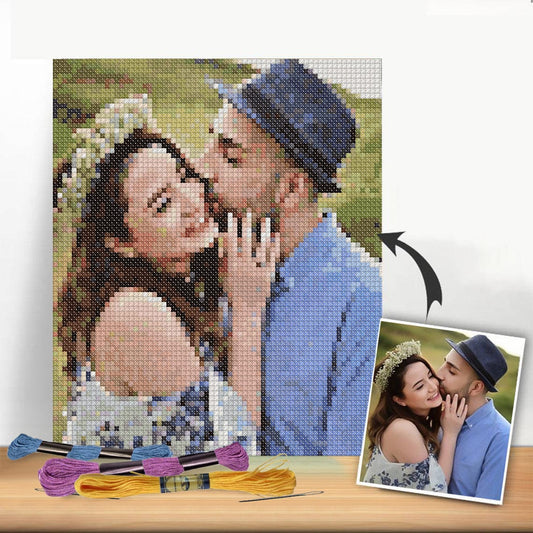
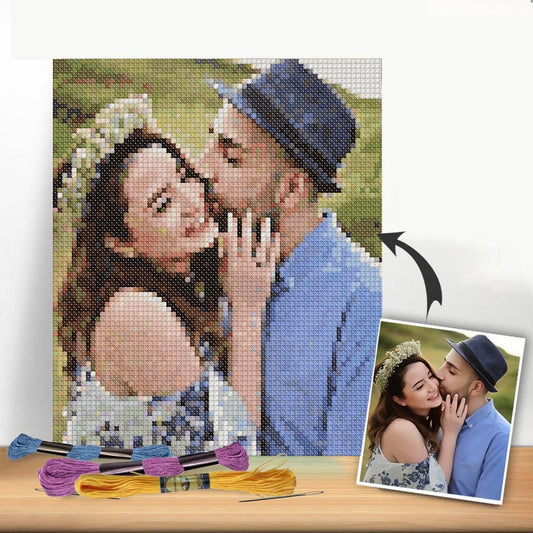
Ready to turn a favorite photo into a work of art? Cross Stitched makes it easy to create a custom kit from any picture you love. Start your personalized cross stitch project today and get everything you need delivered right to your door.