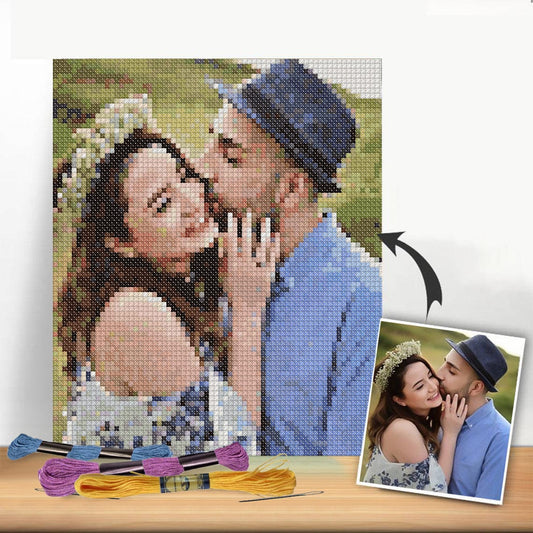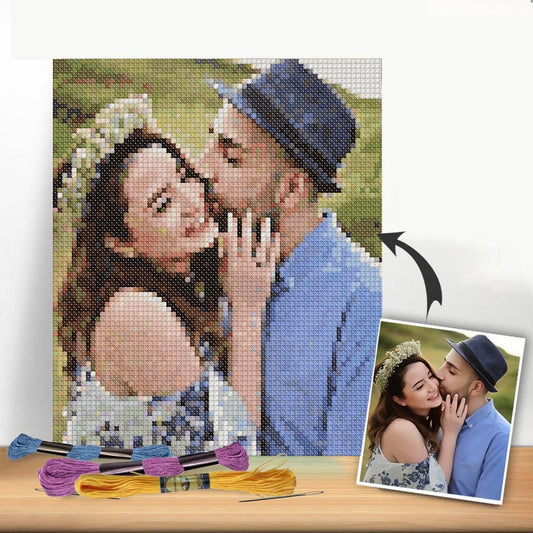
If you've ever looked at a finished cross-stitch piece and admired its sharp lines and tiny, perfect details, you've seen the magic of backstitching. It's the technique that transforms a collection of colorful 'X's into a crisp, defined picture. Think of it as the inking stage in a comic book—it adds the final outlines that make everything pop.
What Exactly Is Backstitching?
Imagine your cross-stitch pattern is like a coloring book. The cross stitches are the vibrant crayons you use to fill in the large areas, creating beautiful blocks of color and texture. But without outlines, those colors can sometimes blur together.
That’s where backstitching comes in. It acts like a fine-tipped pen, drawing the sharp lines, delicate text, and small details that give your work a polished, professional look. It turns a soft, pixelated image into a clear and readable piece of art.
How The Stitch Works
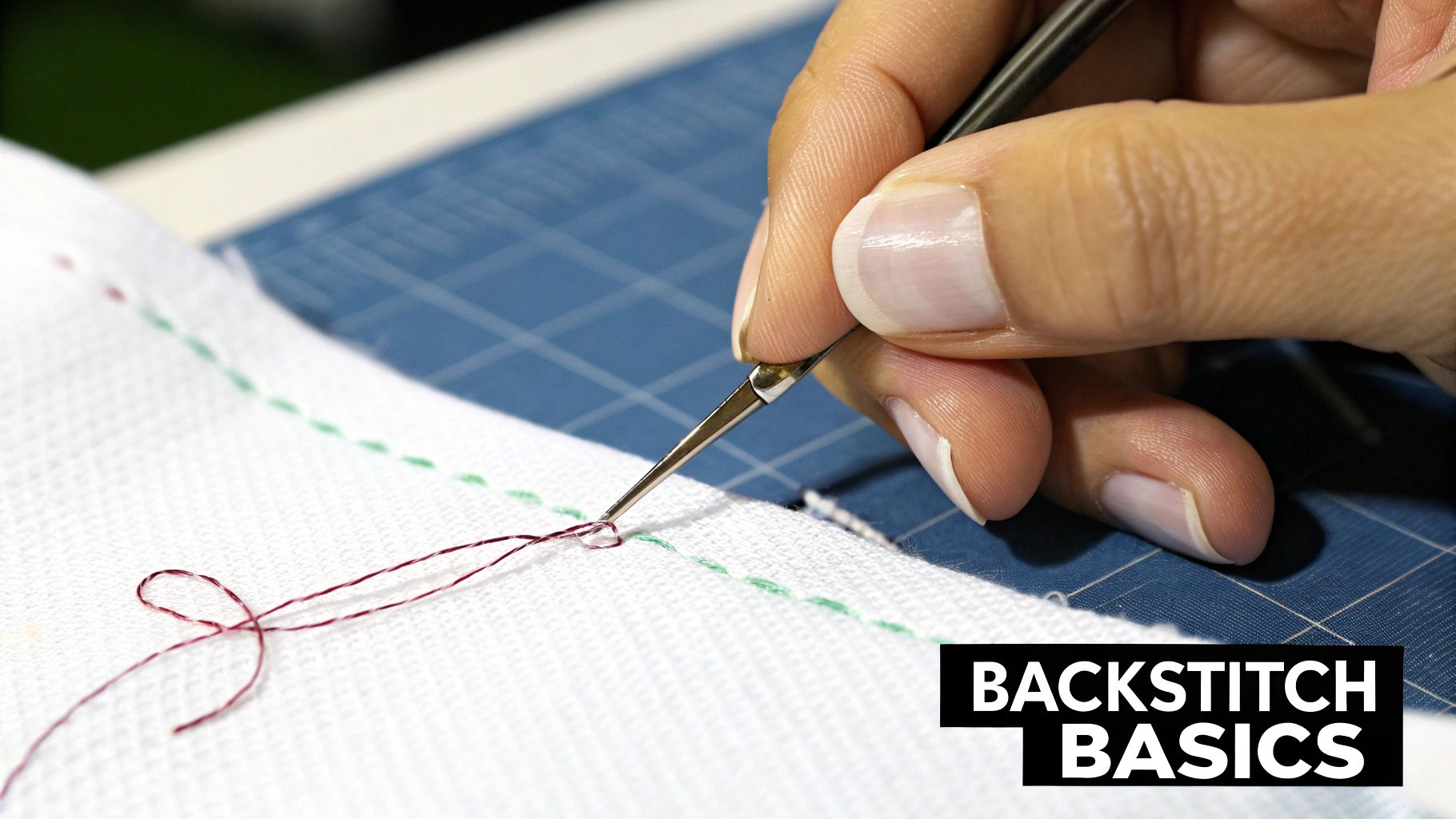
The name "backstitch" gives you a perfect clue about how it’s done. To create a solid line, you bring your needle up through the fabric a little ahead of your last stitch, then you go back down into the very same hole where that previous stitch ended. This simple "backwards" motion creates a strong, continuous line moving forward. It’s surprisingly simple but incredibly effective.
This technique isn't new; it's one of the oldest and most trusted stitches around. For centuries, it was used not just for decoration but for its strength, forming durable seams on clothes and tapestries long before sewing machines existed.
The real power of the backstitch is its ability to direct the viewer’s eye. It highlights key features, separates similar colors, and adds a layer of dimension that makes a design truly stand out from the fabric.
To give you a quick overview, here’s a simple breakdown of what backstitching is all about.
Backstitching At A Glance
| Characteristic | Description | Primary Use In Cross-Stitch |
|---|---|---|
| Appearance | A solid, continuous line resembling a pen stroke. | Creating outlines and defining shapes. |
| Technique | Stitching "backwards" to connect stitches seamlessly. | Adding fine details like lettering, eyes, or whiskers. |
| Strength | Very strong and durable. | Securing fabric and adding structural integrity. |
| Function | Adds clarity, contrast, and a finished look. | Separating similar colors to prevent them from blending. |
Ultimately, backstitching is what gives your work that final, professional touch.
The Visual Impact On Your Project
A pattern without backstitching can sometimes look a bit fuzzy or incomplete. Once you add those defining lines, you'll see a huge difference.
- It Creates Sharp Outlines: Backstitching clearly defines the edges of everything, from the gentle curve of a flower petal to the distinct shape of a character.
- It Adds Intricate Details: It’s the go-to stitch for all the small but vital elements—facial features, tiny text, and the delicate veins on a leaf.
- It Makes Text Readable: If your pattern has names, dates, or quotes, backstitching ensures the words are crisp and easy to read from a distance.
- It Provides Depth And Contrast: It's fantastic for creating a boundary between two similar colors that might otherwise merge, adding a sense of depth to the piece.
By getting comfortable with this stitch, you gain the power to elevate your projects from good to great. To learn more about other essential techniques, you can explore our guide on the 7 different types of embroidery stitches.
When To Use Backstitching For Maximum Impact
Knowing how to form a backstitch is one thing, but knowing when to use it is what truly elevates your work. Think of backstitching as the secret ingredient that transforms a soft, pixelated design into a sharp, polished piece of art. It’s what gives your projects that professional finish that cross stitches alone just can't provide.
While the cross stitches create the beautiful, colorful body of your design, the backstitching draws the clean, crisp lines that bring it to life. It’s the final, defining touch.
Adding Definition And Clarity
The number one job of a backstitch is to outline shapes and add detail. It's the stitch you reach for when you need to draw a sharp line around a flower petal or define the silhouette of a building against the sky. This becomes absolutely essential in a few key areas:
- Facial Features: A handful of carefully placed backstitches can create expressive eyes, a subtle smile, or capture a character's entire personality.
- Sharpening Text: If your pattern includes names, dates, or quotes, backstitching is what makes the lettering pop and ensures it's perfectly readable.
- Separating Colors: When two similar shades sit side-by-side, they can visually blend into a single blob. A backstitch outline creates a clean separation and much-needed contrast.
Without these lines, crucial elements can get lost in the sea of colored X’s. Backstitching is how you guide the viewer's eye and tell it exactly what's important.
Creating Delicate Details
Beyond just outlining, this versatile stitch is a master at creating the fine, linear details that would be clumsy or impossible to achieve with bulky cross stitches. It’s perfect for rendering all those little elements that give a design its unique character.
Just think of all the places it shines:
- Whiskers on an animal
- Delicate stems on a flower
- Intricate veins in a leaf
- The rigging on a sailboat
This level of precision is especially vital in custom photo-to-pattern kits, like the ones you can create with our Pic2Pat generator. These personalized patterns depend on backstitching to capture the unique lines of a photograph—making sure the defining features of a loved one's face or the specific silhouette of a pet aren't lost in the grid.
The strategic use of backstitching is what truly brings a cross-stitch project to life. It’s the difference between a collection of colored squares and a recognizable, dynamic image.
It's also worth noting how this technique fits into bigger trends. Globally, market analysis shows that 36% of embroidery firms are expanding into sustainable fibers, often pairing detailed, backstitched designs with eco-friendly Aida for popular seasonal projects. You can learn more in this embroidery market report. By knowing exactly when to add those final outlines and details, you can make sure every single project you create has the most powerful visual impact possible.
A Step-By-Step Backstitch Tutorial
Alright, are you ready to bring your cross-stitch project to life with those sharp, defining lines? Let's walk through the backstitching process together. I'll break it all down into simple steps, from getting your thread started to stitching lines that look clean and professional.
Getting Your Workspace Ready
Before you even think about making that first stitch, a little prep work goes a long way. Trust me, getting everything in order first makes the entire process smoother and more fun.
- Gather Your Tools: Grab your cross-stitch project, the pattern chart that shows the backstitching, and your embroidery floss. Most patterns call for a single strand, but always double-check. You'll also need a sharp needle and a good pair of scissors.
- Secure Your Fabric: Pop your fabric into an embroidery hoop or a Q-snap frame. Keeping the fabric taut is the #1 secret to getting beautifully even stitches and avoiding any frustrating puckers.
- Thread Your Needle: Cut a comfortable length of floss—about 18 inches is perfect. Any longer, and it tends to tangle. Thread your needle, but don't tie a knot at the end. We’ll use a much neater trick to anchor it.
With this quick setup out of the way, you’re ready for the main event.
The Basic Backstitch Process
Now for the fun part! The magic of the backstitch is that you work backwards to move forwards, creating a solid, continuous line. It sounds a bit odd, but you'll get the hang of it in no time.
Here’s how it works:
- Start Your Thread: From the back of your fabric, bring the needle up at your starting point. Just leave a little tail of thread on the back. As you make the next few stitches, you'll simply catch that tail underneath them. This anchors your thread securely without a lumpy knot.
- Make the First Stitch: Move your needle forward over one or two squares of fabric (this is your stitch length) and push it back down. That's it! First stitch, done.
- Go Backwards to Move Forwards: Now, bring your needle up again, one stitch length ahead of where that first stitch ended. Here's the key move: bring the needle back down into the exact same hole where your previous stitch ended. This is the "back" in backstitch, and it’s what connects your stitches into a clean line.
- Keep the Line Going: Just keep repeating that motion. Come up one stitch length ahead, then go back down into the end of the last stitch. You'll quickly see a strong, seamless line start to form.
- Secure the End: Once you've finished a line, flip your work over. Weave your needle under the last few stitches you made on the back to lock it in place, then snip the thread.
This diagram really helps visualize where backstitching fits into the whole process.
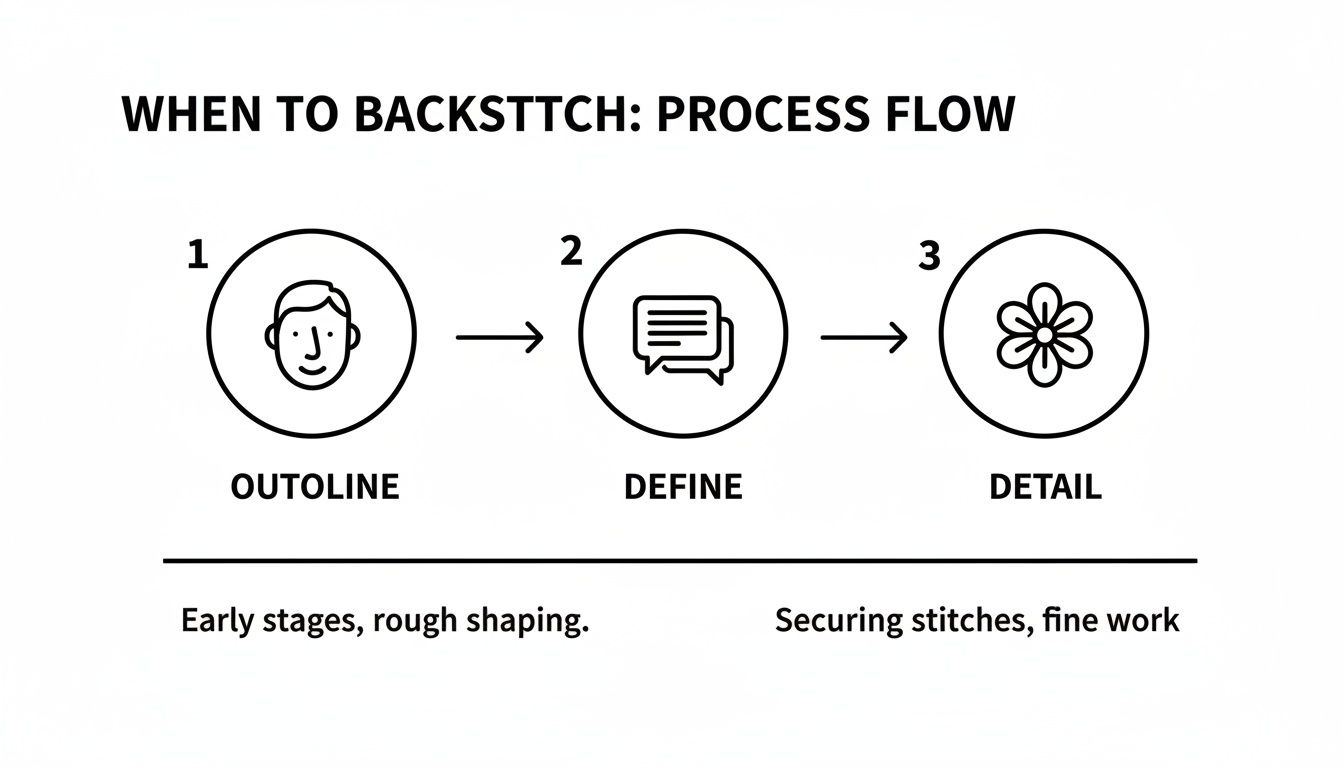
As you can see, backstitching is that final, transformative step. It’s what you use to outline shapes, define lettering, and add all those delicate details after the main cross-stitches are in place.
Pro Tip: When you're stitching curves, use shorter stitches to keep them looking smooth and rounded. For crisp, sharp corners, make sure one stitch ends right in the corner hole, then start the next stitch in that very same hole as you change direction.
Backstitch Variations To Try
Once you've got the basic stitch down, you can start playing with a few variations to create different textures and effects.
- Holbein Stitch (or Double Running Stitch): This clever stitch creates a line that looks exactly the same on the front and back of your fabric. You start by making a simple line of running stitches, then you work your way back, filling in all the gaps.
- Whipped Backstitch: This one adds some real pop. First, you lay down a standard line of backstitch. Then, with a new thread (this is a great place to use a contrasting color), you "whip" or wrap it around each backstitch without ever piercing the fabric. The result is a bold, rope-like line that stands out.
Getting comfortable with these steps will make a huge difference in how polished your projects look. If you’re hungry for more, check out our complete guide on how to backstitch in cross-stitch projects for even more advanced techniques.
Choosing The Right Threads And Needles
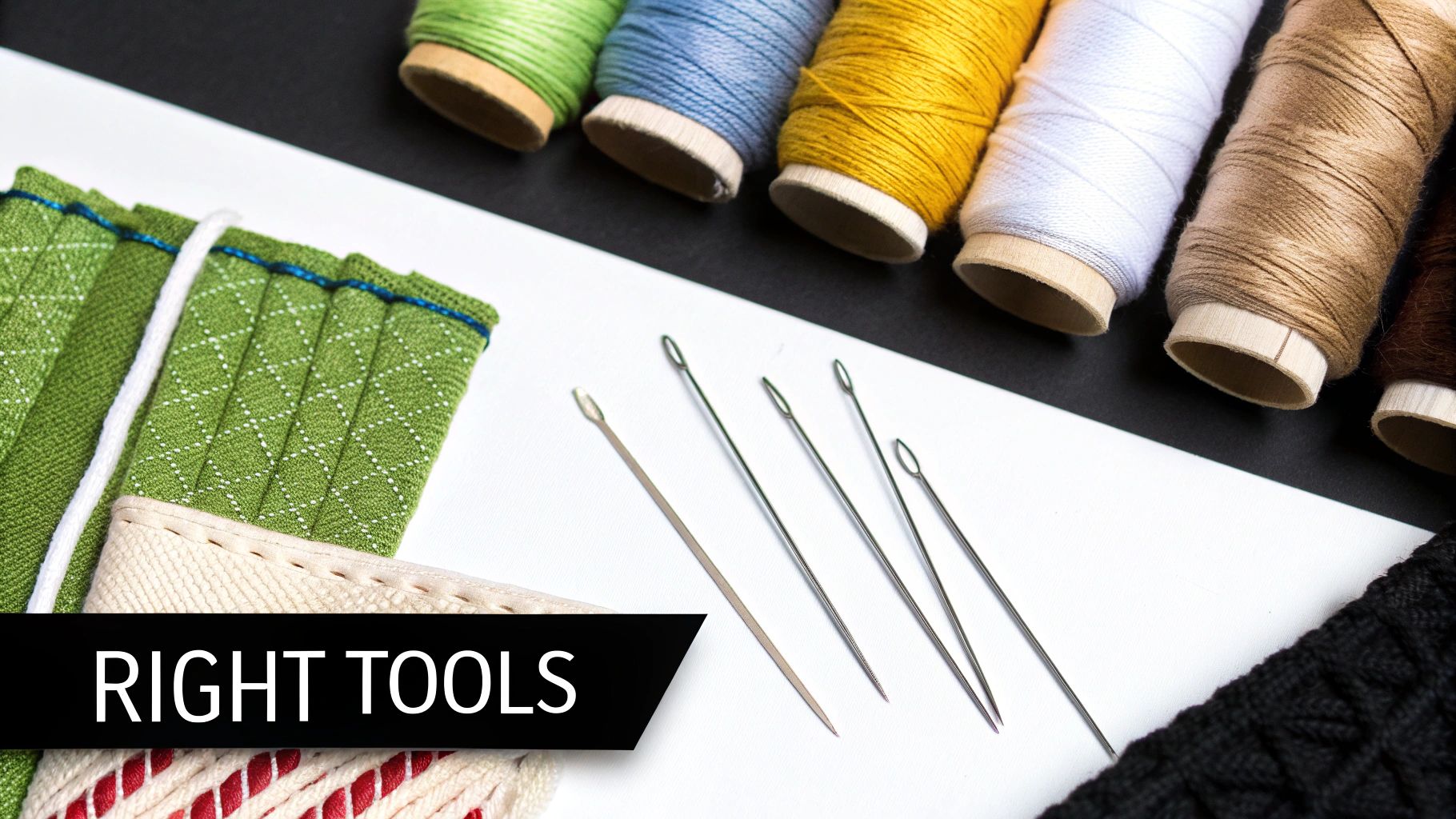
The final look of your backstitching really comes down to the tools you have in your hands. Think of it like a painter choosing the right brush—the thickness of the bristles determines the kind of line they can create. For us stitchers, getting that line just right depends entirely on our thread and needle. This is where good work becomes great work.
The first big decision is always about the thread. Standard embroidery floss, like the kind you get from DMC, is made up of six little strands twisted together. The magic is that you can separate them to control how thick or thin your backstitch lines are.
For backstitching, most patterns call for just one strand of floss. This gives you a lovely, fine line that's perfect for adding detail without overpowering your cross stitches.
This single-strand technique is my go-to for things like facial features, tiny lettering, or the delicate veins on a leaf. But what if you need something to stand out? Using two strands creates a much bolder, more defined outline that really makes certain parts of your design pop.
Matching Needles To Your Fabric
Just as important as your thread is the needle you pair it with. Grab a needle that's too big, and you'll leave behind noticeable holes in your fabric. Go too small, and you'll be fighting to thread it, and it might even bend on you.
The trick is to match your needle size to the count of your fabric. Higher-count fabrics, like 18-count Aida, have a tighter weave, so you need a smaller, thinner needle—think a size 26 or 28. For a more open weave like 14-count Aida, a slightly larger size 24 needle is your best bet.
Here’s a quick reference I always keep in mind:
- 14-Count Aida: Use a size 24 tapestry needle.
- 16-Count Aida: Use a size 26 tapestry needle.
- 18-Count Aida or Higher: Use a size 28 tapestry needle.
When you get this right, the needle glides through the fabric’s holes without a fight. If you want to dive deeper, our guide on selecting embroidery hand needles has even more tips. By pairing the right number of strands with the perfect needle, you're setting yourself up for clean, crisp lines every single time.
Of course! Here is the rewritten section, designed to sound natural and human-written, as if from an experienced stitcher.
How To Fix Common Backstitching Mistakes
Even seasoned stitchers hit a snag now and then. Don't think of backstitching mistakes as failures—they're just little puzzles that help you sharpen your technique. Once you learn to spot and fix these common frustrations, you'll gain a ton of confidence and get that polished, professional look you’re after.
Most issues boil down to just a few things, and the good news is, they’re all easy to correct. Let's walk through the most common problems and I'll give you some simple, practical ways to get your lines looking sharp and clean.
Why Are My Stitches Uneven or Wobbly?
This is probably the number one headache for stitchers, and it almost always comes down to inconsistent tension. If your fabric is too loose, it’s all too easy to pull some stitches tighter than others. The result? A wobbly, uneven line that just doesn't look crisp.
The absolute best way to solve this is to use an embroidery hoop or a Q-snap frame.
- How to Fix It: Always, always secure your fabric in a hoop before you start backstitching. A hoop keeps the fabric drum-taut, which helps you apply the same amount of tension to every single stitch. This simple tool is honestly your greatest ally for creating those smooth, uniform lines.
What Causes Loose Loops on the Back?
Ever flipped your project over and found a tangled mess of loose loops? This usually happens when you carry your thread too far across the back of your fabric between two separate backstitched sections. These long strands can easily snag or just refuse to lie flat.
Pro Tip: As a rule of thumb, try not to carry your thread more than two or three cross stitches away on the back. It might feel faster at the moment, but it often creates more problems than it solves, leading to a messy-looking back and wonky tension on the front.
- How to Fix It: When sections are far apart, it’s always better to end your thread and start a new one. This keeps the back of your work tidy and makes sure the tension on the front stays consistent, preventing any puckering or pulling.
Navigating Tricky Corners and Curves
Are your sharp corners looking a bit soft? Are your smooth curves looking... not so smooth? This is a classic case of your stitch length being too long for the shape you’re trying to create. A long stitch just can't bend gracefully around a tight curve or pivot neatly at a corner.
- How to Fix It: For curves, shorten your stitch length—a lot. Using tiny stitches will create a much smoother, more natural-looking arc. For sharp corners, make sure one stitch ends precisely in the corner hole, then start the next line from that very same hole as you change direction.
Nailing these fixes is a game-changer, especially for detailed projects like personalized photo-to-pattern kits. For the Cross Stitched community, using this technique in all-in-one kits with Aida and DMC threads is a huge reason for our 95% customer satisfaction in reviews. In fact, industry stats show a 31% growth in custom services, where good backstitching prevents 25-30% of the most common errors in beginner projects. If you're curious, you can dive deeper into these trends in the latest embroidery market research.
Even with the best advice, sometimes you just need a quick cheat sheet. Here's a little table to help you quickly diagnose and solve any backstitching issues you run into.
Backstitching Troubleshooting Guide
| Common Problem | Potential Cause | Solution |
|---|---|---|
| Wobbly or Uneven Lines | Inconsistent tension from loose fabric. | Always use an embroidery hoop or Q-snap frame to keep fabric taut. |
| Loose Loops on the Back | Carrying the thread too far between sections. | End the thread and start a new one for sections more than 2-3 stitches apart. |
| Jagged Curves | Stitches are too long to create a smooth arc. | Use shorter, smaller stitches to follow the curve more accurately. |
| Soft or Rounded Corners | Not ending a stitch precisely in the corner. | End one stitch directly in the corner hole, then begin the next stitch from the same hole. |
| Puckered Fabric | Pulling the backstitch thread too tight. | Relax your tension slightly. The thread should lie flat on the fabric, not pull it. |
Think of this table as your go-to guide whenever something looks a little off. A quick glance can often point you right to the solution and get you back to stitching smoothly.
Your Backstitching Questions Answered
Even after you've nailed the basics, a few questions always seem to pop up when it's time to add those finishing lines. I've gathered the most common ones I hear from stitchers right here, so you can get quick, clear answers and get back to your project with confidence.
We'll cover when to do your backstitching, how many strands of thread to use for the best effect, and what to do when your lines look a little... wobbly. Getting these details right is what really makes a finished piece sing.
Should I Do Backstitching Before Or After Cross Stitches?
The answer is almost always: do it last. Think of it like inking a pencil drawing. You do all the coloring first, and then you add the clean, defining outlines over the top.
When you finish all your cross stitches first, you create a nice, solid canvas for the backstitch to sit on. This helps your lines look crisp and clean. If you try to backstitch first, you'll find your beautiful lines get buried or distorted as you fill in the cross stitches around them. They can even get snagged by your needle, which is incredibly frustrating.
The only exception is if a pattern specifically tells you to outline a section first, but that’s pretty rare.
For the best results, stick to the golden rule of cross-stitch: color first, outline last. This one tip will make a huge difference in how polished and professional your work looks.
Waiting until the end also gives you the full picture. You can see the whole design and know exactly where those final lines will have the most impact.
How Many Strands Of Thread Should I Use For Backstitching?
This is a great question because the number of strands you use completely changes the look of your outline. It controls the thickness—the visual "weight"—of the line. The first place to look is always your pattern's key; it should tell you exactly what the designer intended.
But what if it doesn't? The unofficial standard is one strand of floss. This creates a delicate, fine line that's perfect for adding subtle detail without overpowering your cross stitches. Think facial features, tiny text, or the whiskers on a cat.
If you want a bolder look, or need certain elements to really pop, two strands is your best bet. This works wonders for outlining the main subject of your piece or for creating lettering that's easy to read. A little tip: if you're unsure, start with one strand. You can always go back over it to make it thicker. It's much harder to take out a two-strand stitch that you decide is too heavy.
Why Do My Backstitch Lines Look Uneven Or Jagged?
Ah, the dreaded jagged line. This is a super common frustration, but the good news is it's usually caused by just two culprits: inconsistent stitch length and uneven tension. Both are fixable.
First, let's talk about stitch length. For straight lines, try to keep your stitches consistent, covering just one or two squares of Aida at a time. The real trick is with curves. For a smooth, graceful arc, you need to shorten your stitches. Tiny stitches will create a beautiful curve, while long stitches will give you a series of sharp, jagged angles.
Second—and this is the big one—you absolutely need to use an embroidery hoop or a Q-snap frame. This isn't optional if you want smooth lines.
- How a Hoop Helps: It keeps your fabric perfectly taut. When the fabric is held firm, it’s much easier to pull each stitch through with the same amount of pressure. This consistent tension is the secret ingredient for preventing those wobbly, loose, or too-tight stitches that make a line look messy.
If you're still struggling, grab a scrap piece of fabric and just practice. A few minutes of doodling with backstitch will help you build the muscle memory for smooth, confident lines.
Ready to turn your favorite photos into timeless keepsakes? At Cross Stitched, our custom kits provide everything you need—pre-sorted DMC threads, high-quality Aida fabric, and a personalized pattern—to create a beautiful piece of art. Start your next project today and stitch your memories to life.
Create Your Custom Cross-Stitch Kit Now