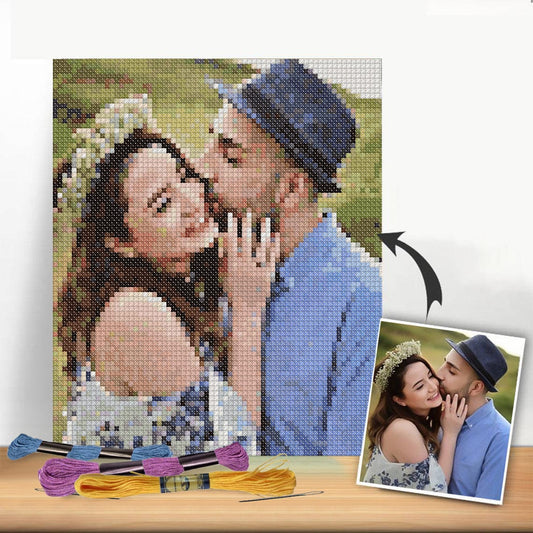
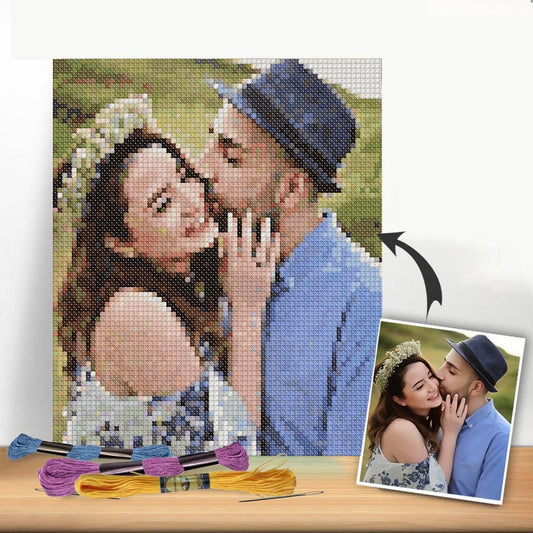
If you've ever admired a cross stitch piece with a flawlessly smooth background where the stitches seem to float on the fabric, you were likely looking at evenweave. It's a beautifully refined material, cherished by stitchers for the professional finish it gives to any project.
What Exactly Is Evenweave Cross Stitch Fabric?
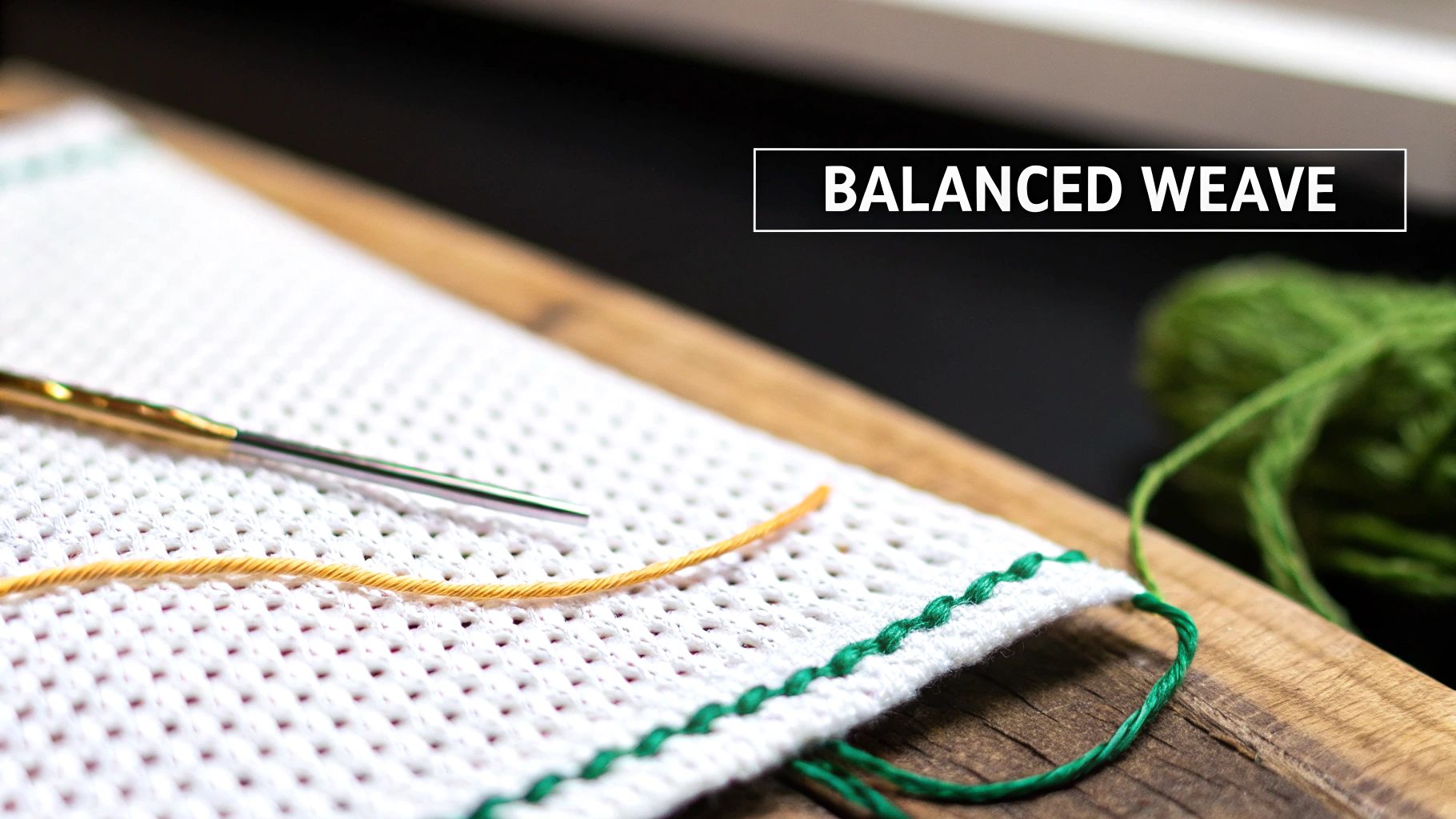
Think of Aida fabric as a learning grid—its blocky structure and obvious holes are perfect when you're just starting out and need help counting. Evenweave, on the other hand, is like a smooth, silky canvas. The grid is still there, but it's formed by the individual threads of the fabric itself, which is what gives it such a sophisticated look.
The name "evenweave" tells you everything you need to know. It’s woven with a perfectly even number of single threads per inch, both vertically and horizontally. This tight, consistent weave creates a surface without the distinct holes of Aida, letting your beautiful stitches take centre stage.
Popular Types of Evenweave
Walk into any needlework shop, and you'll hear two names pop up again and again: Lugana and Jobelan. These aren't just brand names; they're specific fabric blends, each with its own personality.
- Lugana: Usually a mix of cotton and viscose (rayon), Lugana is incredibly soft to the touch and has a wonderful drape. It’s a go-to choice for projects that will be framed or displayed as decorative art.
- Jobelan: This is typically a cotton and modal blend, and it’s known for its lovely subtle sheen and impressive resistance to wrinkling. That durability makes it fantastic for items that will see some use, like cushions, tote bags, or even accents on clothing.
Fabrics like these are the foundation of the needlecraft world. In fact, the global market for needlecraft patterns is valued at an incredible USD 34,026.8 million in 2025 and is expected to climb to USD 63,872.9 million by 2035. This boom shows just how much people around the world love creating high-quality, detailed crafts. You can learn more about the rising popularity of needlecraft patterns and the community driving this trend.
The secret to evenweave's elegance lies in its single-thread construction. Unlike Aida, where you stitch from hole to hole, on evenweave you typically stitch "over two" threads. This technique creates stitches that sit beautifully on top of the fabric rather than sinking into it.
Stitching "over two" is what opens the door to a world of intricate detail. It makes techniques like fractional stitches—which are tricky on blockier fabrics—much easier to execute, resulting in a smoother, more polished final piece. When you choose evenweave, you're not just picking fabric; you're deciding to turn your project into a potential heirloom.
Evenweave vs. Aida and Linen: A Practical Comparison
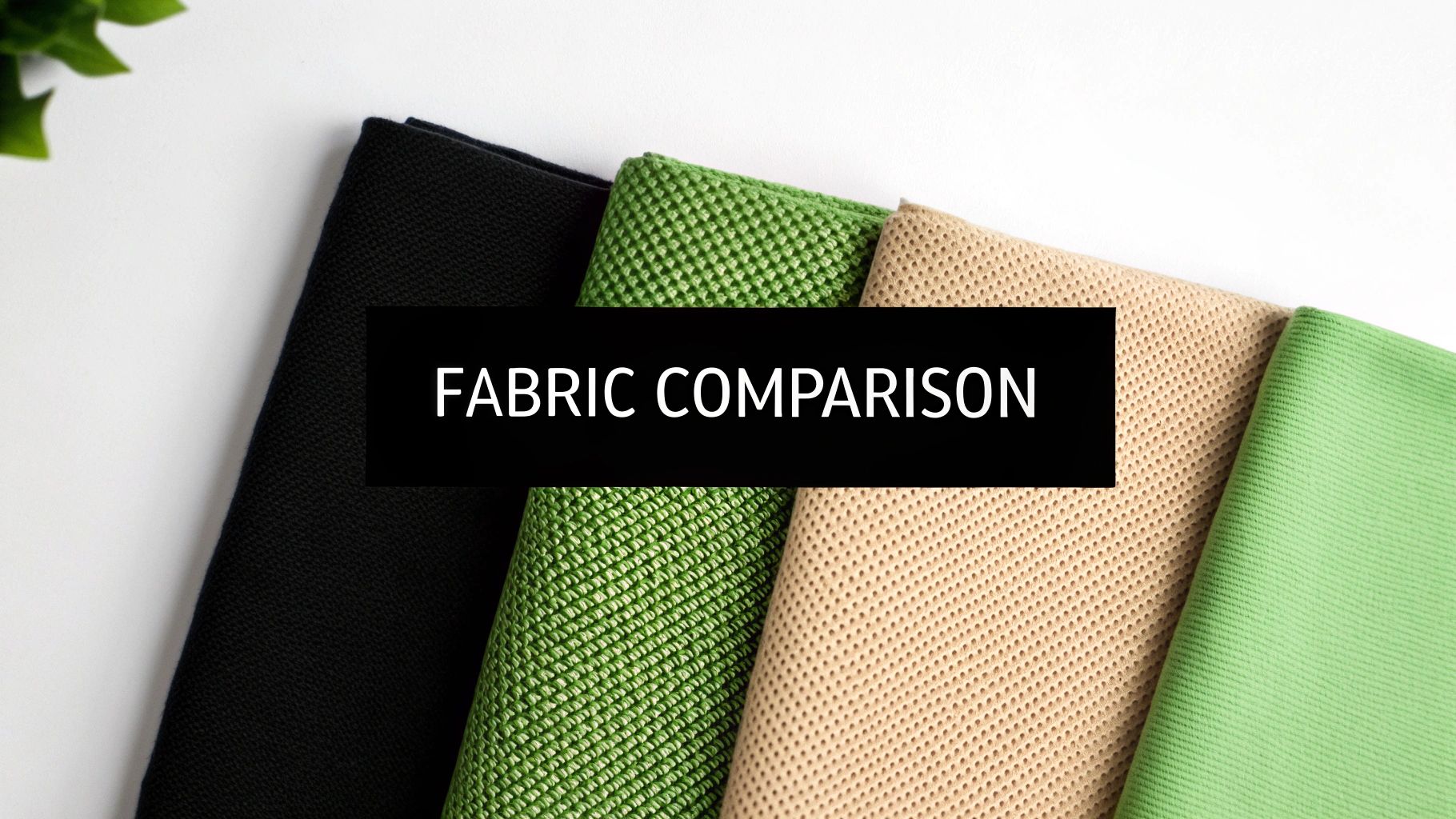
Picking the right fabric is one of the first, and most important, choices you'll make for a new cross-stitch project. It shapes not just how your finished piece looks, but how you feel stitching it every step of the way. Think of Aida, evenweave, and linen as different canvases for your thread painting—each one brings out a different quality in your work.
For many, Aida is the familiar starting point, with its clear grid and easy-to-follow structure. Evenweave is the next step up, offering a much smoother canvas, while linen provides that classic, rustic texture perfect for creating a future heirloom.
Comparing The Weave
The real difference between these fabrics comes down to how they're made.
Aida fabric has a very distinct construction. It's woven with little bundles of thread that create obvious squares, with a visible hole at each corner. This grid-like structure makes it incredibly easy to see exactly where to place your stitches, which is why it’s a go-to for anyone just starting out.
Evenweave cross stitch fabric, just like its name implies, is woven with a single thread over and a single thread under, creating a perfectly balanced, or "even," grid. There are no blocks, just a smooth, uniform surface. This gives your finished project a much more refined look, where the stitches seem to blend into the fabric rather than sitting on top of a grid.
Linen is technically an evenweave fabric too, but it's woven from natural flax fibres. These fibres aren't perfectly uniform; they have tiny variations in thickness called "slubs." Don't mistake these for flaws! These slubs are what give linen its organic character and beautifully textured appearance, a quality cherished by many experienced stitchers. If you're fascinated by natural materials, you can delve deeper into linen fabrics to see what makes them so special.
How You Stitch On Them
Your stitching technique will change depending on the fabric you choose. On Aida, it’s simple: you stitch from one corner hole to the next within each square. It’s direct, easy to count, and very straightforward.
With evenweave and linen, the standard approach is stitching "over two" threads. This means each leg of your cross stitch spans over two fabric threads instead of one block. It might sound complicated, but it's this technique that makes all the difference. For example, stitching "over two" on a 28-count evenweave will produce stitches that are the exact same size as stitching on 14-count Aida. It just takes a little more focus.
Stitching "over two" is the key to unlocking the true beauty of evenweave and linen. It's what allows for more advanced techniques like fractional stitches (quarter and three-quarter stitches), which are absolutely necessary for creating smooth curves and fine details in complex patterns.
Let's break down the key differences in a simple table.
Fabric Comparison: Aida vs. Evenweave vs. Linen
| Feature | Aida | Evenweave | Linen |
|---|---|---|---|
| Weave | Block weave with distinct holes | Single-thread, smooth grid | Single-thread, with natural slubs |
| Material | 100% Cotton | Cotton/Rayon blend (e.g., Jobelan, Lugana) | 100% Flax |
| Feel | Stiff, firm | Soft, pliable, smooth | Soft, textured, drapes beautifully |
| Stitching Method | Over 1 block | Typically over 2 threads | Typically over 2 threads |
| Best For | Beginners, full-coverage designs | Intermediate/advanced, detailed patterns | Advanced, heirloom projects, samplers |
| Fractional Stitches | Difficult | Easy | Easy |
Ultimately, each fabric has its place in a stitcher's toolkit. The choice depends entirely on what you want to achieve with your project.
The Best Uses For Each Fabric
Matching the fabric to the project is where the magic happens. While our comprehensive guide on selecting the best fabric for cross stitch goes into more detail, here’s a quick rundown:
- Aida: The undisputed champion for beginners. Its easy-to-see grid is perfect for learning, tackling simple kits, and for any project where the background will be completely filled with stitches.
- Evenweave: The perfect choice for intermediate stitchers ready to move beyond Aida. It truly shines in projects that feature intricate details, fractional stitches, or have areas of unstitched background where its smooth finish can be admired.
- Linen: The premium option for experienced stitchers creating timeless, heirloom-quality pieces. Its unique texture and elegant drape provide a stunning foundation for traditional samplers and sophisticated designs that deserve to be showcased.
How to Calculate Stitch Count and Project Size
Getting a handle on fabric count is what really lets you take control as a stitcher. It's the one simple measurement that dictates the final size of your work, making sure you always buy the right amount of evenweave cross stitch fabric and that your finished piece looks just like you imagined it would.
Fabric count is just the number of threads woven into one inch of material. On Aida, it's a piece of cake: 14-count Aida has 14 neat little squares per inch, giving you 14 stitches per inch. Evenweave is a bit different, and the secret lies in a popular technique called "stitching over two."
The Magic of Stitching Over Two
When you stitch "over two" on evenweave, you're creating each cross stitch over a 2x2 square of fabric threads. This effectively halves the fabric's native count, which is a fantastic trick to know.
Think of it this way: on a piece of 28-count evenweave, your needle is skipping over a thread for every single stitch. Because you're using two threads horizontally and two threads vertically for one "X," you can only fit half as many stitches into that one-inch space.
The math is beautifully simple:
Evenweave Count ÷ 2 = Equivalent Aida Count
So, stitching over two on 28-count evenweave gives you the exact same project size as stitching on 14-count Aida (because 28 ÷ 2 = 14). This straightforward conversion means you can confidently swap out Aida for evenweave on almost any pattern you find. If you're curious, you can dive deeper into how different fabric counts affect your projects.
Pro Tip: Always, always calculate your final project dimensions before you cut your fabric. This is how you make sure you have enough, plus at least a three-inch border on all sides for washing, ironing, and framing. A small misstep here can mean your finished piece won't fit the frame you bought for it!
A Quick Conversion Guide
To make things even easier, I've put together a handy reference chart for the most common evenweave counts when you're stitching over two threads.
Evenweave to Aida Stitch Count Conversion When Stitching Over Two
Here's a quick reference table to determine the equivalent Aida count when stitching over two threads on common evenweave counts.
| Evenweave Count | Equivalent Aida Count | Stitches Per Inch |
|---|---|---|
| 25-Count | 12.5-Count (Between 11ct and 14ct) | 12.5 |
| 28-Count | 14-Count | 14 |
| 32-Count | 16-Count | 16 |
| 36-Count | 18-Count | 18 |
| 40-Count | 20-Count | 20 |
This table is a great starting point for substituting fabrics and planning your next piece with confidence.
This ability to create such fine, detailed work without tiny, hard-to-see stitches is why evenweave is so popular for high-end kits and heirloom projects. In fact, you'll find that 28-count evenweave is used in around 65% of intermediate to advanced patterns, as it hits that sweet spot between amazing detail and comfortable stitching.
Using higher counts like 32-count evenweave is perfect for really intricate designs. A side benefit is that it can also reduce your total fabric needs by up to 20% compared to a lower-count option like 14-count Aida, which is a nice bonus for bigger projects. Knowing this helps you not only plan your projects better but also appreciate the quality and efficiency you get from your fabric choice.
Getting to Grips with Evenweave Stitching Techniques
Alright, let's move from the theory to the fun part—actually stitching on this stuff. The real magic of evenweave fabric isn't just how it looks, but how it feels to work with. The techniques are pretty straightforward once you get the hang of them, but they make a huge difference in how your final piece turns out, opening up a whole new world of detailed, artistic projects.
The most important technique to learn is stitching "over two."
Unlike Aida, where you're just popping your needle in and out of the big, obvious holes, evenweave asks you to count the individual threads. I know that sounds a little intimidating at first, but trust me, you'll quickly fall into a rhythm and it becomes second nature.
What "Stitching Over Two" Actually Means
When we say "stitch over two," it simply means that each leg of your cross stitch will cross over two threads of the fabric, both horizontally and vertically. It’s this very method that lets you use a high-count fabric like 28-count evenweave and end up with stitches that are the exact same size as those on 14-count Aida. You get all the detail and smooth background without having to make microscopic stitches.
Ready to try your first one? Here’s the breakdown:
- Bring your needle up from the back, leaving a little tail to weave in later.
- Now, count two threads to the right and two threads up.
- Push your needle down into that spot. That's the first half of your 'X'.
- To finish it, bring your needle back up two threads directly below where you just went down.
- Finally, count two threads to the right and two threads down (you should be back in your starting hole) and push your needle through to the back.
That's it! You've just made a perfect "over two" cross stitch. This technique helps your stitches sit beautifully on top of the fabric, giving your work that polished, almost professional look.
The Secret Weapon: Fractional Stitches for Incredible Detail
This is where evenweave really pulls ahead of Aida. Fractional stitches, like quarter stitches (¼) and three-quarter stitches (¾), are absolutely crucial for creating smooth, curved lines and the subtle shading that makes photorealistic designs pop. Trying to do these on Aida means forcing your needle through the middle of a stiff, woven block, which can be a real struggle and often looks messy.
But on evenweave? The single-thread grid gives you a perfect, natural center hole inside every 2x2 stitch area. This makes doing fractional stitches an absolute breeze. Your needle slips right through the middle to create clean, precise quarter or three-quarter stitches without warping the fabric.
Honestly, this one feature is a total game-changer. It gives you the confidence to take on those really complex, intricate patterns because you know your fabric is built to handle the tiny details that bring a picture to life.
If you want a closer look at these different stitch types, our cross stitch stitches chart has some great visual guides. The ability to handle these advanced stitches so easily is exactly why so many stitchers make evenweave cross stitch fabric their top choice for their most ambitious and cherished projects.
How to Choose the Right Evenweave for Your Project
Stepping into the world of evenweave can feel a bit like visiting a specialty shop—so many beautiful options, but where do you even start? Choosing the perfect evenweave cross stitch fabric is about more than just picking a color. It's about matching the fabric's personality to your project's soul.
It's a lot like deciding between silk for an elegant blouse or sturdy denim for a pair of jeans. Both are fantastic fabrics, but you wouldn't use them interchangeably. The same logic applies here.
Meet the Most Popular Evenweave Brands
When you start browsing for evenweave, you'll quickly notice two names pop up constantly: Zweigart's Lugana and Jobelan. Think of them as the trusted workhorses in the stitching community, each with its own unique feel and best use.
-
Zweigart Lugana: This is a much-loved blend of cotton and viscose. It's incredibly soft to the touch, drapes like a dream, and comes in a massive range of gorgeous colors. Its elegant finish makes it a go-to for pieces that will be framed and displayed, where that smooth, flawless texture can really shine.
-
Jobelan: Known for its subtle, silky sheen and fantastic wrinkle resistance, Jobelan is usually a blend of cotton and modal. This built-in durability makes it a smart, practical choice for functional items—things like cushions, tote bags, or keepsakes that will be handled and loved over the years.
The diagram below shows the simple "stitching over two" process that gives evenweave its signature detailed look.
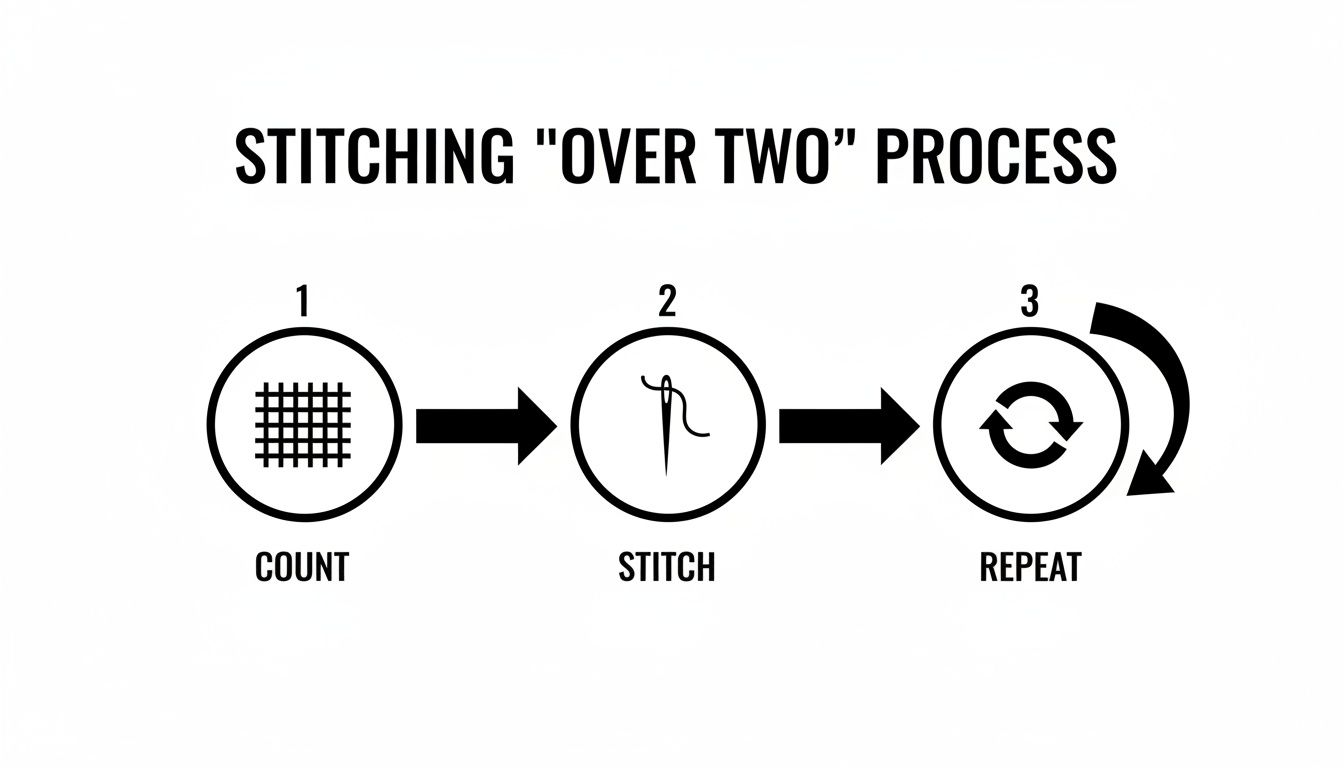
This visual guide breaks the technique down into three simple actions—Count, Stitch, and Repeat. You can see exactly how you create each stitch over a little 2x2 grid of threads.
Connecting Fabric to Your Creative Vision
By the end of the 20th century, European fabric makers like Zweigart had completely changed the game by introducing these wonderful blended fabrics. They gave us Lugana, a cotton-viscose blend you can find in counts from 25 to 32. Europe still leads the way with premium choices like Jobelan (a cotton-modal blend in 28 to 32 counts), which stitchers love for the softness and wrinkle-resistance it gets from its beech-derived modal.
In fact, recent data shows that stitchers feel their finished pieces look up to 40% smoother on evenweave, and sales jumped by 25% after 2020 when home crafting really took off. If you're a history buff, you can discover key insights about their development at Lost in Cross Stitch to learn more.
When you're making your choice, think about where your project will end up. Is it a framed piece destined for a gallery wall? Lugana’s soft drape is perfect. Is it a personalized cushion that’s going to get lots of cuddles on the sofa? Jobelan's resilience is the way to go.
Ultimately, choosing the right evenweave is all about aligning the fabric's properties—its texture, durability, and sheen—with the story you want your finished work to tell.
Taking Care of Your Finished Evenweave Piece
Once you've tied off that last thread, it’s time to get your masterpiece ready for its big reveal. Giving your project a proper finish doesn't just make it look stunning—it protects the delicate evenweave fabric and keeps your floss looking vibrant for years, turning all your hard work into a genuine heirloom.
The journey starts with a gentle bath. No matter how careful you've been, our hands naturally leave behind oils, and dust can settle in over weeks or months of stitching. The safest bet is always to hand-wash.
Washing and Pressing
First, grab a clean sink or basin and fill it with cool or lukewarm water. Add just a tiny drop of a mild, pH-neutral soap (like a dedicated quilt wash or gentle liquid soap) and give it a swish. Submerge your project and just let it soak for about 15 minutes.
You can gently move it around in the water, but never, ever scrub or wring it out. That kind of rough handling can easily distort your stitches and ruin the fabric's beautiful, even grid.
When it's time to rinse, hold it under cool, running water until you're sure all the soap is gone. To get the excess water out, lay the piece flat on a clean, thick towel. Roll the towel up with your stitching inside and press down gently. Then, unroll it and let it air dry the rest of the way on a new dry towel.
My Favorite Trick: The secret to a perfect finish is to iron your piece while it's still just a little bit damp. Place it face down on a thick, fluffy towel and press it from the back with a warm iron. This fluffs up your stitches from the front and makes the fabric perfectly crisp without flattening all your hard work.
Framing and Storing for the Long Haul
Framing isn't just for looks; it's the best line of defense against dust, sunlight, and everything else. When you're picking out materials, make sure you insist on acid-free mat boards and backing. Over time, the acid in standard cardboard can leach into your fabric, causing it to yellow and become brittle.
If you aren't framing it right away, you'll want to store it safely. The best way is to gently roll your project—stitches facing out—around an acid-free cardboard tube. Keep it rolled up and stored flat somewhere dark and dry. This prevents hard creases and protects it from sunlight and moisture, which can cause fading or even mildew.
Got Questions About Evenweave? Let's Get Them Answered
Even seasoned stitchers can feel a little hesitant when trying a new fabric for the first time. Getting a few key questions out of the way can make all the difference, helping you start your next project with total confidence.
So, let's dive into some of the things people wonder about most when it comes to evenweave cross stitch fabric.
A big one we hear all the time is, "Is this okay for a beginner?" While Aida is the go-to for most people starting out, a determined newcomer can definitely handle evenweave. My advice? Start with a lower count, like a 25 or 28-count, which makes the threads bigger and easier to see and count.
Another common point of confusion is just how to handle the fabric. Evenweave is noticeably softer and has more drape than stiff Aida, which means keeping it taut is the secret to getting those perfect, even stitches you're after.
Your Evenweave Questions Answered
To clear things up and get you stitching, here are some straight-to-the-point answers to the questions we see most often.
-
Do I really need a hoop or frame? Yes, I can't recommend this enough. Whether you prefer a classic hoop, a Q-snap, or a scroll frame, you absolutely need one. The soft, flexible nature of evenweave means it needs that support to keep the tension consistent. It’s the best way to avoid puckered stitches and get that smooth, professional finish.
-
How many strands of floss should I use? This really comes down to the fabric count and how you want the finished stitches to look. For stitching "over two," a great rule of thumb is to use two strands of floss for 28-count and 32-count evenweave. If you're working on a 25-count, you might find that three strands give you that fuller, more lush coverage.
Pro Tip: Before you dive into the main event, always stitch a little test patch in a corner of your fabric. It only takes a few minutes, but it lets you see exactly how the floss coverage looks and decide if you like it before you're hours into the project.
At the end of the day, evenweave is an incredibly rewarding fabric to work with. It opens up a whole new world of detail and elegance in your cross stitch projects.
Ready to turn a cherished photo into a stunning work of art? At Cross Stitched, we transform your memories into beautiful, easy-to-follow cross stitch kits. Start your custom project today!