Have you ever looked at a beautifully stitched piece of art and thought, "I wish I could make that"? Well, you absolutely can. Beginner cross-stitch kits are your gateway into this incredibly satisfying and relaxing craft, designed to take all the guesswork out of getting started.
Everything you need to create your first masterpiece comes neatly packed in one box.
Why a Cross Stitch Kit Is the Perfect Creative Start
Jumping into a new hobby can be intimidating. There are new tools to learn, strange new terms, and a whole lot of "am I doing this right?" A good beginner's kit cuts through all that noise and acts as your personal crafting coach. It's a bit like a paint-by-numbers, but with gorgeous, colourful thread and fabric.
This simple, guided approach is a huge reason why cross-stitch is making such a big comeback. It’s more than just a craft; for many, it's a form of active mindfulness. The gentle, repetitive rhythm of making tiny 'X' stitches helps calm a busy mind, making it a fantastic way to de-stress and quiet anxiety. Every single stitch is a small, satisfying step toward a finished piece you can be truly proud of.
The Growing Appeal of Mindful Crafting
This isn't just a fleeting trend—it's a global movement. The cross-stitch market was valued at an impressive USD 0.15 billion in 2024 and is on track to hit USD 0.24 billion by 2035. This boom is fueled by people everywhere looking for a real, hands-on escape from their digital lives.
A kit gives you a structured, screen-free project with a clear beginning and end. The benefits are pretty immediate:
- All-in-One Convenience: Forget hunting for the right fabric, needles, or a dozen different thread colours. It's all right there.
- Reduced Stress: The methodical nature of stitching is incredibly calming and almost meditative.
- Builds Confidence: Finishing even a small project gives you a huge sense of accomplishment and the motivation to start the next one.
Cross stitch is about more than just the finished product. It's about the quiet moments, the focus, and the joy of creating something beautiful with your own hands.
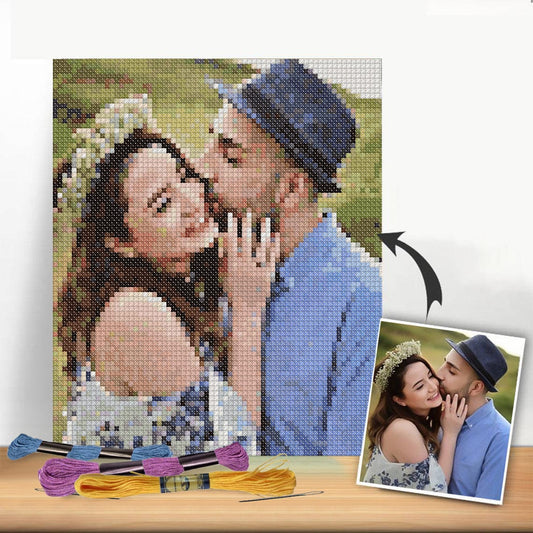
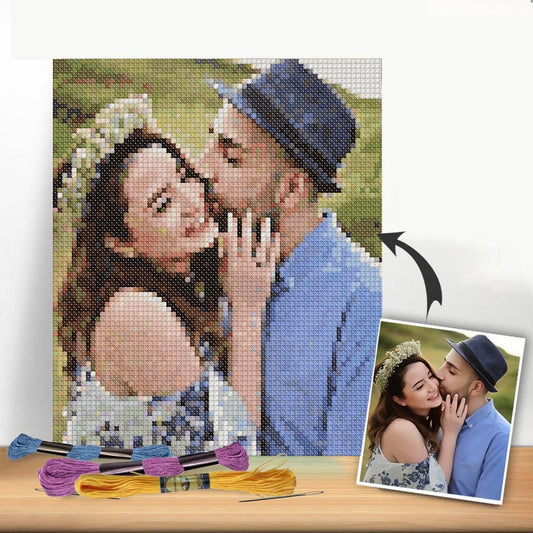
Ultimately, a kit is an invitation to slow down, disconnect, and create. It empowers you to make something personal and lasting. You can even turn a favourite photo into a custom pattern, transforming a precious memory into a work of art. To get a better handle on the fundamentals, take a look at our guide on what cross stitch is all about.
Unboxing Your First Cross Stitch Kit
There’s a special kind of excitement that comes with opening your first cross stitch kit. It’s like a little box of creative potential, waiting for you to bring it to life. Let’s take a look inside and get familiar with your new tools so you can jump in with confidence.

Think of these items as your artist’s palette. Every single piece plays a specific, important role in creating your final masterpiece. Knowing what’s what is the first step toward a project you’ll be proud of.
Your Essential Stitching Supplies
Most beginners cross stitch kits come with a standard set of goodies. Once you know what each item is for, the whole process feels way less intimidating and a lot more fun.
- Aida Fabric: This is your canvas. It's a special cotton fabric woven into a perfect grid of little squares, which makes it super easy to create neat, even "X" stitches.
- Embroidery Floss: These are the vibrant threads that create your picture. They typically come pre-sorted and labeled with symbols that match your pattern.
- Tapestry Needles: These aren't your average sewing needles. They have a blunt tip and a larger eye, designed to glide smoothly through the holes in the Aida without accidentally splitting the fabric's threads.
- The Pattern Chart: This is your treasure map. It’s a grid covered in symbols, where each symbol tells you exactly which color to use and where to place each stitch.
You might also find an embroidery hoop in your kit. While not always included, it's a game-changer. It keeps your fabric pulled tight, which is the secret to preventing puckers and making your stitches look perfectly uniform.
Don't let the new supplies overwhelm you. It's just like following a recipe: the fabric is your baking dish, the floss is your ingredients, and the pattern is your step-by-step instructions.
Counted Kits Versus Stamped Kits
As you shop around, you'll see two main types of kits: counted and stamped. Figuring out the difference is the key to choosing a first project that you'll actually enjoy.
A stamped kit is pretty straightforward—the design is printed right onto the fabric in color. Your job is to simply stitch over the matching colored squares. It's a fantastic way to get the hang of things, as you don't have to keep looking back and forth at a separate chart.
On the other hand, a counted kit gives you a blank piece of Aida and a paper pattern. You have to count the squares on your fabric to transfer the design from the chart. This might sound a little more intense, but it’s the most common method and the one that allows for truly precise, detailed artwork.
For your very first time, a stamped kit can be a great way to learn the rhythm of stitching without worrying about counting. But you'll find that most stitchers quickly graduate to counted cross stitch because the quality and detail are on another level. That's why many high-quality beginners cross stitch kits use the counted method, but with simple, easy-to-follow patterns. This helps you build the core skills you'll rely on for every project you ever do.
How to Choose the Right Beginner Kit
Stepping into the world of cross stitch is exciting, but let's be honest—the sheer number of kits out there can feel a bit overwhelming at first. Don't sweat it. Picking the right kit is really just about matching the project to your skill level and what you find beautiful. Think of it like choosing your first recipe; you want something simple and satisfying that teaches you the basics without being a huge headache.
The whole point is to find a project that gets you excited from the very first stitch to that proud moment when you tie off the final thread. So, let's walk through the key things to look for to make sure your first experience is a great one.
Understanding Fabric Count and Size
The most critical piece of any beginner cross stitch kit is the fabric, especially its count. You’ll see "14-count Aida" recommended almost everywhere, and for very good reason. The "count" simply refers to how many little squares—and therefore, stitches—fit into one inch of fabric.
A lower number like 14 means the squares are bigger and much easier to see. This makes it a breeze to guide your needle and create neat, even stitches without squinting. Higher counts, like 18 or 22, have a much tighter weave for more detailed work, but they’re definitely something to work up to once you’ve got a project or two under your belt.
For your first project, 14-count Aida fabric is your best friend. It strikes the perfect balance between being easy to see and still looking great, setting you up for a frustration-free stitching session.
The overall size of the design matters just as much. A massive, sprawling pattern can feel like a mountain you’ll never climb. Instead, look for kits with smaller finished dimensions, usually under 8x10 inches. Finishing a small project relatively quickly builds some serious momentum and gives you that "I can do this!" confidence boost to tackle something bigger next time.
To get a better handle on all the different materials you might run into, take a peek at our detailed guide on essential embroidery supplies for beginners.
Evaluating Design Complexity
After you’ve got the fabric sorted, the next thing to look at is the design itself. A pattern with 50 different colors and a ton of intricate shading might look amazing on the box, but it can be a real handful for a first-timer. The secret is to start simple.
Here are a few things to look for in a beginner-friendly design:
- Limited Color Palette: A kit with fewer than 15 colors is a great starting point. It makes managing your threads and following the chart so much simpler.
- Blocked Colors: Look for designs with big, solid blocks of a single color. This lets you get into a nice, comfortable stitching rhythm without having to constantly switch threads.
- Minimal "Confetti": Try to avoid patterns with lots of single, isolated stitches scattered all over the place. In the stitching world, we call these "confetti," and they can be a bit fiddly to deal with.
Luckily, current trends are on your side. There's a big shift toward minimalist and modern designs with fewer colors and more open space, which is fantastic news for beginners. For more on what's popular, you can explore the current cross stitch pattern trends on accio.com. By picking a kit that follows these principles, you're not just choosing an easier project—you're starting with a fresh, modern aesthetic that’s fun and totally achievable.
Beginner Cross Stitch Kit Feature Comparison
To help you visualize what to look for, here's a quick breakdown of the most important features in a beginner's kit.
| Feature | Beginner-Friendly Option | Why It's a Good Choice |
|---|---|---|
| Fabric Type | 14-count Aida | Large, easy-to-see holes reduce eye strain and make stitching simple. |
| Design Size | Under 8x10 inches | A smaller project is quicker to finish, building confidence and momentum. |
| Color Count | Fewer than 15 colors | Makes the pattern chart easier to follow and simplifies thread management. |
| Pattern Style | Large blocks of solid color | Allows for a relaxing, rhythmic stitching experience without constant thread changes. |
| Included Tools | Needle, hoop, thread | Ensures you have all the absolute essentials to start right out of the box. |
Choosing a kit with these features gives you the best shot at a smooth, enjoyable, and successful first cross stitch project. You can always tackle more complex designs later on
Making Your First Stitches Step by Step
Alright, this is where the magic really starts. You've got your kit, you've laid everything out, and now it's time to actually put needle to fabric. I know that first stitch can feel like the biggest hurdle, but trust me, it’s way easier than you think. Let's walk through it together, from threading your needle to making that very first, very satisfying 'X'.
The whole point is to get you comfortable and confident. By the time you're done with this section, you'll have the basic rhythm of cross stitch down. You’ll go from someone just looking at a kit to someone who is actively creating with it. So, let’s get started.
This diagram is a great little cheat sheet for remembering what to look for when you're choosing a kit.

As you can see, sticking with 14-count Aida, a smaller design, and fewer colors is the perfect recipe for a successful first project.
Prepping Your Thread and Needle
First things first, you need to get your thread ready. The colorful embroidery floss you see in beginners cross stitch kits comes as a skein made up of six smaller strands all twisted together. For nearly every project, your pattern will tell you to use only two of those six strands at a time.
- Cut a Piece: Snip off a length of floss that’s about 18 inches long. Any longer, and you’ll be fighting with knots and tangles the whole time. It's just not worth the frustration.
- Separate the Strands: This is the trickiest part for many beginners. Hold the floss with one hand and gently pinch a single strand with the other. Pull that single strand straight up and out of the group. It might look like it’s going to bunch up, but it will slide out smoothly. Do this again for a second strand.
- Thread Your Needle: Take those two strands you just separated, line up the ends, and guide them through the eye of your tapestry needle. You’ll want to leave a tail of about four inches hanging from the needle.
The Pro Trick: A Knotless Loop Start
Want to know one of the best habits you can learn from day one? The loop start method. It helps you anchor your thread without making a single knot, which keeps the back of your work much cleaner and flatter.
To try this, you'll start with just one long strand of floss, about 36 inches. Fold it exactly in half, so the two cut ends meet. Now, thread those two cut ends through your needle together. You should have a neat little loop at the other end of the thread.
Perfect! Now you're ready to make that first stitch.
Making Your First 'X'
With your needle threaded using the loop start method, it's time to dive in. Find the center of your fabric (your pattern guide should help with this) and pick a block of color to begin with.
- The First Leg: From the back of the fabric, push your needle up through a bottom-left hole of one of the Aida squares. Pull the thread all the way through until the loop on the back is just about to touch the fabric.
- The Second Leg: Now, push the needle down into the top-right hole of that same square. But wait! Before you pull it tight, flip your project over to the back.
- Catch the Loop: See that loop of thread on the back? Simply pass your needle right through it and give it a gentle tug. Your thread is now anchored securely—no knots needed!
- Finish the 'X': Flip your work back over to the front. Bring the needle up through the bottom-right hole and finally, go down through the top-left hole. And just like that, you've made your first perfect cross stitch!
From here, you just keep making stitches exactly like that, following the symbols on your pattern chart. For more detailed instructions and other stitch techniques, our printable embroidery stitch guide is a fantastic resource to have handy.
Turning Your Photos Into Stitched Art
Learning the ropes with pre-made designs in beginners cross stitch kits is a brilliant start, but there’s a special kind of magic that happens when you create something that is completely, undeniably you. This is where custom photo-to-pattern kits come in, letting you turn your craft from a fun hobby into a deeply personal way to tell a story.
Just imagine turning one of your most treasured memories into a tangible piece of art. That goofy photo of your dog, a candid family portrait from years ago, or a breathtaking vacation sunset—all of these moments can become your next project. Modern tools make it surprisingly simple to upload a favorite photograph and convert it into a detailed, easy-to-follow cross stitch pattern.
From Digital Image to Physical Heirloom
This whole process beautifully bridges the gap between the fleeting digital memories on your phone and a handmade heirloom you can touch and feel. Instead of just picking a generic design off a shelf, you get to stitch a moment that holds real meaning for you.
The finished piece isn't just another wall decoration; it's a preserved feeling, a tribute to a person, or a memory of a place that matters.
This desire for personalization is a huge part of why crafting is so popular right now. In fact, the market for needlecraft patterns, which includes cross stitch, is expected to grow to USD 776 million by 2033. This growth is largely driven by people like you wanting unique projects that reflect their own lives and tastes. You can explore more about this growing market and see just how much personalization is shaping the industry.
Turning a photo into a cross stitch pattern elevates your project from a simple craft to a meaningful act of creation. It's about stitching your own story, one 'X' at a time, creating a one-of-a-kind gift or a future family heirloom.
Why Choose a Custom Photo Kit?
Going with a custom kit brings a whole different level of satisfaction. It also makes for an incredibly thoughtful and impressive gift. It’s the ultimate way to show someone you care, pouring your time and creativity into a piece that celebrates a shared memory.
Here are a few reasons a custom photo kit is such a fantastic choice:
- Truly One-of-a-Kind: No one else will ever have a project exactly like yours. It’s a true original.
- The Perfect Gift: A hand-stitched portrait of a pet or a favorite family photo is a heartfelt present that will be treasured for years to come.
- A Deeper Connection: There's something special about stitching a familiar face or a beloved place. It creates a stronger bond with your work, making the whole process even more rewarding.
At the end of the day, custom kits let you be the artist. They come with all the same beginner-friendly materials you'd expect—fabric, pre-sorted threads, and needles—but the pattern is pulled directly from your own life. This changes cross stitch from just a hobby into a way to literally weave your memories into existence.
Finishing and Displaying Your Creation
Congratulations, you’ve tied off that final stitch! There's nothing quite like the feeling of finishing a project you’ve poured your time and care into. But before you show it off, a few simple finishing touches will turn your beautiful handiwork into a true masterpiece.

This last step is the secret to a polished, professional look. A quick, gentle wash and a careful press are all it takes to make your thread colors pop and get your fabric perfectly flat and ready for its debut.
Washing and Pressing Your Work
First things first, let's give your project a little spa day. Even with the cleanest hands, natural oils can transfer to the fabric while you work. A quick bath ensures your piece stays bright and beautiful for years to come.
-
Give It a Gentle Wash: Fill a clean sink or basin with lukewarm water and a tiny drop of a very mild, color-safe detergent. Let your cross-stitch soak for a few minutes, swishing it around gently. Then, rinse it thoroughly under cool, running water until the water is clear.
-
Blot, Don't Wring: Whatever you do, don't twist or wring out your fabric! This can stretch and distort your stitches. Instead, lay your piece flat on a clean, thick towel, place another towel on top, and press down firmly to soak up the excess water.
-
Iron While It's Damp: Place your project face-down on a fresh, dry towel. Set your iron to a low or medium heat setting with no steam, and press the back of the fabric. The towel cushions your stitches, preventing them from getting flattened while you iron out all the wrinkles.
This simple cleaning process does wonders. It brightens the floss, smooths out any hoop marks, and gives your project a crisp, professional look that's ready to be framed or displayed.
Creative Ways to Display Your Art
Now for the best part—deciding how to show off your new creation! The possibilities are practically endless, so you can find the perfect way to match your project to your home decor and personal style.
-
Classic Framing: A traditional frame is a timeless choice that elevates your cross stitch into a beautiful piece of wall art. It just looks so elegant.
-
Modern Hoop Display: For a more rustic, crafty vibe, you can finish the piece right in the embroidery hoop you used to stitch it. A neatly gathered back and a felt covering make it ready to hang on the wall instantly.
-
Functional Art: Think beyond the wall! Your small projects can be turned into bookmarks, keychains, or even the centerpiece of a one-of-a-kind decorative pillow.
Once you've completed your cross stitch artwork, consider transforming it into a cozy accessory. Learn how to choose throw pillows for your sofa like a pro to display your stitched creation beautifully.
Got Questions? We've Got Answers for New Stitchers
When you're first starting out, a million little questions can pop into your head. That's totally normal! Learning something new always comes with a bit of a learning curve, so trust me, you're in good company. Let’s tackle some of the most common questions we hear from people just opening their first beginner's cross stitch kit.
Getting these fundamentals sorted will help you sail through those early projects and stitch with a lot more confidence.
What's the Best Fabric for a Total Beginner?
Hands down, start with 14-count Aida fabric. If you see one thing in almost every beginner kit, it's this.
So, what does "count" even mean? It's just the number of squares (and therefore, stitches) per inch of fabric. A lower number like 14 means the squares are bigger, making them a breeze to see and guide your needle through. Think of it as the perfect canvas to learn on before you move to fabrics with a finer weave.
Do I Really Need to Use an Embroidery Hoop?
Technically, no. But should you? Absolutely.
An embroidery hoop is your best friend when it comes to getting clean, even stitches. It holds the fabric taut—nice and tight like a little drum—which makes it so much easier to work with. This tension is the secret weapon against puckered fabric and messy stitches, giving your final piece a much more polished, professional look. Most good kits include one for exactly this reason.
How Many Strands of Floss Should I Use?
Your cross stitch thread, or floss, comes as a thick cord made up of six smaller strands all twisted together. While you should always check your kit's instructions, the gold standard for 14-count Aida is to use two strands.
You'll need to gently separate two of these strands from the main group of six before threading your needle. Using two strands gives your stitches a lovely, full look with great coverage, but they're not so bulky that it's a struggle to pull them through the fabric.
A Quick Tip for a Happier Stitching Life: So many beginners stress about making the back of their work look as neat as the front. Here's a secret from a seasoned stitcher: nobody ever sees the back. Seriously. Focus on making your stitches on the front look fantastic and don't lose a moment's sleep over a few stray threads on the other side.
Ready to transform a favorite photo into a one-of-a-kind, hand-stitched piece of art? At Cross Stitched, we create custom kits from your memories. Start your personal masterpiece today by exploring our custom kit options.