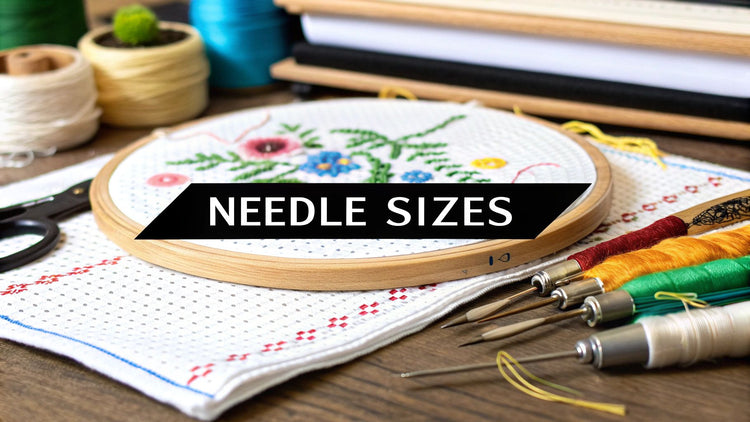
So, you've got your fabric picked out, but what about the needle? The size of your needle is just as crucial as the fabric count, and getting this pairing right is the secret to beautiful, even stitches. For the most popular fabric out there, 14-count Aida, your go-to will be a size 24 tapestry needle. It's the perfect match.
This needle is big enough to open up the holes in the Aida cloth just a bit, letting your thread pass through smoothly without getting shredded. But it's not so big that it stretches the fabric out of shape.
Your Quick Guide to Cross Stitch Needle Sizes
Choosing the right needle is one of those small details that makes a huge difference. Think of it like this: trying to use a giant needle on a fine-weave fabric is like trying to fit a square peg in a round hole. You'll end up with distorted, gaping holes.
On the flip side, using a needle that’s too tiny will cause a constant battle. The eye will be too small, and the constant friction will fray your beautiful floss before it even becomes a stitch. The sweet spot is a needle that glides through the existing holes in the fabric, creating just enough space for your thread to follow without a fight. This is one of the foundational skills you'll pick up when learning the cross stitch basics.
Matching Needles to Fabric Count
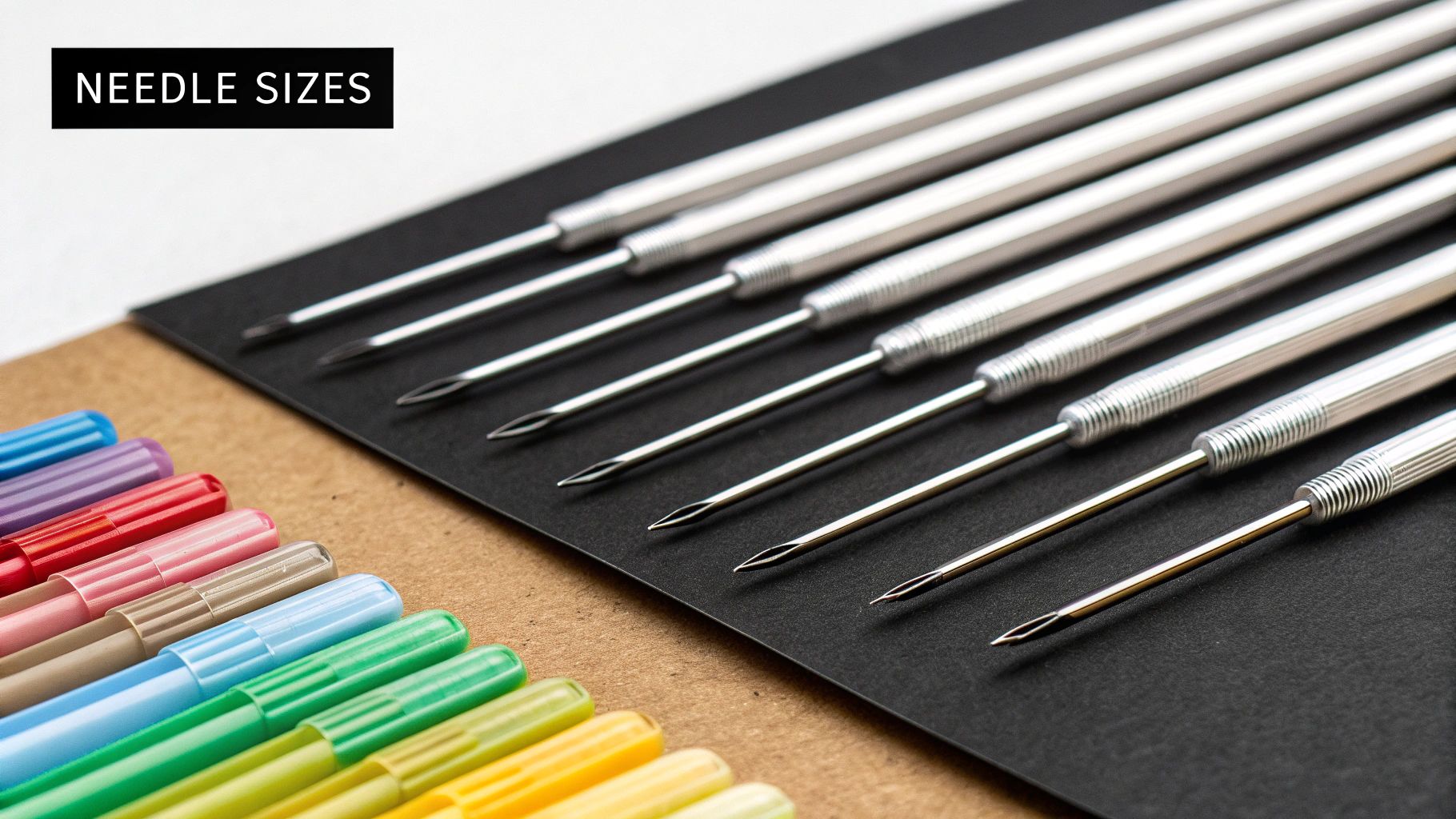
The world of tapestry needles might seem confusing at first, but for cross stitch, you really only need to remember a few key sizes: 24, 26, and 28.
It's all about the fabric count. The "count" simply means how many stitches you can fit into one inch of that fabric.
- For 14-count Aida, which has 14 stitches per inch, a size 24 needle is perfect.
- When you move to a finer fabric like 16-count Aida, you’ll want a slightly smaller size 26 needle.
- For even tighter weaves, like 18-count Aida and up, a slender size 28 needle is the only way to go.
Key Takeaway: Here’s the slightly weird part you just have to memorize: the higher the fabric count, the higher the needle size number. But a higher needle number actually means a smaller, finer needle.
Quick Guide to Matching Needle Size with Fabric Count
To make it even easier, here's a simple chart to help you grab the right needle every time.
| Aida Fabric Count (Stitches per Inch) | Recommended Needle Size |
|---|---|
| 11-count | 22 |
| 14-count | 24 |
| 16-count | 26 |
| 18-count | 28 |
This little table covers the most common pairings you'll encounter. Pin it, save it, or just keep it in mind—it'll save you a lot of guesswork on your next project
Why a Smaller Number Means a Bigger Needle
If you’re new to cross stitch, the way we number needles can feel completely upside down. You’d think a size 28 needle would be bigger than a size 24, but it’s actually the other way around. The tiny, delicate needle is the 28, while the chunkier one is the 24.
So, what gives? It’s a quirky system left over from the old days of industrial manufacturing.
The easiest way to wrap your head around it is to think about wire gauges. A thick, heavy-duty electrical cable might be a 12-gauge, while the super-thin wire inside your headphones could be a 22-gauge. The higher the number, the finer the wire. Cross stitch needles work the exact same way.
The number actually refers to how many needles could be produced from a standard length of steel wire. To get more needles out of the same amount of metal, each one has to be smaller. So, a bigger number means a smaller needle. Simple, once you know the secret!
This visual really drives home why getting the right match between your needle and fabric is so critical for beautiful, clean stitches.
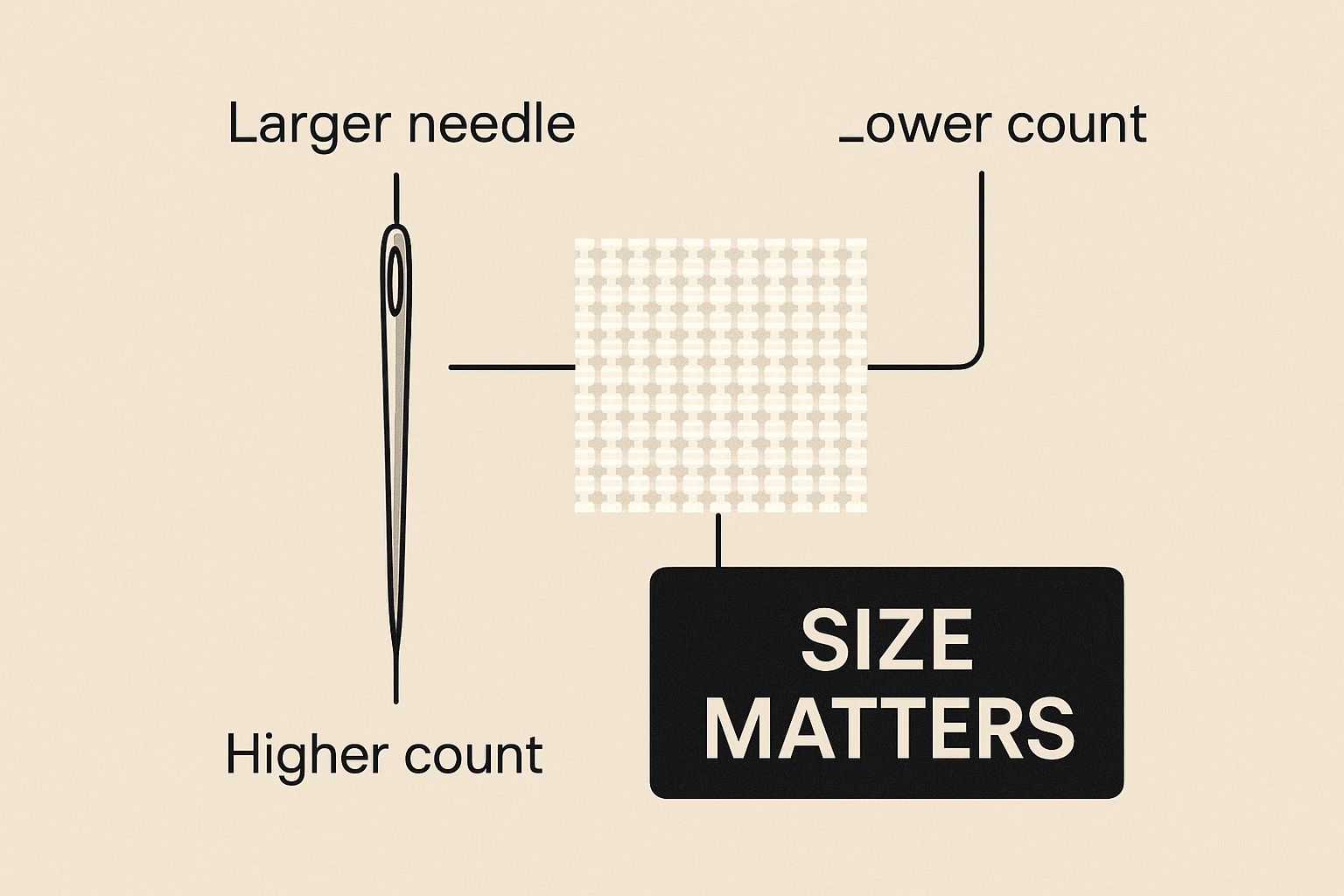
As you can see, the goal is for the needle to gently part the threads of your fabric, not to shove them out of the way.
The Anatomy of the Perfect Needle
Beyond the confusing numbers, the right needle for cross stitch is a specific type called a tapestry needle. It’s built differently from a regular sewing needle, and for good reason. Two key features make it the perfect tool for the job.
-
A Blunt Tip: A standard sewing needle is sharp because it needs to pierce through tightly woven fabric. But in cross stitch, the holes are already there for you in the Aida or evenweave. A tapestry needle’s rounded, blunt tip is designed to find those holes easily, gliding through without splitting the threads. Using a sharp needle would be a constant battle, snagging fibers and making your stitches look messy.
-
A Large Eye: Trying to thread six strands of cotton floss through the tiny eye of a sewing needle is an exercise in frustration. Tapestry needles have a long, wide eye that makes threading a breeze, even with multiple strands. This larger opening also means less wear and tear on your floss as you pull it through the fabric, which helps keep it from fraying.
The blunt tip and the large eye are a powerhouse combination. They work together to protect your fabric from damage and your floss from shredding, making the whole process smoother and more enjoyable.
How Fabric and Floss Influence Your Needle Choice
Picking the right needle isn't just about matching a number to the fabric count on the box. The real art comes from understanding the interplay between your needle, your fabric, and how many strands of floss you're using. Think of them as a trio that needs to be in perfect harmony for your project to sing.
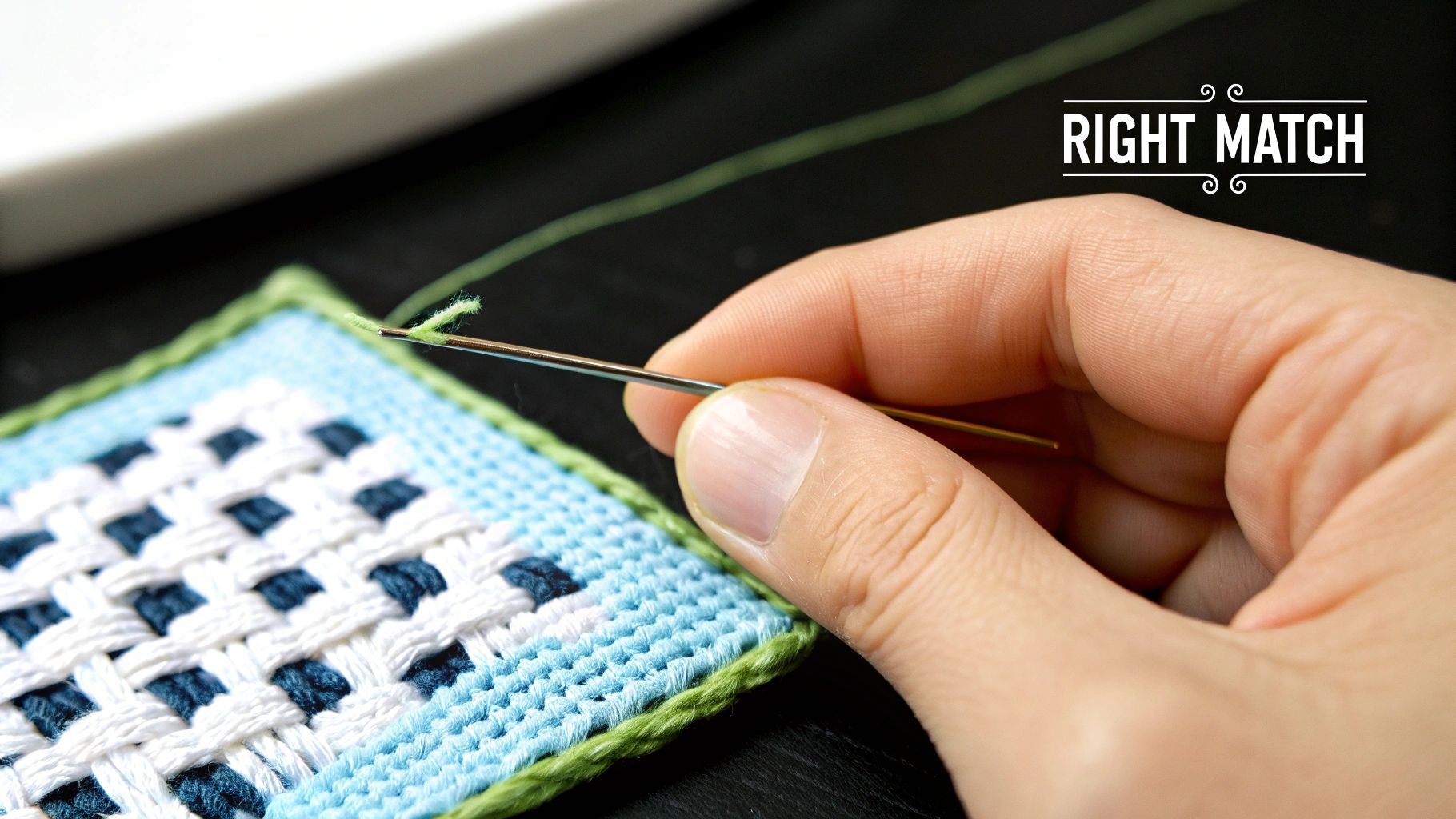
The goal is always the same: you want a needle that parts the threads of your fabric just wide enough for your floss to glide through smoothly. No forcing, no fraying, just a clean pass.
Beyond Standard Aida Fabric
While Aida is the go-to for many stitchers, you'll eventually find yourself working with other materials like linen or evenweave. These fabrics are a different ballgame. Their threads are often finer and woven more tightly than the distinct grid of Aida, which means they need a gentler approach.
For these more delicate fabrics, a smaller needle is almost always the answer. Let's say you're working on 28-count linen. Many stitchers work "over two," which makes it dimensionally the same as 14-count Aida. But you wouldn't use the same needle. You’d reach for a size 26 or even a 28 needle to avoid stretching out the finer weave. You can learn more about what makes Aida fabric so different in our guide.
A needle that’s too large for linen will leave noticeable holes and can permanently warp the fabric, messing up the uniform, tidy look you're working so hard to achieve.
How Many Strands Are You Using?
The thickness of your thread bundle is the final piece of the puzzle. Most patterns suggest two strands of floss, and the standard needle recommendations are built around that. But what happens when a pattern calls for more strands to get better coverage or a bolder effect?
Picture this: you're stitching on 14-count Aida, but you're using four strands of floss instead of two. Suddenly, you're trying to pull twice the bulk through the same little hole. A standard size 24 needle might start to feel awfully snug. You’ll feel a drag with every stitch, and that friction can start to shred your beautiful floss.
This is where you have to make a judgment call. It's a delicate balance:
- Too Small: A needle with a tiny eye will fray your floss as you thread it and fight you on every stitch.
- Too Large: A needle that's too beefy will stretch out the holes in your fabric, which can make your final piece look loose or puckered.
Making the right choice ensures your floss lies smoothly and your fabric stays perfect. It’s what gives your work that polished, professional finish. Your needle should feel like a partner in the process, not something you have to wrestle with.
Signs You're Using the Wrong Needle Size
Ever feel like you're fighting with your fabric? Is your floss shredding into a fuzzy mess before you've even finished a row? These are classic red flags that your needle isn't the right fit for your project.
Recognizing these little signs of trouble is a huge part of becoming a more confident stitcher. It saves you from frustration and helps you get back to that smooth, satisfying rhythm we all love.
When Your Needle Is Too Big
Using a needle that's too bulky for your fabric is like trying to fit a square peg in a round hole. The damage is often obvious and, unfortunately, can be permanent.
The biggest giveaway is that the needle visibly stretches the holes in your Aida or evenweave. Instead of parting the fibers gently, it forces them apart, leaving behind noticeable gaps around your stitches.
This creates a second problem: loose, messy-looking stitches. The oversized holes can't grip the floss properly, so your stitches won't have that neat, uniform tension you're aiming for. It's an uphill battle for a clean finish.
When Your Needle Is Too Small
Going too small with your needle is just as frustrating, but the clues are a little different. This is all about friction and wear-and-tear.
The number one sign is shredded or frayed floss. The eye of the needle is simply too narrow for the number of strands you're using. Every time you pull the thread through the fabric, it's getting scraped and worn down.
Stitching should feel effortless. If you have to physically force or yank the needle through the fabric with each stitch, your needle is almost certainly too small for the thread you're using.
You'll also notice that just threading the needle feels like an impossible task. If you're struggling, it's a clear signal to size up. A simple needle change can make all the difference, turning a chore back into a joy.
Exploring Specialty Needles for Cross Stitch
While the trusty tapestry needle is the workhorse for most cross stitch projects, there's a whole world of specialty needles out there. Think of them like a mechanic's specialized tools—you don't need them for every job, but when you do, they make the work so much easier.
Knowing the right size needle is your foundation, but knowing the right type can elevate your stitching from a hobby to an art form. Let's look at a few you might want to add to your kit.
Needles for Comfort and Speed
If you're someone who stitches "in hand" without a hoop, you need to try petite needles. They're exactly what they sound like: shorter versions of standard tapestry needles. That shorter length gives you more control and helps you develop a faster, more fluid rhythm.
Ever notice your needles getting dull or tarnished? Or worse, do you have a nickel sensitivity? Gold-plated or platinum-plated needles are a fantastic solution. Not only do they glide through fabric like a dream, but they're also incredibly durable and a must-have for anyone whose skin gets irritated by standard needles.
For those with nickel allergies, a plated needle is more than just a fancy tool. It's the key to enjoying hours of comfortable, irritation-free stitching.
Tools for Advanced Techniques
When your pattern calls for a bit of sparkle, you'll quickly find your tapestry needle is just too bulky. This is where beading needles come to the rescue. They are incredibly thin and flexible, with a tiny eye designed specifically to slip through the minuscule holes in beads and sequins.
For stitchers who use a two-handed method (often with a lap or floor stand), twin-pointed or double-ended needles can be a revelation. With a point on both ends and the eye in the middle, you can pass the needle up from below and back down from above without ever flipping it. This can seriously boost your speed and is one of the more popular advanced cross stitch techniques that experienced stitchers swear by.
Got Questions About Your Cross Stitch Needles? We’ve Got Answers.
Even with the best guides, sometimes you just run into a practical question right in the middle of a project. Let's tackle some of the most common things stitchers wonder about their needles.
Think of this as your go-to troubleshooting guide. Getting these little details right can make a huge difference in how smoothly your projects go.
How Often Should I Change My Needle?
While there's no hard-and-fast rule, it's a great habit to start each big new project with a fresh needle. Over time, needles just get worn down. The plating can wear off, and the tip can become dull, which means it has to fight the fabric a little bit more with every stitch.
You should definitely swap it out if you notice any of these signs:
- It starts to feel “draggy” or sticky as you pull it through the fabric.
- You find yourself having to push harder than you used to.
- You can see it’s tarnished, bent, or has a rough spot on it.
A new needle will glide through the fabric, putting less strain on your thread and, more importantly, your hands. Keep in mind that needles with special plating, like gold or platinum, will usually last a lot longer than the standard nickel-plated kind.
Can I Just Use a Sharp Sewing Needle?
This is probably one of the most common mistakes beginners make, and it’s a big one. Please don't use a sharp needle for cross stitch! It fundamentally works against how cross stitch is supposed to function.
Remember, cross stitch is a “counted-thread” technique. Your goal is to gently guide the needle between the woven threads of your fabric, using the natural holes in the grid. A sharp needle is designed to do the opposite—it pierces right through fibers. Using one on Aida or evenweave will constantly split the threads, ruining that neat, uniform grid you’re working so hard to create.
Always, always stick with a blunt-tipped tapestry needle. Its rounded point is perfectly designed to slip into the existing holes of the fabric without shredding the weave. This is the secret to clean, perfectly placed stitches.
What’s the Best Way to Find a Lost Needle?
We’ve all been there—that heart-stopping moment when a needle disappears into the carpet or the depths of the sofa. The absolute best and safest way to find it is with a magnet.
You don't need anything fancy; a strong fridge magnet often works just fine. For a more dedicated tool, a magnetic wand or even your needle minder will do the job. Just sweep it slowly over the area where you think the needle fell, hovering just above the surface. You'll hear a satisfying 'click' when it finds its target.
Another handy trick? Turn off the overhead lights and use a flashlight. Hold it low, almost parallel to the floor or furniture. The light will often catch the metallic glint of the needle, making it much easier to spot.
Ready to start your next masterpiece with the perfect tools? At Cross Stitched, we have everything you need, from premium kits to specialty needles. Transform your favorite photo into a beautiful cross stitch pattern today!