For anyone who loves cross-stitch or embroidery, DMC conversion charts are a must-have tool. Think of them as a universal translator for thread colors, allowing you to find the closest match for a specific DMC floss number in other popular brands like Anchor, Madeira, or Cosmo. This ensures your project's colors stay true to the original design, no matter what brand of thread you have on hand.
Why DMC Conversion Charts Are Essential
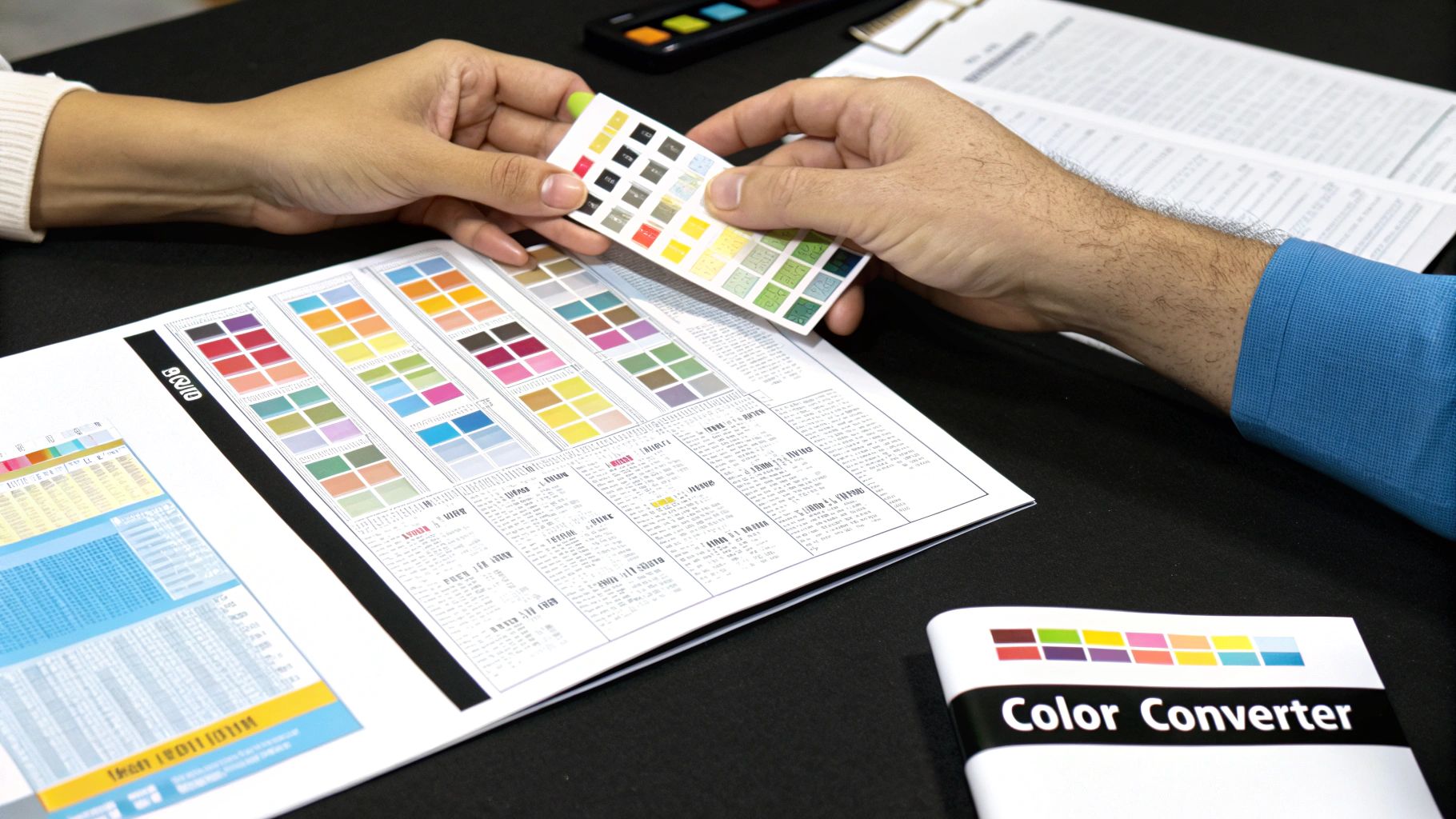
It’s a familiar scenario: you find the perfect pattern, but it calls for a brand of thread you don’t own or can't find locally. This is exactly where a good conversion chart saves the day. DMC's numbering system is widely considered the industry benchmark, so the vast majority of patterns are created using their extensive color palette.
With a history stretching back to the 18th century, the French company DMC has developed a reference system with over 400 distinct colors that designers rely on. Conversion charts are your key to matching those shades to their closest counterparts in other brands, so you can stitch with confidence even when you need to make a substitution. To see the full range, check out our guide to DMC embroidery floss numbers.
Key Benefits of Using Conversion Charts
Having a reliable conversion chart in your toolkit offers some serious practical advantages. Whether you're a seasoned stitcher or just starting out, these charts give you the flexibility to tackle any project.
- Creative Freedom: You can easily swap threads based on what’s already in your stash, which is great for both your budget and your timeline.
- Adaptability: It's simple to adapt patterns from designers who use brands that aren't readily available in your area.
- Problem-Solving: When a specific color is discontinued or out of stock, a chart helps you find the next best thing without compromising your design.
For those times you need a quick answer for a common color, this table is a lifesaver.
Quick Reference DMC to Anchor Conversion
Here’s a handy table for converting some of the most frequently used DMC colors to their Anchor equivalents. It’s perfect for when you need to find a match on the fly.
| DMC Number | DMC Color Name | Anchor Number | Anchor Color Name |
|---|---|---|---|
| 310 | Black | 403 | Black |
| B5200 | Snow White | 2 | White |
| 321 | Red | 46 | Christmas Red |
| 741 | Medium Tangerine | 316 | Med Orange |
| 972 | Deep Canary | 298 | Deep Canary Yellow |
| 798 | Dark Delft Blue | 133 | Dark Delft Blue |
| 700 | Bright Green | 246 | Christmas Green |
| 415 | Pearl Gray | 398 | Lt Pearl Grey |
| 666 | Bright Red | 47 | Bright Christmas Red |
| 820 | Very Dark Royal Blue | 140 | Very Dk Royal Blue |
Remember, while these are the official "closest" matches, slight variations can exist due to different dye lots and materials. Always trust your eye if a color seems off!
Understanding how to use these charts gives you the confidence to navigate the detailed reference tables throughout this guide. For another excellent resource, you can also explore the DMC thread conversions at colourandcotton.com.
The Ultimate DMC to Anchor Conversion Chart
It’s a familiar scenario for any stitcher: you have a pattern that calls for DMC thread, but your stash is overflowing with Anchor. This is where a trusty conversion chart becomes your best friend. DMC and Anchor are the two titans of the embroidery floss world, and while their colors are often incredibly close, they aren't always a one-to-one match.
Some crafters will tell you that Anchor thread has a slightly higher sheen, giving it a bit more lustre. In contrast, DMC tends to have a softer, more matte finish. These differences are subtle, but for a project where texture and light are key, it's something to keep in mind. If absolute consistency is what you're after, it's usually best to stick with one brand for the entire piece. For most projects, though, a good conversion works beautifully.
How to Use the DMC to Anchor Chart
We've designed this conversion chart to be straightforward and easy to use. DMC's numbering system makes finding colors a breeze, and their core collection features around 500 distinct shades. Our chart zeroes in on matching these popular colors to their closest Anchor counterparts. If you'd like to dive deeper, you can find an excellent DMC to Anchor thread conversion chart on stitchtastic.com that goes into even more detail.
Here's what a typical conversion chart looks like, so you know what to expect.
This clean layout means you can find the DMC number from your pattern and instantly see its corresponding Anchor match, getting you back to stitching faster.
Using the chart is simple: just find the DMC number your pattern lists in the first column. Right next to it, you'll find the recommended Anchor equivalent.
Pro Tip: What if there's no perfect match? Take a look at your project's overall color palette. Sometimes, picking an Anchor shade that's a touch lighter or darker than the direct substitute can actually create a better visual blend within your design.
And don't forget about dye lots! Even within the same brand, there can be tiny variations from one batch to the next. If you're working on a large area with a single color, like a background, always buy all the thread you'll need at once. With this chart in hand, you can confidently switch between brands and keep your projects on track.
DMC to Madeira and Cosmo Conversion Charts
While Anchor is a common go-to, two other fantastic brands you'll likely come across are Madeira and Cosmo. Both are top-notch in terms of quality, but each brings something different to the table that can really change the look and feel of your finished piece. This is why having reliable DMC conversion charts for them is so useful—it just gives you more options.
Madeira is a German brand known for its six-strand embroidery floss, which goes through a double mercerization process. What does that mean for you? It results in a thread with a brilliant, eye-catching sheen that's also incredibly strong and won't bleed. Then there's Cosmo, a floss from Japan that stitchers absolutely love for its incredibly soft, silky texture. It has a low-lint finish that makes it a genuine pleasure to work with.
Matching Colors Across Brands
Knowing the unique character of each thread brand is key when you're thinking about making a substitution. A DMC conversion chart will give you the closest number, sure, but the final result can be quite different depending on the thread's finish and material.
- Looking for a high-sheen, vibrant pop? A Madeira substitute is probably your best bet.
- Need a soft, almost luxurious feel with a more subtle luster? Cosmo is almost always the right choice.
This chart gives a great visual breakdown of how many colors match up directly between DMC, Madeira, and Cosmo.
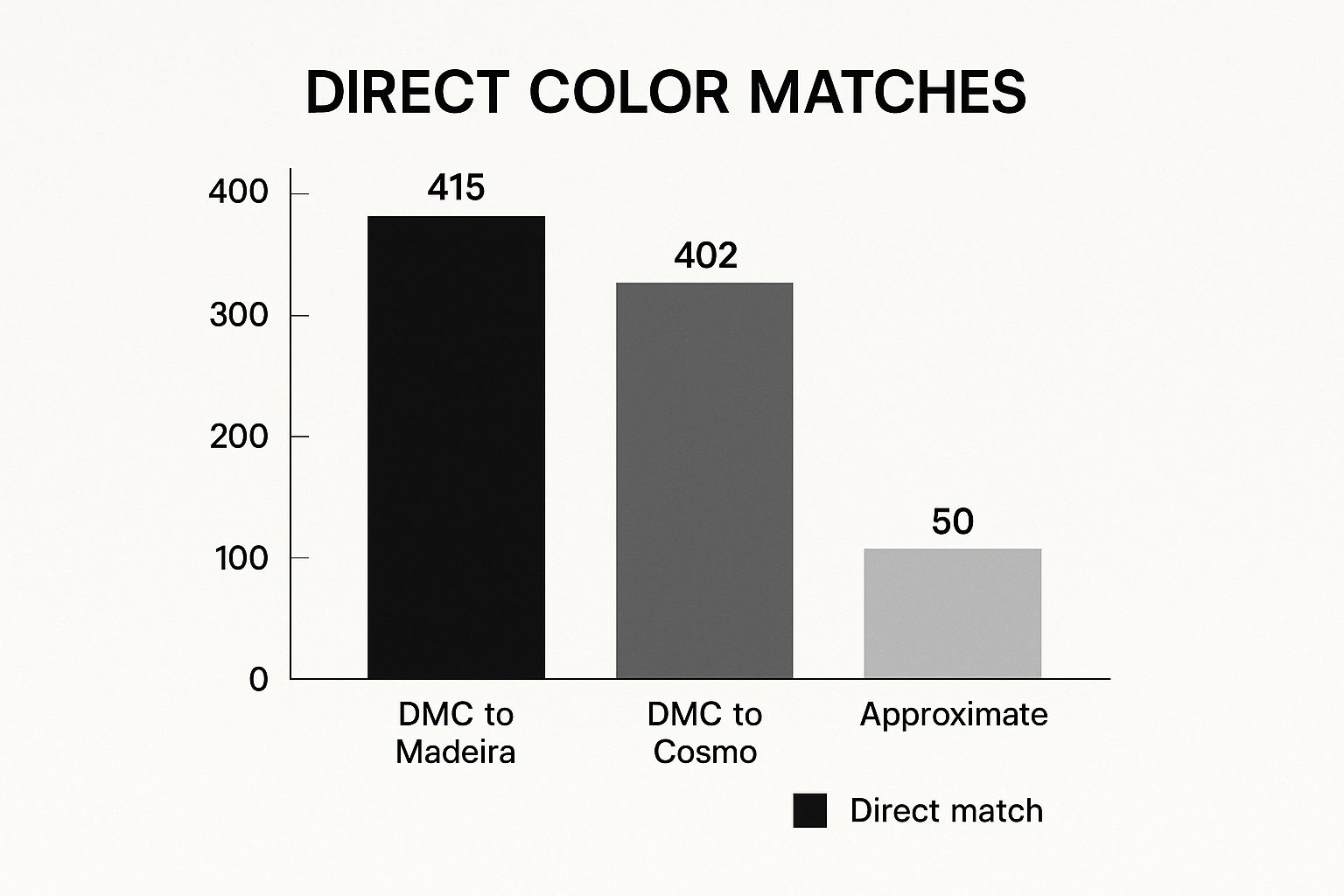
As you can see, there are over 400 solid color matches for both brands, which is fantastic. However, there's a smaller group of about 50 DMC colors where finding a good substitute requires a bit more care. For those tricky ones, nothing beats comparing the physical skeins side-by-side if you can.
A little tip from my own experience: when you don't have an exact match, think about how that color is being used. If it's part of a gradient or shading sequence, going a touch lighter or darker often works just fine. But if it's a standalone color that needs to be just right, you'll want to find the closest match possible.
How to Choose the Perfect Color Match
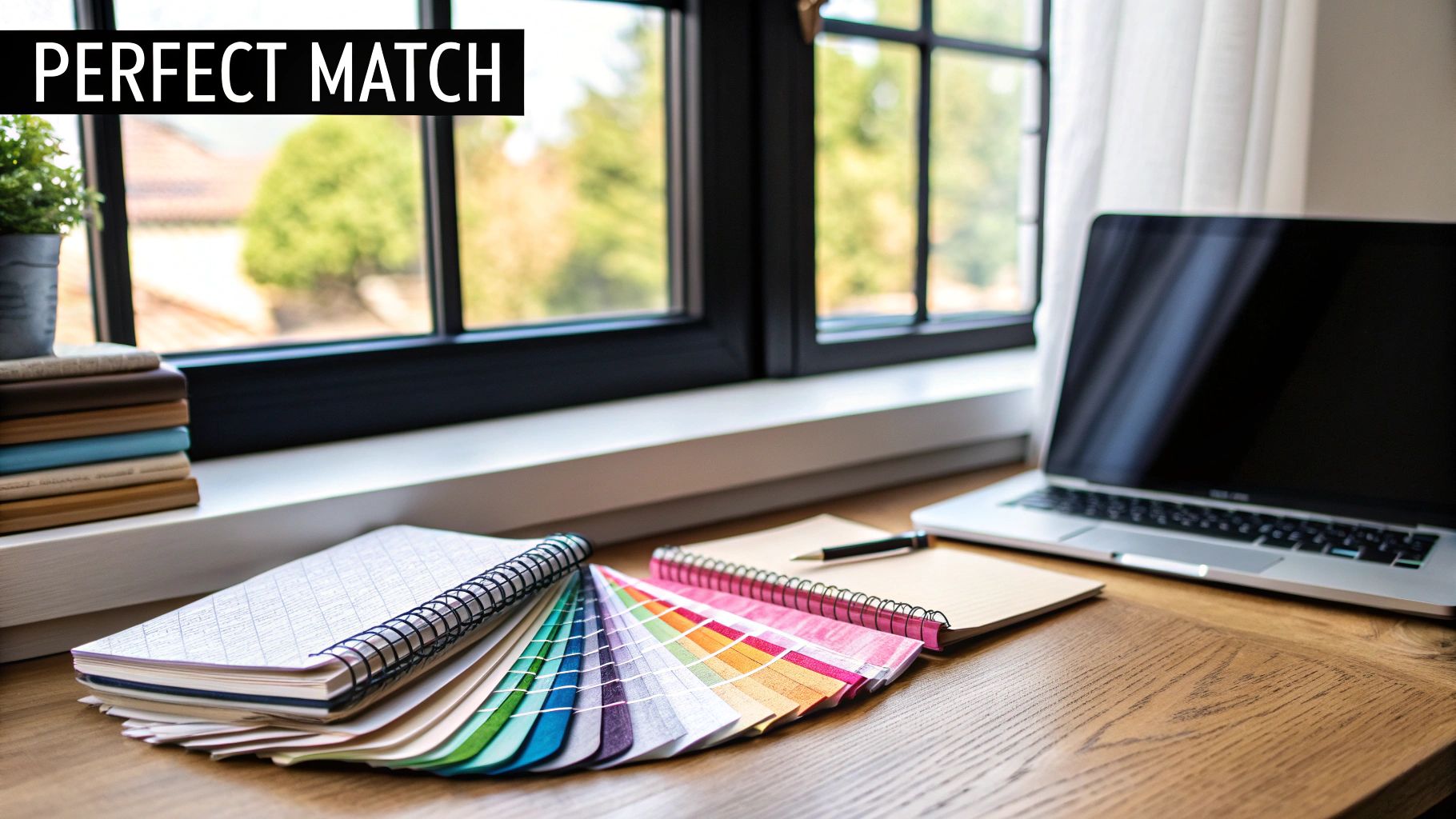
While DMC conversion charts are an incredible starting point, think of them as a guide, not a gospel. An exact number-for-number match on paper doesn't always guarantee a perfect match in person. Things like dye lot variations and even the material of the thread itself can cause subtle color differences that a chart just can't predict.
Honestly, the best way to be sure about a substitution is to get your hands on the actual thread. Laying the two skeins side-by-side lets you see nuances that a screen or printed page will always miss.
Looking Beyond the Numbers
When that specific DMC color is nowhere to be found, your own eye becomes your most valuable tool. Making a great substitution isn't just about color; it's about understanding how light and texture play together in your finished piece.
- Go to the Light: Always, always compare your thread choices in natural daylight. Your indoor lighting can cast a warm or cool tint, completely changing how the colors look and potentially leading you to a choice you'll regret.
- Think About Sheen: Different brands finish their threads differently. For example, a glossy Madeira floss might look out of place next to a more matte DMC thread, even if the color is spot on. You can dive deeper into the unique qualities of various types of embroidery floss in our other guide.
- A Thread Card is Your Best Friend: If you're serious about stitching, a physical thread card with real floss samples is worth its weight in gold. It gives you the truest color representation, something a monitor or phone screen can never quite achieve.
Ultimately, if a "perfect" match from a chart just looks off for your project, it probably is. Trust your gut. Choose the color that looks right and works best with the other colors in your palette, even if it's not the official converted number. Sometimes a slightly lighter or darker shade is exactly what the project needed all along.
Tips for Stitching with Converted Threads
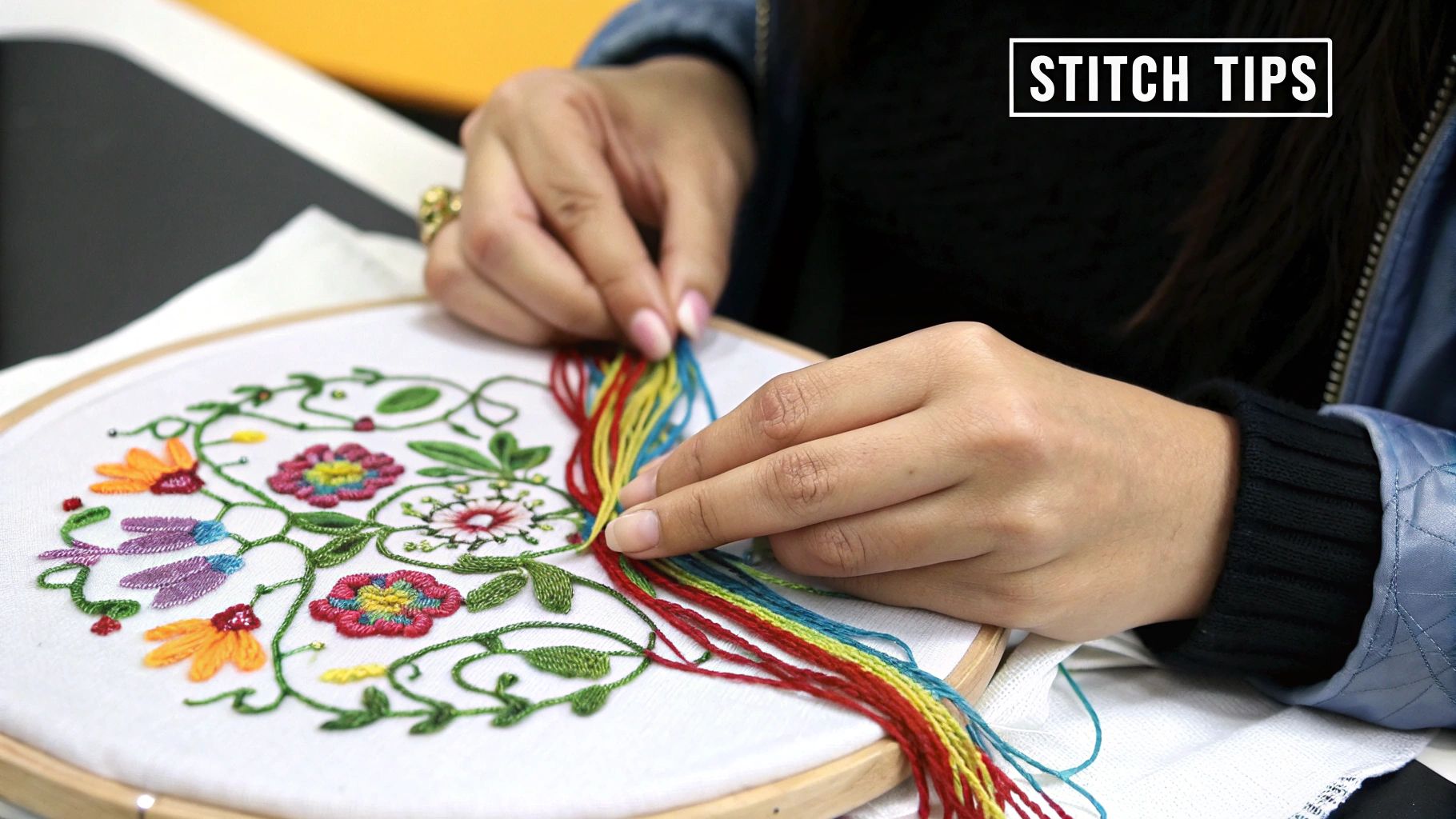
Using a DMC conversion chart is a game-changer for opening up your pattern options, but getting a flawless finish when you mix and match brands takes a little finesse. Threads from different manufacturers will always have subtle variations in thickness, sheen, and even how they feel sliding through the fabric. Knowing how to work with these differences is the key to a beautiful result.
The first thing you'll probably notice is the thread's thickness, or "grist." Some brands are just a bit finer, while others can be slightly more plush. An easy fix is to simply adjust the number of strands you're using. If a converted thread looks a little thin and isn't giving you good coverage, don't hesitate to add an extra strand to fill out your stitches.
Adjusting Your Technique for Consistency
Beyond just getting the color right, making your project look seamless is all about your stitching technique. How you handle the needle and thread can smooth over those minor differences between brands.
- Modify Stitch Tension: Got a thicker thread? You might need to loosen your tension just a tad to keep the fabric from puckering. For a finer thread, a slightly tighter pull can help ensure the fabric doesn't show through.
- Blend with Purpose: If you're tackling a large section of a single color, it’s a good idea to use thread from the same brand for that whole area. This keeps the texture and sheen perfectly uniform.
- Lead with the Dominant Brand: Is your project mostly one brand of floss? Let its characteristics be your guide. Set your standard tension and strand count based on what works best for that dominant thread.
Always Stitch a Test Swatch: Before diving into your main project, grab a scrap of your Aida cloth and do a small test patch. This is, without a doubt, the best way to see how the converted colors truly look next to each other and how the threads behave. It’s your chance to check coverage, tension, and color harmony without putting your masterpiece at risk.
Using Digital Tools for Instant Thread Conversion
While I'll always have a soft spot for my trusty printed DMC conversion charts, I have to admit that digital tools have completely changed the game. For modern stitchers, websites and mobile apps offer a level of convenience and speed that a paper chart just can't compete with.
Think about it: instead of manually looking up every single color for a new project, you can convert an entire pattern's palette in just a few seconds. A huge time-saver! Plus, many of these apps come with handy inventory management features, letting you keep track of the threads you already have. This is brilliant for avoiding duplicate purchases and instantly knowing what you need to pick up for your next piece.
What to Look for in a Digital Converter
The best digital tools go way beyond simple conversions; they're more like a project assistant in your pocket. They're built to make your stitching life easier from the moment you pick a pattern.
Here are a few features I find particularly useful:
- Shopping List Creation: This one is a must. The app can compare your pattern's color list with your digital stash and automatically generate a shopping list of only the threads you’re missing.
- Multi-Brand Conversions: Ever found the perfect pattern but it only lists Anchor colors? A good converter will show you the DMC, Madeira, and Cosmo equivalents all at once.
- Palette Visualization: This is a fantastic feature. It lets you see the new, converted color palette on screen. You can spot any potentially "off" substitutions and make adjustments before you even thread your needle.
For anyone who's comfortable with tech, these tools are a no-brainer. They put accurate, up-to-the-minute conversions right at your fingertips, making project prep fast and painless.
And speaking of helpful digital aids, you can figure out your fabric size and other project dimensions with our cross-stitch calculator. It’s another great tool to have in your digital toolbox.
Your Top Questions About DMC Thread Conversions
Let's be honest, swapping thread brands can feel a bit like a high-stakes art experiment. You want your project to look just right, but what happens when you need to substitute a color? Here, I'll tackle some of the most common questions stitchers run into when using DMC conversion charts.
First things first: are the converted colors a perfect match? The short answer is no. Think of them as the closest possible match. Each brand has its own unique dye lots, manufacturing secrets, and finishing processes, so you'll always find slight differences in color, shine, and even the feel of the thread.
What If a DMC Color Has No Match?
It's a moment that can make any stitcher's heart sink a little. You scan the conversion chart for a specific DMC number, only to find a glaring blank space next to it. This isn't uncommon, especially with brand-new DMC shades or specialty threads that just don't have a counterpart in another brand's lineup yet.
Don't panic! You've got a few solid options:
- Go Old School: The most reliable method is to take your floss or a color card to the craft store. Nothing beats seeing the threads in person to find a substitute that fits your project's color scheme perfectly.
- Pick a Neighbor: Take a look at the DMC colors that are numerically close to the one you need. Often, a shade that's just a tiny bit lighter or darker will work beautifully and blend right in.
- Ask the Community: Online stitching forums and social media groups are invaluable. Post your dilemma—chances are, another stitcher has already solved this exact problem and can share their perfect substitution.
Key Takeaway: A DMC conversion chart is an incredible guide, but your own eye is the final judge. If a suggested color swap doesn't look quite right to you, trust your gut and pick one that does.
At the end of the day, these charts are here to help you get creative, not box you in.
Below are a few more quick-fire questions we hear all the time.
Common Questions on Thread Conversion
| Question | Answer |
|---|---|
| Why isn't the conversion a perfect match? | Each brand uses different dye formulas and manufacturing processes, leading to subtle variations in color, sheen, and texture. Charts show the closest available option, not an identical one. |
| Can I mix brands in one project? | Yes, you can! However, be mindful of differences in sheen and thickness, as this can affect the final look. It's often best for "confetti" stitches or small areas. |
| How often are conversion charts updated? | It varies. Most online charts are updated periodically as new colors are released, but printed charts can become outdated. Always try to use the most current version you can find. |
| What's more important: color or number? | When substituting, the visual color match is always more important than getting a numerically "close" thread from another brand. Trust what your eyes tell you. |
Hopefully, these answers clear things up and give you the confidence to tackle any project, regardless of the brand of floss you have on hand.
Ready to turn your favorite memories into a work of art? At Cross Stitched, we transform your photos into beautiful, easy-to-follow cross-stitch kits, complete with everything you need to get started. Create your own personalized masterpiece today.