When you first look at a cross stitch pattern, it can seem like a secret code. But don't be intimidated! It's really just a map. Reading a pattern simply means translating the symbols on a gridded chart into colorful 'X' stitches on your fabric.
Think of it this way: you find a symbol on the chart, look up what thread color it represents in the key, and then stitch it onto the corresponding square on your fabric. That's the core of it.
Your Guide to Cross Stitch Patterns
A cross stitch chart is a page filled with tiny symbols, numbers, and lines, all working together to guide your needle. Once you learn to read its language, you'll see it's a wonderfully logical system. Every single element, from the grid lines to the color codes, has a specific job to do.
The Anatomy of a Pattern
Every cross stitch pattern, whether simple or complex, is built from the same basic parts. Getting familiar with these components is the key to confidently tackling any project that comes your way.
The basic flow is simple: see a square on the grid, identify the symbol inside it, and find that symbol in the key to know which color to thread your needle with.

This rhythm—grid to symbol to key—is the heartbeat of cross stitching. You'll repeat it for every single stitch you make.
It's a craft that continues to grow, too. The cross-stitch market is projected to hit USD 0.24 billion by 2035, and popular magazines still pull in over 44,000 readers each month. With so many people picking up a needle and thread, understanding patterns is more important than ever.
My Pro Tip: Before you even think about making your first stitch, give the whole pattern a once-over. Check the total number of colors, get a feel for the finished size, and look for any notes about special stitches. A quick 30-second scan can save you a lot of headaches later on.
To help you get comfortable, let's break down the essential pieces you'll find on a typical chart.
Anatomy of a Cross Stitch Chart
This table gives you a quick rundown of what you're looking at when you open a new pattern.
| Pattern Element | What It Is | Why It's Important |
|---|---|---|
| Grid | The network of horizontal and vertical lines that makes up the chart. | Each square on the grid represents one cross stitch on your fabric. It's the foundation of your design. |
| Symbol | A unique character (like a letter, number, or shape) inside a grid square. | Each symbol corresponds to a specific thread color. This is how you know which color to use where. |
| Key/Legend | A list that matches each symbol to a specific thread brand and color number (e.g., DMC 310). | This is your color decoder. Without it, the symbols are meaningless. It tells you exactly which floss to buy and use. |
| Center Arrows | Arrows along the top and side edges of the grid that point to the center lines. | These help you find the exact center of the pattern, which is the best place to start stitching to ensure your design is centered on the fabric. |
Knowing these parts will make any pattern feel instantly more approachable.
Understanding this layout is especially helpful when you're not working from a paper copy. If you're using a tablet or computer, our guide on how to use a cross stitch pattern PDF has some great tips for digital stitching.
Once you have this foundational knowledge, what once seemed complicated becomes a simple, enjoyable process. You'll be ready to bring any design to life.
Finding Your Starting Point On Your Pattern
That moment before your first stitch can feel a little daunting, especially with a large chart spread out before you. Where in the world do you begin? The answer is almost always the same: start from the center. This simple practice is your best insurance against a design that ends up awkwardly shifted to one side.
Most patterns make this easy for you. Take a look along the top, bottom, and side edges of your chart. You'll likely spot small arrows or triangles pointing inward along the grid lines. Follow them to their intersection point, and voilà—that's the exact center of your design. Think of it as the "X marks the spot" on your stitching treasure map.

Locating Center On Your Fabric
Once you’ve found the center on paper, you need to mirror that spot on your Aida cloth. The classic folding method is the quickest and most reliable way to do this.
- First, fold your fabric in half lengthwise and make a gentle crease.
- Next, fold it in half again widthwise, creating a second soft crease.
- Now, unfold the fabric. The point where those two creases cross is the physical center of your material.
I usually mark this spot with a pin or a water-soluble fabric marker, but you could also just make your very first stitch right there. Taking this one simple step can save you from the nightmare of running out of fabric halfway through a project.
A Stitcher's Pro Tip: I often use a single loop of a contrasting, bright thread to mark my center. It’s impossible to miss and pulls out easily later on without leaving any residue or pinholes.
Counting Your Way Out From The Center
With your starting position anchored on both the chart and the fabric, you can now navigate anywhere on the pattern with confidence. The bold 10x10 grid lines on your chart are your best friends here; use them as guideposts.
Let's say the first symbol you want to stitch is five squares up and three squares to the left of the center mark on your chart. You just mimic that movement on your fabric. From your marked center point, simply count five squares up and three squares over, and you're ready to make your first stitch.
This counting method is really the core skill you need to read any cross-stitch pattern accurately. It breaks a massive, intimidating design down into small, manageable chunks. You’re now set up to stitch with perfect placement every single time.
Cracking The Code: Symbols and DMC Colors
Once you’ve got your bearings on the grid, it’s time to dive into the heart of the pattern: the symbols. Every little square filled with a shape, letter, or icon is a command telling you which color thread to use for that exact stitch. This is where your symbol key, sometimes called a legend, becomes your best friend.
Think of the key as the Rosetta Stone for your project. It’s a simple chart that pairs every unique symbol on the grid—whether it’s a star, a triangle, or the letter 'B'—with a specific DMC color code. DMC is the gold standard for embroidery floss, so their numbering system is something you'll see on almost every pattern out there.
For instance, you might see a black square symbol (■) on your chart. A quick glance at the key will show that it corresponds to DMC 310, the code for classic black floss. That's your cue to thread your needle with DMC 310 and get stitching. This universally understood system is a huge part of why the needlecraft industry is so successful, with the market for patterns alone estimated to be around USD 500 million. You can dig deeper into the needlecraft patterns industry on archivemarketresearch.com.

What Your Symbol Key Is Really Telling You
A good symbol key gives you more than just the color number. Take a closer look, and you’ll find other vital pieces of information you need to stitch the design just right.
- DMC Number: This is the non-negotiable part. It's the specific code for the thread color, like 310 for black or 743 for a medium yellow.
- Color Name: Most keys also list the color name ("Black" or "Medium Yellow"), which is a nice sanity check.
- Number of Strands: This is critical. Standard DMC floss is made of six strands, but patterns usually ask you to use just two at a time for your main cross stitches. Using the wrong number can completely change the look of your project.
- Stitch Type: The key will also clarify if a symbol is for a standard cross stitch, a backstitch, or another specialty stitch.
A Stitcher's Pro Tip: Before you make your first stitch on a new kit, take a few minutes to organize your threads. I swear by using a floss organizer or even just hole-punching some index cards to keep each color labeled and tangle-free. It saves so much time compared to hunting through a messy pile every time you need to switch colors.
Blended Colors And Color Blocks
Every so often, you’ll spot a symbol in your key that’s matched with two different DMC numbers. No, it's not a typo! This indicates a blended stitch. The designer wants you to take one strand from each of the two specified colors and thread them through your needle together. This clever trick creates a subtle, custom shade that adds incredible depth and realism to your piece.
You might also come across patterns, especially simpler or more modern ones, that use color blocks instead of symbols. Here, the grid squares are just filled with color. It’s a more direct, visual way to stitch, but it can get tricky when you have several shades of the same color that look almost identical on paper. When in doubt, always trust the key to confirm the correct DMC number. For a full rundown, check out our comprehensive guide to the DMC threads chart.
4. Reading Special Stitches and Line Work
Once you get the hang of the basic cross stitch, you'll start noticing other little markings on your chart—lines, dots, and tiny triangles. These are special stitches, and they’re what truly bring a design to life. They add the texture, definition, and intricate details that elevate a project from just a bunch of squares into a real piece of art.
Think of them as the finishing touches. Most patterns use special stitches for outlining shapes, adding lettering, or creating delicate features like the sparkle in an eye or the slender stem of a flower. They might look a bit intimidating at first, but reading them is just as straightforward as the rest of the chart once you know what to look for.

Decoding Backstitch and Outlines
The most common special stitch by far is the backstitch. On your pattern, you'll see this marked as solid lines, often in a bold, contrasting color like black. These lines show you exactly where to place straight stitches to outline shapes, define text, or add fine details like whiskers on a cat.
The line on the chart will stretch from one corner of a grid square to another. Your goal is to simply replicate that line on your fabric, usually with a single strand of floss for a delicate look. So, if a line on the pattern spans three grid squares, you'll make one long backstitch that covers those same three squares on your Aida.
Pro Tip: I always save my backstitching for the very end. This keeps those neat little outlines from getting snagged, loosened, or distorted by my hoop while I'm busy filling in all the cross stitches.
Interpreting Fractional Stitches and Knots
Beyond simple lines, some charts get a little more complex to create smoother, more detailed images. These advanced stitches are what separate a good piece from a great one.
-
Fractional Stitches: Have you spotted a symbol that only fills up a corner or three-quarters of a grid square? That's a fractional stitch (either a quarter stitch or a three-quarter stitch). Designers use these to soften sharp corners and create more realistic curves. You just make a partial "leg" of a cross stitch that matches what you see on the chart.
-
French Knots: Those tiny, filled-in circles or solid dots on a pattern almost always mean it's time for a French knot. These create lovely, raised dots perfect for adding texture—think eyes on a character, the center of a flower, or stars dotting a night sky. The symbol's placement on the grid tells you exactly where to pop the knot.
To help you quickly identify these on any pattern, here's a quick reference guide for how they are typically represented.
Interpreting Special Stitch Symbols
| Stitch Type | Common Symbol on Chart | Primary Use |
|---|---|---|
| Backstitch | Solid or dashed lines connecting grid intersections | Outlining, lettering, and adding fine details |
| Quarter Stitch | A small symbol (often a triangle) filling ¼ of a grid square | Creating curves and smoothing jagged edges |
| Three-Quarter Stitch | A symbol filling ¾ of a grid square (a quarter + a half stitch) | Refining details and curves where more coverage is needed |
| French Knot | A small, solid dot or circle centered in a grid square | Creating textured dots for eyes, flower centers, or stars |
Remember, this table shows the most common symbols, but a designer can use anything they want. Your pattern’s key is always the final authority on what each mark means.
A quick word on French knots: many stitchers find them tricky to get just right. If you're struggling, a great alternative is the colonial knot, which some find easier to master. For a perfectly uniform look, you could even substitute a tiny bead if the design allows for it. Just make sure to always check your pattern's key—it will tell you exactly what the designer intended for each special symbol.
So, you've got the basics down and now you're eyeing those huge, full-coverage pieces with hundreds of colors. It’s an exciting next step! These highly detailed designs, the ones that look almost like photographs, are incredibly rewarding but definitely require a different game plan.
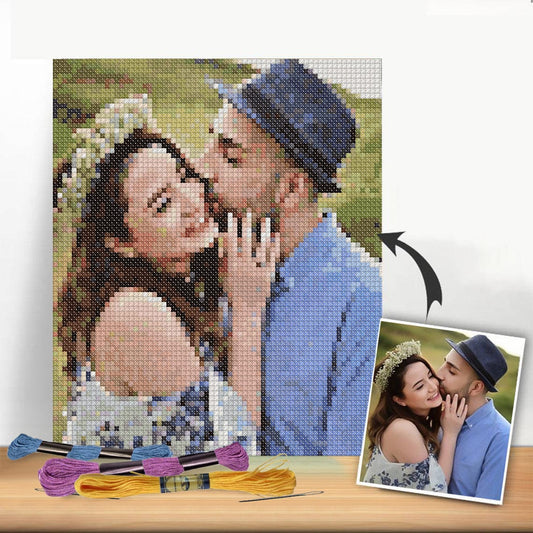
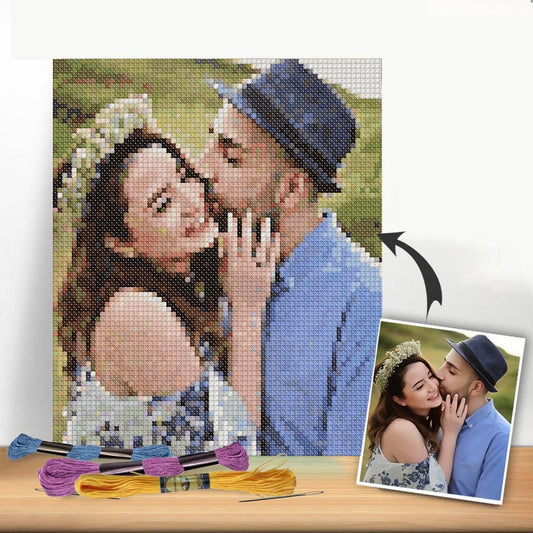
Custom kits, especially those generated by tools like Pic2Pat, often introduce you to a concept affectionately known in the stitching world as confetti. This is just a nickname for areas packed with single, isolated stitches of many different colors. On the chart, it looks like pure chaos, but it's the secret to creating those beautiful, subtle shading effects.
Don't let a chart that looks like a Jackson Pollock painting scare you off. A little bit of planning and a few new techniques are all you need to conquer these epic projects without losing your mind. The trick isn't to stitch faster, but to stitch smarter.
This push towards more intricate designs is a huge deal in the crafting world. In fact, the global needlecraft patterns market was valued at nearly USD 34 billion in 2025 and is only expected to keep growing. Stitchers are hungry for more sophisticated and personal patterns, which makes knowing how to read them more important than ever. You can learn more about the booming needlecraft market on futuremarketinsights.com.
Stitching Methods for Complex Charts
When you're staring down a section full of confetti, you have two main ways to tackle it. There’s no right or wrong answer here; it all comes down to what feels most comfortable and efficient for you.
-
Cross-Country Stitching: This is probably how you learned. You stitch all the symbols of one color in a given area before swapping your thread for the next color. It works wonderfully for patterns with big, solid blocks of color. But for confetti? You’ll be starting and stopping constantly, which can get old pretty fast.
-
The Parking Method: For many stitchers, this technique is a total game-changer for complex patterns. Instead of working color by color, you work stitch by stitch, often in a 10x10 grid. When you're done with a color in that little square, you don't cut the thread. You simply "park" it by bringing your needle up in the next spot on the chart where that same color appears. The thread just hangs out on the front of your fabric until you get to that square.
The Parking method is fantastic for keeping the back of your work tidy and it saves a surprising amount of thread. It does demand more concentration, but it transforms a confetti-filled mess into a calm, methodical process.
Managing Multi-Page Patterns and Floss
Bigger projects mean bigger charts—often printed across multiple pages. To keep from getting lost, look for the overlap guides. These are usually a few rows or columns on the edge of each page that are grayed out. They show you stitches from the neighboring page, so you can line everything up perfectly and avoid any weird gaps or seams in your finished piece.
Getting your floss in order is just as important. When you're dealing with a kit that has over 100 colors, your little plastic bobbin box isn't going to cut it. A popular solution is to create your own "floss drops." Just get some cardstock tags, label them with the DMC number and the pattern symbol, and loop your threads through. It makes grabbing the right color a breeze.
Ultimately, finishing a massive, complex piece is all about breaking it into manageable bites. Concentrate on one 10x10 grid at a time, get your supplies organized before you even make the first stitch, and trust the process. For more pro tips, check out our guide to working with complex cross stitch patterns.
Frequently Asked Questions About Reading Cross-Stitch Charts
Even seasoned stitchers hit a snag now and then when reading a pattern. Certain questions pop up over and over in stitching circles, from beginner forums to seasoned Facebook groups. This is where we tackle those common head-scratchers so you can get back to what you love—stitching.
Think of this as the collected wisdom from stitchers who’ve been there, done that, and figured out a clever fix. We’ll cover everything from telling tricky symbols apart to not getting lost on a huge, full-coverage piece.
What To Do When Two Symbols Look Almost Identical
It’s the classic cross-stitch dilemma. You’re staring at a black-and-white chart, and one symbol is a solid black circle while the other is a solid black square. After an hour of stitching under less-than-ideal light, they all start to look the same.
First off, good lighting is non-negotiable. Stitching near a bright window or using a daylight lamp can make a world of difference. A magnifier is also a stitcher’s best friend, whether it's a simple handheld one or a lamp with a built-in lens. It brings those tiny symbols into crisp, clear focus.
But my favorite trick is to color-code the chart before I even start.
- For paper charts: Grab a pack of highlighters. Before you thread your needle with a new color, go through and highlight every single corresponding symbol on the page. Use a completely different, bright color for the next symbol you plan to tackle.
- For digital patterns: If you're using a PDF reader or a dedicated app, there's almost always a markup tool. Use it! Tapping a symbol to "check it off" as you go is incredibly satisfying and keeps you organized.
When you’re truly stuck, don't forget your best reference: the finished picture that came with the pattern. If you honestly can't tell if a square is meant to be dark brown or black, a quick glance at the final image will usually solve the mystery based on its location.
What Do Overlapping Symbols Mean In The Key?
Every now and then, you'll look at your pattern's key and see a single entry with two different DMC numbers listed next to two overlapping symbols. Don't worry, it’s not a typo! This is the designer's way of telling you to create a blended stitch.
This technique is a fantastic way to create a soft, unique color that you can't get straight off the bobbin. It adds a beautiful, painterly depth to the finished piece.
To make a blended stitch, you just take one strand of each color and thread them through your needle at the same time. So, if the key shows DMC 310 (black) and DMC 762 (light gray) paired together, you'll stitch using one strand of black and one strand of gray.
How Can I Keep My Place On A Really Big Pattern?
Losing your place on a massive, full-coverage chart is practically a rite of passage. It happens to everyone. That sea of symbols can be overwhelming, but stitchers have come up with some brilliant methods for staying on track.
A lot of people simply use a highlighter on their paper charts, coloring in the squares as they finish them. An even better method, in my opinion, is using a magnetic board. You can slide a long magnetic strip down your chart row by row, which keeps your current working line perfectly marked.
For those of us who've gone digital, pattern-keeper apps are an absolute lifesaver. They let you tap and mark off stitches right on your tablet or phone, making it almost impossible to lose your spot. It's a clean, eco-friendly way to manage your progress on any project, big or small.
Ready to turn your favorite photo into a stitched work of art? At Cross Stitched, our custom kits give you everything you need, from pre-sorted threads to a perfectly charted pattern. Start creating your personalized masterpiece today.