So you’re thinking about swapping Weeks Dye Works floss for DMC? It’s a common move, and it's simpler than you might think. The short version is this: start with an online conversion chart, but always—and I mean always—double-check the suggested DMC solid color against your WDW thread with your own eyes.
The real trick is understanding what makes them different. WDW gives you that gorgeous, hand-dyed variegation, while DMC delivers rock-solid, consistent color. Let's break down how to make smart substitutions that will make your project shine.
WDW vs. DMC: What's the Real Difference?
Choosing between Weeks Dye Works and DMC is a bit like choosing between watercolor and acrylic paint. Both are fantastic, but they create entirely different effects. Getting to know their unique personalities is the key to successfully converting one to the other.
Weeks Dye Works came onto the scene in the early '90s and really changed the game with its hand-overdyed floss. WDW is all about subtle, variegated color that ebbs and flows, giving your stitching a beautiful, artisanal texture. It’s my go-to for anything with a rustic, vintage, or folk-art vibe.
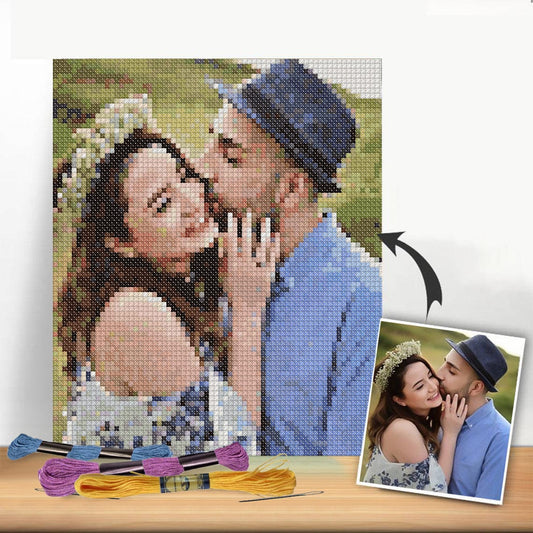
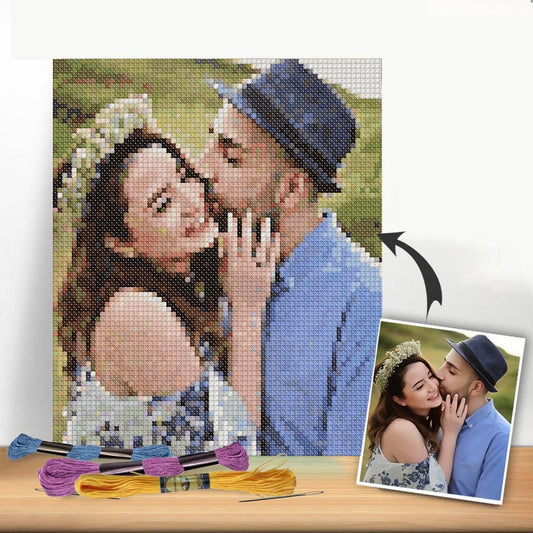
Then you have DMC, the tried-and-true classic. With a history going all the way back to 1746 in France, DMC is the gold standard for consistency. Its massive range of over 489 solid colors means you get the exact same shade every time, which is essential for detailed, photorealistic pieces—like the custom kits we create from photos. The global embroidery thread market is full of options, but these two are pillars of the craft for a reason.
Key Differences at a Glance
Let's put them head-to-head to see where each one excels. WDW is perfect for creating organic, blended looks, while DMC is the undisputed champ of precision.
Weeks Dye Works (WDW)
- Color Style: Variegated. You get gentle, non-repeating color shifts along a single strand of floss. No two stitches look exactly alike.
- Texture & Finish: It's a bit softer and has a matte finish, which lends a lovely, aged feel to your work.
- Consistency: Because it's hand-dyed, you'll see variations from one dye lot to the next. It's part of its charm!
- Best For: Samplers, folk art, and any design where those soft color movements add character and depth.
DMC (Dollfus-Mieg & Cie)
- Color Style: Solid. The color is perfectly uniform from one end of the skein to the other.
- Texture & Finish: That signature DMC look comes from its mercerized cotton, which gives it a smooth feel and a subtle sheen.
- Consistency: Incredibly standardized. A skein of DMC 310 bought in Ohio will be identical to one bought in France. No dye lots to worry about.
- Best For: Photorealistic patterns, projects with complex shading, and anything that demands precise, repeatable color matching.
Understanding the Core Differences in Thread Behavior
To really get a feel for converting Weeks Dye Works to DMC, you have to understand that these threads don't just look different—they behave differently. The way they pass through the fabric, catch the light, and contribute to the final piece is fundamentally distinct. Knowing these quirks is the secret to making smart substitutions that truly work for your project.
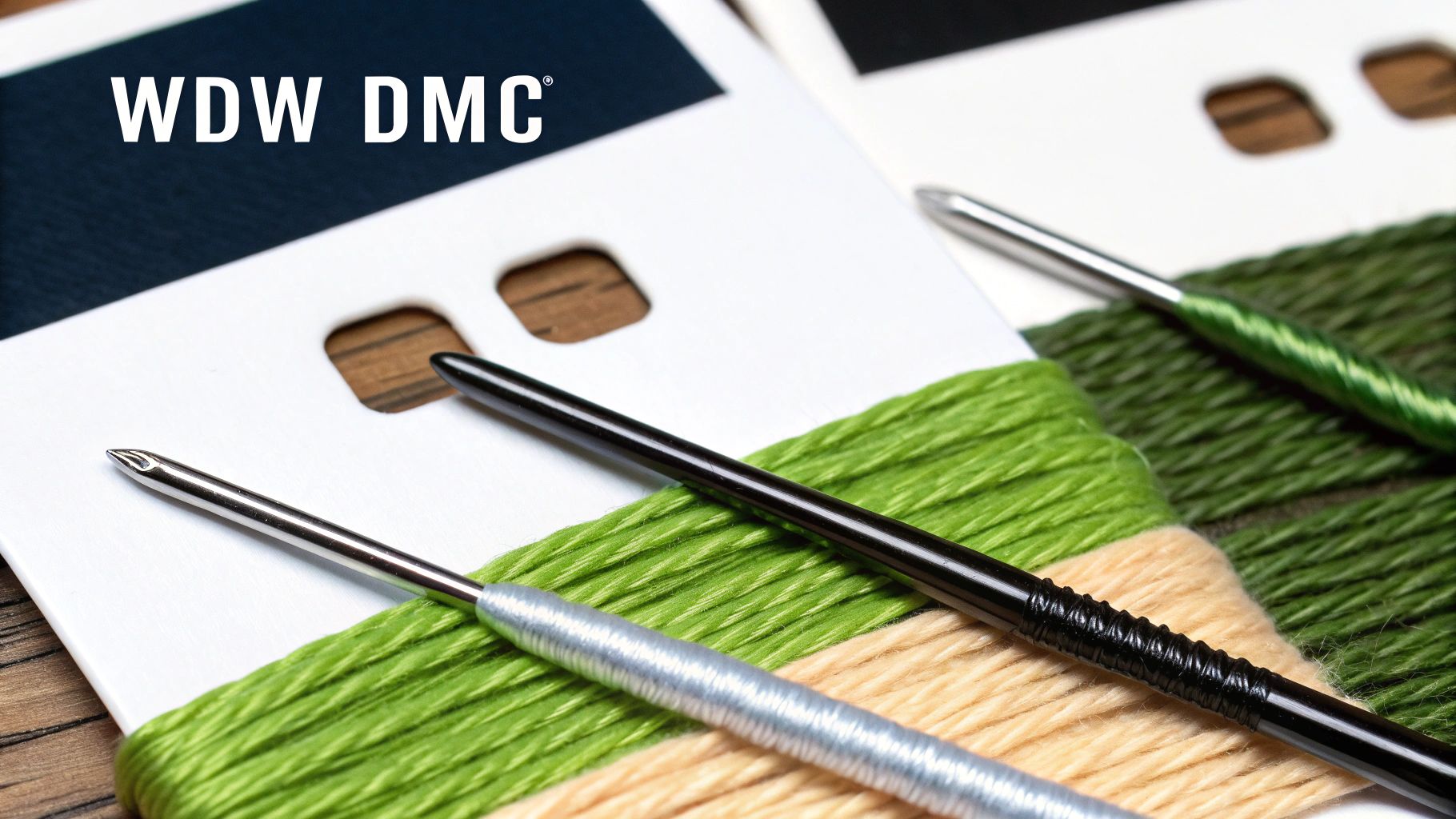
Weeks Dye Works floss is a product of its hand-overdyed origins. The cotton fibers are a bit less twisted and aren't mercerized, which gives it a wonderfully soft, almost fluffy feel and a signature matte finish. This absence of shine lends projects a gentle, vintage, or rustic quality. Of course, the subtle, organic color variations are the star of the show, creating a depth that solid colors just can't match.
DMC, on the other hand, is the gold standard for consistency. Its mercerized cotton has been treated to boost its luster, strength, and ability to hold dye. This is what gives DMC its famous subtle sheen and silky-smooth texture, letting it glide through fabric with ease.
Finish and Feel in Your Hands
The experience of actually stitching with these two threads couldn't be more different. WDW can feel a little "grippy" and have more drag as you pull it through the fabric—a quality many stitchers love because it feels like it gives them more control. In contrast, DMC’s smoothness makes for exceptionally uniform stitches with less fuss, which is why a full 65% of Cross Stitched users say they prefer it for getting that perfect, even coverage on Aida.
The biggest difference really comes down to predictability. With DMC, you know you're getting a uniform line of color with a slight sheen, every time. With WDW, you get a softer, matte texture with an artistic, gentle flow between shades that you can't precisely control.
Durability and Colorfastness
When you're pouring hours into a piece you want to last a lifetime, thread stability is non-negotiable. This is where DMC really shines. Based on ISO testing, DMC threads can handle over 50 wash cycles at 40°C without any major fading. Weeks Dye Works threads are colorfast, but they come with a reported 30% higher risk of shrinkage in similar washing conditions, which is definitely something to think about for items that will be laundered.
This incredible durability is precisely why our Cross Stitched kits, which we ship to over 100 countries, rely on DMC. We want to ensure every personalized photo pattern you stitch becomes a lasting heirloom.
Ultimately, the right thread depends on your project's goals. If you're stitching a photorealistic portrait that needs precision and longevity, DMC's consistency is your best bet. But for a charming sampler or a folk-art piece where a bit of texture and variegation is part of the appeal, WDW is a fantastic choice. To learn more, you can dig deeper into the world of cotton embroidery thread and its properties.
How to Reliably Convert WDW to DMC Floss
Swapping Weeks Dye Works for DMC is part science, part art. While you'll find plenty of conversion charts online, treating them as gospel can get you into trouble. A chart can’t account for the beautiful, subtle variations that come from hand-dyeing, where every dye lot is slightly different.
What you see on your screen is another wildcard. Monitor settings can drastically alter how a color appears, so the floss that arrives in the mail might not be what you expected. The best approach? Use the charts as a starting point, but always trust your own eyes to make the final call. This little bit of extra work ensures your finished piece looks exactly how you envisioned it.
A Practical Weeks Dye Works to DMC Conversion Chart
To get you started, I've put together a quick-reference chart for some of the most popular WDW colors and their go-to DMC equivalents. Think of this as your shortlist for auditioning threads. Pay close attention to the notes—that’s where the real magic of a perfect substitution lies.
Weeks Dye Works to DMC Common Conversion Chart
| Weeks Dye Works Color | Recommended DMC Equivalent(s) | Conversion Notes (e.g., Slightly Lighter, Blend For Effect) |
|---|---|---|
| WDW 1101 Angel Hair | DMC 746 or B5200 | DMC 746 is a bit creamier, while B5200 is a pure, bright white. |
| WDW 1171 Dove | DMC 647 or 648 | DMC 647 is a very close match for a solid medium gray. |
| WDW 1232 Palomino | DMC 841 or 842 | DMC 841 is the standard choice here and a reliable medium beige. |
| WDW 1269 Chestnut | DMC 839 or 840 | A lovely, rich brown. Go with DMC 839 if you need it a touch darker. |
| WDW 1302 Pelican Gray | DMC 3799 | This is an almost perfect match for a deep charcoal gray. |
| WDW 2197 Oscar | DMC 3011 and 3012 | Use one strand of each to mimic the subtle olive-green variegation. |
| WDW 2211 Olive | DMC 732 or 733 | DMC 733 is a classic, dependable substitute for this beautiful olive. |
This process works just as well for other hand-dyed brands. If you want more tips, our guide on converting Classic Colorworks to DMC has some great advice that applies here, too.
The Art of Auditioning Your Floss
Once you have your potential DMC replacements in hand, it's time to "audition" them. This is, without a doubt, the most crucial step for getting an accurate conversion. It’s about more than a quick look; you need to see how the threads behave in different situations.
Here’s a simple, foolproof method I always use:
- Lay Them Side-by-Side: Snip a strand of your WDW floss and place it right next to the DMC you’re considering. This is where you’ll spot those sneaky undertones. Is the DMC a little warmer, cooler, or maybe a bit muddier? Your eyes will tell you instantly.
- Check in Different Lighting: Color is a chameleon. Take your thread pairing and look at it in natural daylight, under a bright LED craft lamp, and even under the warm glow of a standard lightbulb. A true match will look right no matter the lighting.
- Stitch a Small Swatch: The ultimate test. On a scrap of your project fabric, stitch a little 10x10 block with the original WDW and another right next to it with the DMC. This shows you exactly how the color plays with the fabric and lets you compare the final texture and sheen.
By taking a few extra minutes to audition your floss, you move from hoping for a good match to guaranteeing one. It’s the professional's secret to seamless substitutions.
This hands-on method lets you make confident choices, making sure your weeks dye works to dmc conversion honors the original design's spirit. It closes the gap between what a chart says and what your project truly needs.
Adapting Your Stitching Technique for Each Thread Type
Making the switch from Weeks Dye Works to DMC is more than just a color-for-color swap; you'll need to tweak your stitching habits, too. These threads feel and behave differently, and knowing what to expect is the key to a beautiful finish. Your technique has to match the thread's unique personality.
Hand-dyed WDW floss often has a slightly thicker, more textured feel than its DMC counterpart. Some stitchers describe it as having more "grab," which means it might not slide through the fabric quite as effortlessly. You may find yourself naturally loosening your tension just a bit to help the stitches lay flat and prevent any puckering.
Managing Variegation and Coverage
The real magic of WDW is its subtle, organic variegation. But this beautiful quality requires a bit of strategy to prevent "pooling," where one shade clumps together in an obvious patch. To get that perfectly blended look, give these methods a try:
- Complete Each Cross Stitch Individually: Instead of the common method of stitching a row of half stitches and then coming back to complete them, finish each "X" before moving on. This simple change breaks up the color transitions beautifully.
- Turn Your Needle: Every few stitches, give your needle a little quarter-turn. It seems small, but this action twists the floss just enough to alter how the color lays, distributing the variegation more evenly.
- Try Cross-Country Stitching: When you have a large block of a single variegated color, stitching in a more random, "cross-country" pattern helps scatter the color variations naturally, avoiding any harsh lines or blocks.
On the other hand, DMC's smooth, mercerized finish and completely uniform color offer predictability and fantastic coverage. Its biggest advantage is consistency, which is perfect for creating solid, even areas of color without any special handling. The first stitch will look exactly like the last.
This visual guide breaks down the essential checks for any thread conversion project.
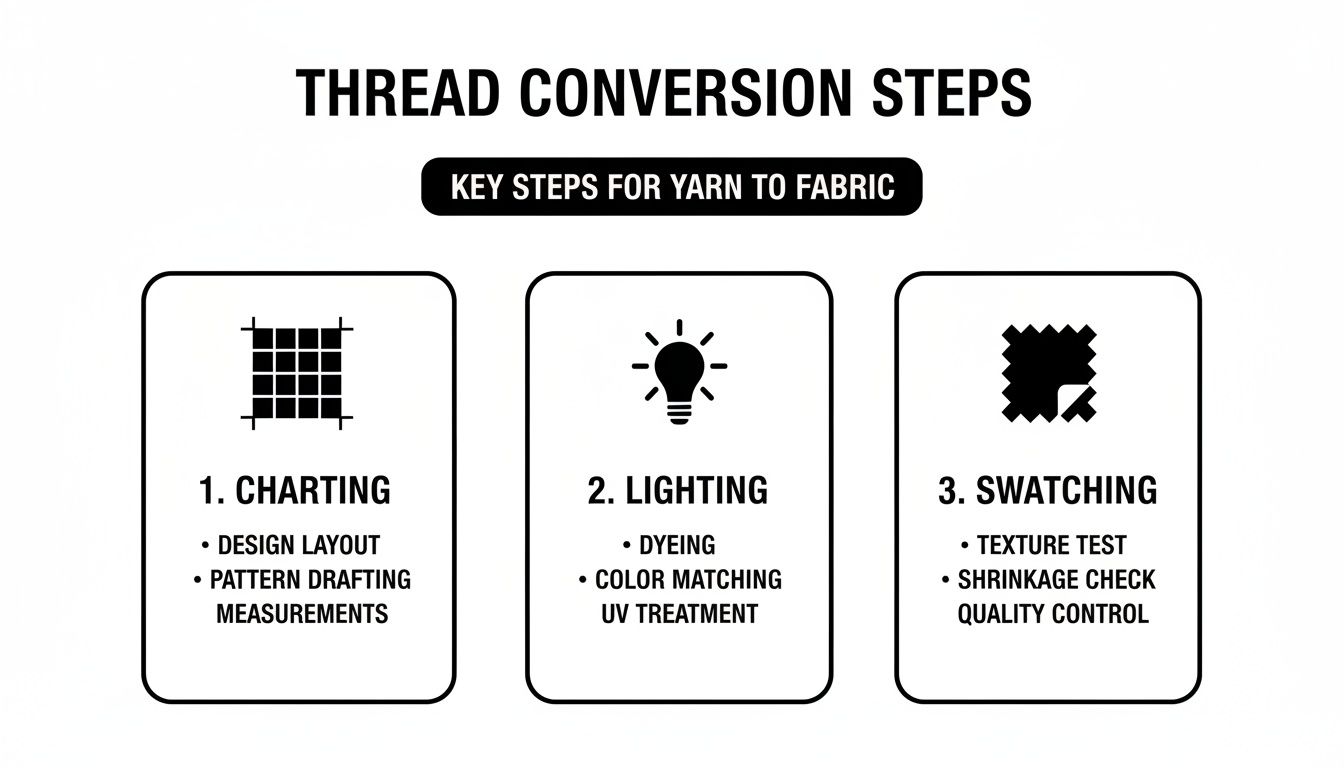
As the diagram shows, a good conversion always comes down to checking your charts, seeing the colors in good light, and stitching a small swatch to be absolutely sure.
Adjusting Floss Usage
The texture of WDW also affects how many strands you might need, particularly when you change fabric counts. Since it’s a bit loftier, you might find that two strands of WDW give you fuller coverage than two strands of DMC on the very same fabric.
A quick tip: if you're swapping in DMC for WDW on a higher-count linen, like 32-count or above, think about using three strands of DMC. This can help you mimic the plush, full coverage you’d get from two strands of WDW. As always, stitch a small test area first to see if you like the look.
This small change can make a huge impact on the final texture and density of your project, making sure it turns out just the way you imagined.
Why Consistency is Everything for Custom Photo Patterns
When you decide to turn a treasured photo into a cross-stitch pattern, you’re trying to capture something incredibly personal. It could be the exact shade of your child's hair, the soft blush on a bride's cheek, or the subtle shift in colors during a perfect sunset. To get those details just right, thread consistency isn't just a preference—it's an absolute must.
This is exactly why DMC is the gold standard for custom photo kits. Think about it: a photograph isn't made of a few solid colors. It’s a beautiful, complex mosaic of thousands of distinct, tiny shades. To even begin to replicate that, you need a massive and perfectly reliable palette. DMC's system, with its 489 solid shades, gives us the control needed to render those photorealistic details with incredible accuracy.
The Bedrock of a Family Heirloom
Hand-dyed threads from brands like Weeks Dye Works are gorgeous and add a wonderful, rustic texture to many projects. But for a portrait, that beautiful, natural variation can actually work against you. The subtle shifts in color within a single skein can disrupt the smooth gradients needed for skin tones or landscapes. Imagine stitching a face only to have the cheek color change halfway across—it would instantly break the illusion of realism.
DMC threads are designed to eliminate that risk. They're engineered for exceptional colorfastness and durability, so you can be sure that a piece you pour your heart into will last for generations without fading or bleeding. This kind of reliability is crucial when you’re creating something meant to be a true family heirloom.
When it comes to custom photo patterns, predictability isn’t a limitation; it's a feature. DMC’s unwavering consistency guarantees that the color you use on day one will be the exact same shade you use a month later, protecting the integrity of your original photograph.
The embroidery thread market is growing, expected to expand from $3.5 billion to a projected $5.7 billion by 2033. Even in this expanding field, DMC's six-strand, 100% long-staple Egyptian cotton is a standout. It has a tensile strength that’s 20% higher than generic brands, making it tough enough for large, complex custom designs. This is why we trust it for our Cross Stitched kits; precise shade matching prevents the color bleeding that can sometimes happen with overdyed threads after washing. You can read more about the growth of embroidery thread markets on datainsightsmarket.com.
Plus, DMC is available almost anywhere in the world. If you run out of a color, you can find a replacement skein easily, ensuring your project never has to stall. When you order a custom kit from us, you're getting a palette chosen specifically for its precision, quality, and longevity. You can see the entire selection in our detailed guide to the DMC thread chart and its colours. It's a choice that lets you create a timeless piece of art with total confidence.
Common Questions About Thread Conversion
When you start swapping threads, especially from a hand-dyed line like Weeks Dye Works to a commercial one like DMC, a ton of questions pop up. It's totally normal. You might worry about getting the colors right, how the final piece will look, or what to do about dye lots. We've been there, so let's walk through some of the most common questions stitchers ask.
Getting these answers straight will help you dodge common frustrations and make smart choices for your project, whether you're sticking to the original design's intent or intentionally making it your own.
Can I Always Swap One WDW Color for One DMC Color?
That's a great question, and the short answer is: not always. While many WDW colors have a pretty solid DMC counterpart, a simple one-for-one swap can miss the mark, especially with highly variegated floss. The magic of WDW is in its subtle shifts in color, and a single solid DMC thread just can't replicate that beautiful, gentle movement.
When a WDW thread has a lot of color variation, a better approach is often to blend two or three similar DMC shades. You do this by putting one strand of each color in your needle at the same time. This creates a "tweeded" effect that does a surprisingly good job of mimicking the original variegated look. For example, to replace a WDW green that shifts from light to medium olive, you might blend a strand of a light olive, a medium olive, and maybe even a slightly brighter green.
The real secret? Always stitch a small test swatch first. It's the only way to see how the blended colors will actually look on your fabric. This little step can save you a world of regret and is absolutely essential for a successful conversion.
How Should I Handle WDW Dye Lot Variations?
Dye lot differences are part of the charm of any hand-dyed floss. Since every skein is dyed by hand in small batches, you’re going to see slight color variations from one lot to the next—it's just the nature of the beast. In fact, it's one of the main reasons some stitchers prefer standardized threads for huge or photorealistic projects where absolute color consistency is a must.
To make sure your color stays uniform with WDW, the best thing you can do is buy all the floss you need for one color at the same time. Before you buy, check the tags and make sure the dye lot numbers match. If you run out mid-project and have to use a skein from a different dye lot, you can blend them together so the change isn't noticeable.
- Alternate Strands: For a few rows, thread your needle with one strand from the old skein and one from the new one.
- Gradual Transition: This technique creates a soft, almost invisible transition between the two dye lots, so you won't see a harsh line where the color changed.
This is a huge difference from DMC, which has no dye lots. A skein of DMC 310 you buy today will be the exact same shade as one you bought ten years ago, which is a big relief for some projects.
Will Using DMC Change How My Project Looks in the End?
Yes, absolutely. Swapping a solid DMC for a variegated WDW will definitely give your project a different vibe, and it’s good to know what to expect. The change isn't just about color—it's also about texture and finish. A piece stitched completely in DMC will look more uniform, crisp, and clean. That classic mercerized cotton gives it a slight sheen that catches the light nicely.
On the other hand, WDW gives a softer, more rustic, and organic feel. Its matte finish is perfect for creating a vintage or primitive look. Neither one is better; they’re just different. It all comes down to the look you're going for. If a pattern relies on sharp, photorealistic detail, DMC's precision is probably the better choice. But for folk art or sampler styles, the gentle variegation of WDW adds a charm and character that's hard to replace.
Why Are Online Conversion Charts Sometimes a Bit Off?
Online conversion charts are fantastic tools, but think of them as a good starting point, not the final word. There are a few reasons why they might not be 100% accurate. For one, color perception is really subjective—what looks like a perfect match to one person might seem slightly off to another.
Also, remember that the person who made the chart was working with a specific dye lot of WDW floss. As we've covered, hand-dyed threads vary, so the DMC color that matched their skein might not be the best match for the one sitting in your stash. And finally, screen calibration is a huge factor. The colors on your monitor can look wildly different from the actual threads in your hand. This is why a successful weeks dye works to dmc conversion always comes down to physically comparing the threads side-by-side in natural daylight before you start stitching.
Ready to turn your favorite photo into a work of art? At Cross Stitched, we handle all the thread matching for you. Every custom kit arrives with perfectly matched, pre-sorted DMC threads, so you can skip the guesswork and get right to stitching.
Start Your Custom Cross-Stitch Project Now