Picture this: you're looking at two different types of fences. One is a fine mesh screen, almost like a window screen, with tiny, intricate openings. The other is a classic garden lattice, with big, clear squares you could easily poke your finger through.
That's the best way to think about the difference between high-count cross stitch fabrics and 8-count Aida. This fabric is the garden lattice of the stitching world—open, inviting, and wonderfully easy to work with. It's the perfect welcome mat for anyone stepping into the craft for the first time.
So, What Exactly Is 8-Count Aida?
The "8 count" part is pretty straightforward. It simply means you can fit exactly eight cross stitches into one linear inch of the fabric.
This low number results in a very open weave with large, distinct holes. It's a world away from the tighter, more common 14 or 18-count fabrics. Think of it as a grid set to easy mode, where every square is a big, friendly target for your needle and thread.
This single quality is what makes 8-count a fantastic choice for certain projects and people. For newcomers, those big squares take all the guesswork and eye strain out of the equation. You can just focus on learning the rhythm of the basic 'X' stitch, see your design come to life quickly, and get that amazing boost of "I made this!" that keeps you coming back for more.
A Welcoming Canvas for Many Stitchers
But it's not just for absolute beginners. The forgiving nature of 8-count Aida makes it a brilliant option for anyone who finds those smaller fabrics a bit of a challenge.
- Young Crafters: Kids can easily grip the larger needles and thicker floss this fabric calls for. It’s a fantastic way to introduce them to a new hobby while building up their fine motor skills and patience.
- Stitchers with Vision Challenges: The holes are so prominent that you often don't need extra magnification. This allows people who might otherwise struggle with the craft to relax and enjoy the simple, meditative process of stitching.
- Quick and Punchy Projects: Sometimes, even seasoned stitchers want to create something big and bold without it taking over their life for the next six months. The chunky stitches give a project a unique, almost pixelated or rustic look that's perfect for graphic designs.
8-count Aida isn't trying to be the fabric for super-detailed, photorealistic pieces. Its whole purpose is to make bold, graphic designs pop with incredible speed and minimal fuss. It’s all about accessibility and the pure joy of creating.
At the end of the day, this fabric's open weave changes the entire feel of stitching. It shifts the experience from a highly meticulous, detail-heavy task to a more relaxed, expressive, and speedy craft. It’s the go-to canvas when you want to make something with impact, have fun doing it, and actually get it finished.
Comparing 8 Count Aida With Other Fabric Counts
Picking the right fabric count can feel like a huge commitment, but it really just boils down to the final look you're going for. When you put a piece of 8 count Aida next to something more common, like 14 or 18 count, the difference is immediately obvious and will totally change how your project turns out.
I like to think of it like this: 8 count Aida is the fabric equivalent of an old-school, 8-bit video game character. The stitches are big, bold, and have a charmingly chunky, pixelated look. On the flip side, 18 count Aida is more like a high-definition photo, where thousands of tiny pixels blend together to create a super smooth, detailed image. Neither one is "better"—they just create completely different vibes.
Size And Detail: A Side-By-Side Look
The most dramatic difference you'll see between fabric counts is the finished size of your piece. A lower count number means fewer stitches fit into each inch, which results in a much larger design. For example, a pattern that is 80 stitches wide will measure a full 10 inches on 8 count Aida. That same 80-stitch pattern on 18 count Aida? It would be only about 4.5 inches wide.
That size difference is a big deal. If you're planning a large, graphic wall hanging that needs to make a statement from across the room, 8 count Aida is a fantastic choice. But for a tiny, intricate Christmas ornament where every little detail matters, you'll definitely want to reach for a higher count like 16 or 18.
This chart really drives home who benefits most from the open, easy-to-see weave of 8 count Aida.
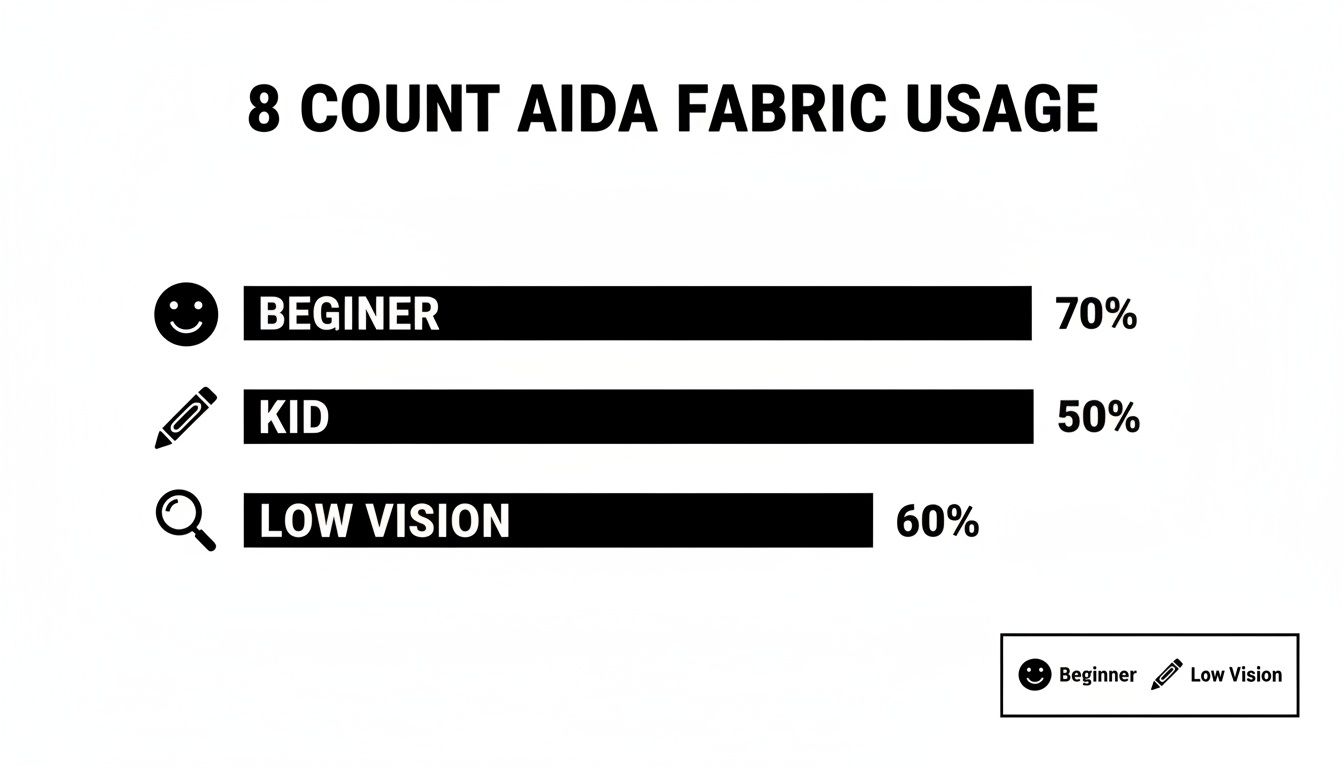 Aida fabric usage: Beginner 70%, Kid 50%, Low Vision 60%.">
As you can see, its user-friendly nature makes it a go-to for beginners, kids, and stitchers with low vision who appreciate not having to squint to find the holes.
How Count Affects Your Supplies And Technique
Your fabric choice also dictates the tools you'll need. The holes in 8 count Aida are quite large, so you'll want a thicker needle—like a size 20 or 22 tapestry needle—that won't just fall right through the weave. More importantly, you'll need a lot more floss to get good coverage for each stitch.
When you're stitching on 8 count Aida, you should almost always use all six strands of your embroidery floss. This creates a lush, full cross stitch that completely covers the fabric, so you don't get any of that distracting "peek-a-boo" white from the Aida showing through.
This is a big change from higher counts. On 14 count, using two strands is the norm, and on 18 count, you might even drop down to one for really fine detail. If you try to use only two strands on 8 count, your stitches will look thin, gappy, and frankly, a bit sad.
To help you choose the perfect fabric for your next project, here's a side-by-side look at how different Aida counts stack up.
Aida Fabric Count Comparison Guide
| Aida Count | Stitches Per Inch | Typical Floss Strands | Ideal For | Finished Look |
|---|---|---|---|---|
| 8 Count | 8 | 6 strands | Kids, beginners, wall art | Chunky, rustic, pixelated |
| 14 Count | 14 | 2-3 strands | Most projects, good detail | Standard, clear definition |
| 18 Count | 18 | 1-2 strands | Highly detailed patterns | Smooth, photo-like, fine |
In the end, choosing between 8 count and a higher count fabric is all about your artistic vision. Are you aiming for a bold, graphic piece that works up in no time? Go for 8 count. Or are you chasing after delicate, photorealistic detail? In that case, a higher count fabric is definitely your friend.
For a more in-depth exploration, our complete guide to cross stitch fabric counts can help you find the perfect match for any pattern.
What's It Really Like to Stitch on 8-Count Aida?
Every fabric has its personality, and 8-count Aida is no exception. Think of it as the friendly giant of the cross-stitch world. For some stitchers, it's the perfect entry point into the craft, while for others, its bold nature can feel a bit limiting. Figuring out if it’s the right canvas for your next project is all about understanding its quirks and charms.
The biggest win? It’s just so easy to see. The holes are big and clear, which means less eye strain and projects that come together surprisingly fast. If you're new to stitching or just want a quick, satisfying finish, this is a huge plus.
The Good Stuff
Working with this wide-open weave has some serious perks, especially if you or your project fits a certain profile.
- You'll Finish in Record Time: Seriously, designs just fly off the needle. A pattern that would be a multi-week commitment on 18-count fabric could be done in a few evenings. That quick hit of accomplishment is a wonderful motivator.
- It’s Welcoming to Everyone: This is the fabric I always recommend for kids, absolute beginners, or anyone whose eyesight makes tiny stitches a challenge. The large grid makes cross-stitching feel approachable and fun, not frustrating.
- A Unique, Bold Look: The chunky stitches it creates have a rustic, almost pixelated vibe that’s a statement in itself. It's fantastic for graphic patterns, fun decor for a kid's room, or big wall art where you want the texture of the stitches to be part of the appeal.
You're not aiming for tiny, perfect details with 8-count. You're embracing a bold, textured style to create something with a lot of visual impact, especially from a distance.
The Trade-Offs to Consider
Of course, the very things that make 8-count Aida so user-friendly also create a few challenges. Its biggest limitation is a lack of subtlety.
Forget about patterns loaded with tiny details, fractional stitches, or delicate backstitching. On this large grid, all that intricate work will just get lost and look messy.
The other common hurdle is getting good, solid coverage. With such large squares, it’s easy for the white of the fabric to peek through your stitches, which can make your work look a little thin.
The solution is pretty simple: you almost always need to use all six strands of your embroidery floss. This makes for a nice, plump cross-stitch that completely covers the fabric. It also helps to pick patterns with big, solid blocks of color. By playing to the fabric's strengths—its boldness and simplicity—you can easily sidestep the potential downsides and create something you'll love.
Perfect Projects and Patterns for 8 Count Aida
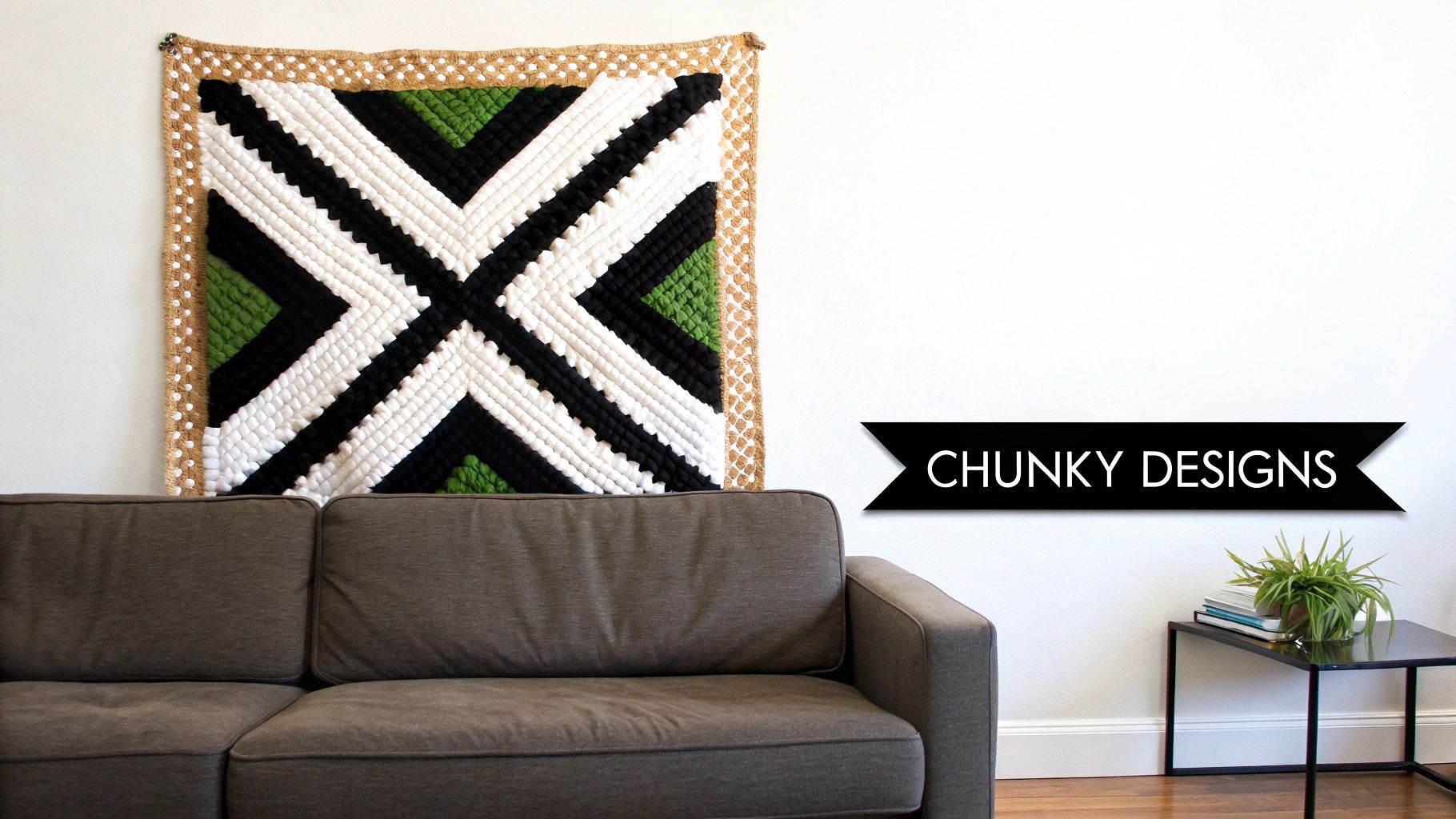
Don't let the chunky, open weave of 8 count Aida fool you into thinking it's just for practice. This fabric is a design choice all on its own, opening up a whole world of creative projects that are meant to be bold and beautiful. Think of it less like a canvas for a miniature portrait and more like the perfect backdrop for a stunning, modern mural.
When you're hunting for the right pattern, simplicity is your best friend. Designs built around large, solid blocks of color absolutely sing on this fabric. The chunky stitches create a wonderfully tactile and graphic look, almost like a piece of rustic pixel art. This makes it a fantastic choice for modern geometric patterns, bold typography, or stylized nature scenes that don't get bogged down in tiny details.
Finding the Ideal 8 Count Aida Project
So, what can you actually make with it? The sturdy, forgiving nature of 8 count Aida lends itself beautifully to items that are both decorative and functional. Because the stitches are so big, the finished piece has a real substance and texture to it, something that holds up well to being handled.
Here are a few project ideas that are a perfect match for this fabric:
- Decorative Throw Pillows: Imagine a vibrant, graphic cushion cover for your sofa. The thick stitches give the pillow a cozy, handmade feel that just begs you to snuggle up with it.
- Kids' Room Decor: This is a lifesaver for projects for little ones. You can stitch up a playful animal, a favorite character, or a personalized name banner so quickly. The fast finish time means you can complete it before their interests change, and the result is a durable piece of art for their space.
- Statement Wall Hangings: This is where 8 count truly excels. A simple geometric or abstract design can be stitched up in no time to create a large-scale piece of fiber art that adds warmth and texture to any room.
- Sturdy Tote Bags: Embellish a plain canvas bag with a bold, stitched panel. The robust fabric and thick thread mean your design will absolutely hold up to the wear and tear of daily life.
What to Avoid in a Pattern
Just as important as knowing what works is knowing what to steer clear of. Because the fabric grid is so large and open, fine details get completely lost. Patterns that are heavy on intricate backstitching, "confetti stitches" (those single, scattered stitches of color), or fractional stitches will just look messy and cluttered on 8 count Aida. Those techniques are really designed for higher-count fabrics where precision is the name of the game.
The magic of 8 count Aida is in its boldness. Instead of fighting its nature by trying to cram in tiny details, lean into its strengths. Choose patterns that celebrate the chunky, visible stitches and let them become a core feature of your finished design.
Must-Have Tools And Techniques For 8 Count Aida
When you switch to the wide-open grid of 8 count Aida, you’ll need to make a few tweaks to your usual stitching setup. Think of it like swapping a fine-point pen for a thick marker—the goal is the same, but the tool has to match the canvas. Getting your tools right from the get-go makes the whole process smoother and ensures your finished piece looks fantastic.
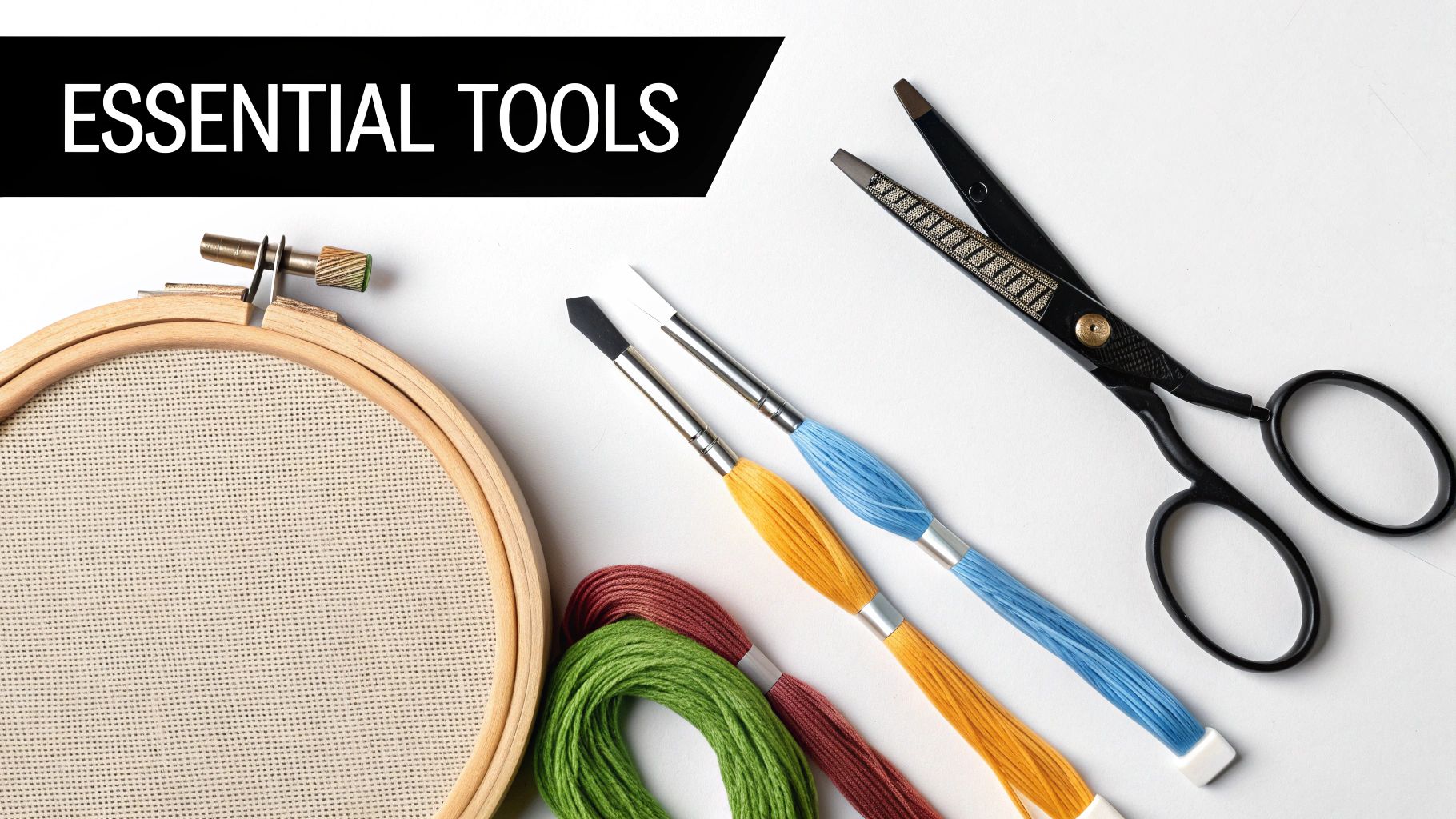 embroidery hoop with Aida fabric, colorful floss, brushes, and scissors.">
The first thing to tackle is your needle. A tiny needle will feel clumsy and might even slip right through the large holes of an 8 count fabric, which is incredibly frustrating. You'll want to grab a bigger tapestry needle, specifically a size 20 or 22. These have a nice blunt tip and a larger eye, making them a dream to thread and much easier to grip as you work.
Choosing Your Floss For Maximum Impact
Your needle is only half the battle; the amount of floss you use is just as critical. If you're used to stitching on 14 count Aida with two strands, that same approach on 8 count will leave your stitches looking gappy and thin. You'll see way too much of the fabric peeking through.
For that beautiful, full coverage that makes a design really stand out, you'll want to use all six strands of your embroidery floss. This makes each cross stitch plump and solid, completely filling the fabric square for a rich, professional look.
To make it easy, here’s a quick reference for pairing the right tools with your 8 count Aida.
Recommended Needle and Floss for 8 Count Aida
This table is a handy cheat sheet for grabbing the right gear. Using these recommendations will help you get that perfect stitch coverage every single time.
| Tool | Recommendation | Reason |
|---|---|---|
| Tapestry Needle | Size 20 or 22 | The larger barrel and eye keep the needle from falling through the fabric's large holes and make it easier to handle. |
| Embroidery Floss | Use all 6 strands | This gives you lush, complete coverage so the fabric grid doesn't show through your finished stitches. |
Getting the needle and floss right is the foundation for a great-looking project on 8 count Aida. If you're curious and want to learn more about the nitty-gritty of needles, our guide to cross stitch needle sizes is a great resource.
Essential Stitching Techniques
Beyond tools, a couple of simple techniques will make a big difference. First, think about how you secure your thread. With such large holes, a tiny knot might just pop right through to the front. A loop start is a fantastic, knot-free option. If you're not using a loop start, just leave a longer tail (about an inch) on the back and catch it under your first few stitches to lock it down securely.
Even tension is also key. It’s surprisingly easy to pull your stitches too tight on this fabric, which can pucker the weave and make your design look warped. Your goal is for each stitch to lie flat and snugly cover its square without tugging on the corners. Using an embroidery hoop or a Q-snap frame is a massive help here—it keeps the fabric taut and makes maintaining consistent tension a breeze.
Finishing and Framing Your Chunky Stitched Art
Once that last stitch is in, it's time for the final, exciting step: getting your project ready to show off. When you're working with 8 count Aida, finishing and framing is all about celebrating that unique, chunky texture, not hiding it.
Before you do anything else, give your piece a gentle wash. A quick hand wash in cool water with a little mild soap is usually all it takes to get rid of any oils or dust from your hands. Afterward, carefully roll it up in a clean towel to soak up the extra water, then lay it flat on another dry towel to air dry.
When it's still just a little damp, flip it face down on a thick, fluffy towel and press it with a warm iron from the back. This little trick is key—it protects your stitches from getting squashed, keeping them nice and puffy.
Choosing the Right Display Method
The bold, almost three-dimensional look of stitches on 8 count Aida really calls for a display that lets that texture shine. A traditional frame with glass can sometimes flatten your beautiful work, which sort of defeats the purpose of using this fabric in the first place.
Here are a few options that really let your work stand out:
- Framing Without Glass: This is probably my favorite way to display chunky stitches. It lets the light play across the texture of the floss and almost invites people to appreciate the tactile quality of your piece.
- Shadow Box Frames: A deep shadow box is another fantastic choice. It gives your project a wonderful sense of depth and protects it from dust, but leaves enough space so the glass isn't pressing down on your stitching.
Your finishing choice should really lean into the project's rustic charm. The whole idea is to highlight that substantial, handcrafted feel you can only get with a low-count fabric like 8 count Aida.
Creative Ideas Beyond the Frame
Of course, a classic frame isn't your only move. The sturdiness of 8 count Aida makes it perfect for all sorts of creative and functional projects.
You could easily turn your finished piece into a durable throw pillow, a cool fringed wall hanging, or even a decorative banner for a kid's room. Learning how to mount cross stitch properly is the key to giving these projects a polished, professional look that will last for years. By choosing a finish that suits the bold aesthetic, you'll make sure your chunky stitched art makes the statement it deserves.
Got Questions About 8 Count Aida?
Even though it’s one of the most straightforward fabrics out there, a few common questions pop up before stitchers dive into their first project with 8 count Aida. Getting these sorted out first can make the difference between a frustrating experience and a piece you'll be proud to show off.
Can I Use 8 Count Aida For Any Pattern?
Technically, you could, but it's really not the best choice for every design. This fabric truly shines when you use it for simple patterns with big, bold blocks of color. Think graphic art, kids' designs, or large-scale, minimalist pieces.
On the other hand, intricate patterns packed with tiny details, fractional stitches, or lots of delicate backstitching tend to lose their crispness. The large grid can make those fine lines look a bit clunky and muddled. Keep in mind, too, that any pattern you use will turn out significantly larger than it would on a higher-count fabric like 14 or 18 count.
How Do I Figure Out My Fabric Size?
Calculating the fabric you'll need is just a bit of simple math. Grab your pattern and find the stitch count for both the width and the height. Then, just divide each of those numbers by 8.
For example, if your pattern is 80 stitches wide, it will come out to 10 inches on 8 count Aida (80 stitches ÷ 8 = 10 inches). It’s a quick but essential step to make sure you don't run out of space halfway through!
Don't forget to add a generous border all around your stitching area. I always recommend adding at least 3-4 inches on every side. This extra fabric gives you room to hoop or hold your project comfortably and is absolutely crucial for clean finishing and framing later on.
Is 8 Count Aida The Same As Plastic Canvas?
Nope, they're completely different animals! While they might seem similar because of the large holes, they serve very different purposes.
8 count Aida is a soft, woven cotton fabric that's perfect for traditional cross stitch using embroidery floss. In contrast, plastic canvas is a stiff, rigid grid made of plastic. People typically use yarn with plastic canvas to create sturdy, three-dimensional objects like tissue box covers, coasters, or holiday ornaments. Both are fantastic for beginners, but you wouldn't want to mix them up.
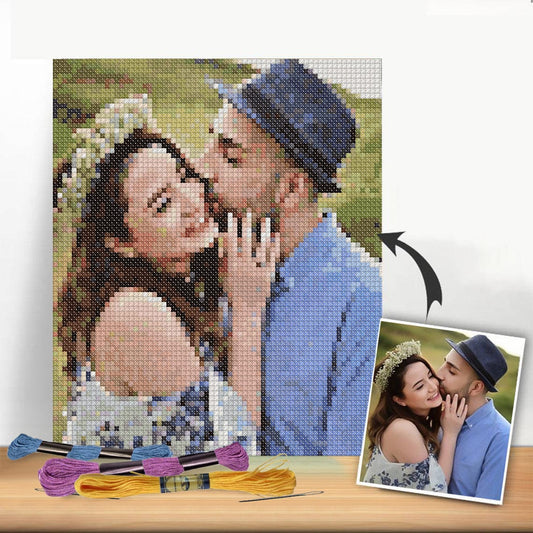
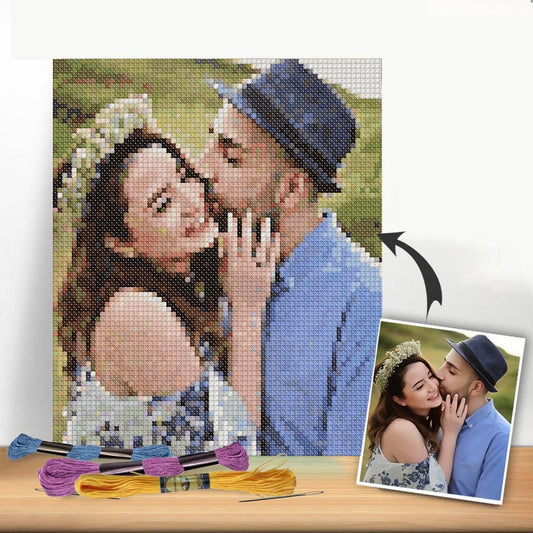
Ready to create something bold and beautiful? At Cross Stitched, we can help you turn any photo into a custom cross stitch kit that's perfect for 8 count Aida. You get an easy-to-follow pattern and all the supplies you need, shipped right to your door. Come create your personalized masterpiece with us today