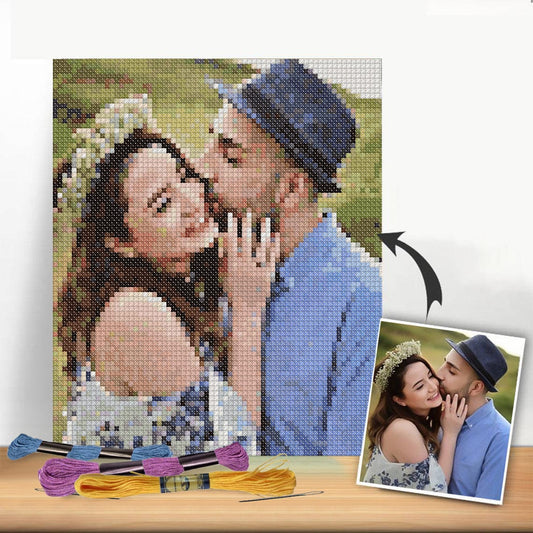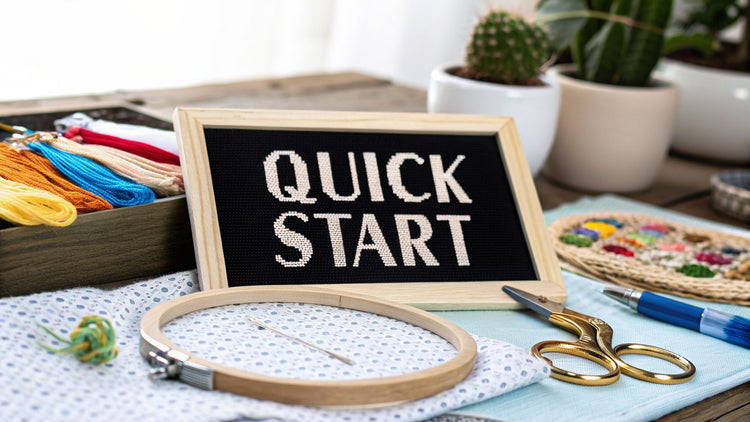
If you're just dipping your toes into the world of cross-stitch, a stamped kit is hands-down the best place to start. Why? Because the pattern is printed right onto the fabric, taking all the guesswork out of the equation. This simple feature lets you skip the tricky parts, like counting tiny squares, and jump straight to the fun part: stitching.
What Makes Stamped Cross Stitch Perfect for Beginners
Think of it like this: starting with a blank canvas can feel a little intimidating, right? But a paint-by-numbers kit gives you a clear roadmap to follow. Stamped cross-stitch is the crafting equivalent of paint-by-numbers. It guides your every stitch, making the whole process feel less like a test and more like a relaxing escape.
This guided approach is the secret sauce. It removes the number one frustration for newcomers—losing your place on a complicated chart—and lets you focus on the simple, rhythmic motion of pulling thread through fabric. You get to see your design come to life almost immediately, which builds your confidence and keeps you excited to continue.
The "No-Count" Advantage
The biggest win here is that you don't have to count a single square. In traditional counted cross-stitch, you're constantly flipping between a paper chart and a blank piece of fabric, carefully counting to make sure every "X" lands in the right spot. It’s incredibly easy to make a mistake, and one wrong stitch can throw off an entire section of your design.
With a stamped kit, your fabric is your chart. The color-coded symbols printed directly onto the Aida cloth show you exactly where each stitch goes and which color thread to use. It’s a visual roadmap that lets you focus on your technique, not on counting.
A Gentle Introduction to Crafting
This simplified process gives beginners a huge leg up for a few key reasons:
- Less Overwhelm: It boils the craft down to one simple task: stitch over the printed marks. That's it.
- Builds Core Skills: You can focus on getting your stitch tension just right and making your "X"s look neat and even—skills you'll use in any needlework project.
- Instant Gratification: Watching the picture appear so quickly is incredibly rewarding and gives you the motivation to see the project through to the end.
This easy entry point is a big reason why interest in the hobby continues to grow. The global cross-stitch market was valued at USD 0.15 billion in 2024 and is expected to keep expanding as more people discover the joy of DIY and mindful crafts. Stamped kits are a perfect fit, offering an all-in-one package that has everything you need to get started.
At the end of the day, stamped cross-stitch is all about making your first experience a great one. It removes the common roadblocks so you can discover a relaxing, rewarding hobby that you'll love for years to come. To see how this method stacks up against others, check out our guide on the different types of cross stitch.
Unpacking Your First Stamped Cross Stitch Kit
Opening up your first stamped cross stitch kit feels a bit like Christmas morning. There’s that rush of excitement as you peel back the packaging, and inside, a whole creative project is waiting for you. Let's walk through what you’ll find in there so you can move from "what's all this?" to "let's get started!"

The real beauty of a kit is that everything you need is right there in the box. This all-in-one approach is exactly why stamped cross stitch kits for beginners are so popular—they let you dive straight into the fun part without a frantic trip to the craft store.
The Foundation: Your Stamped Fabric
The heart of the kit is the Aida fabric. You'll see the pattern printed directly onto it, usually in water-soluble ink that vanishes later. You might also notice a number on the packaging, something like "11-count" or "14-count." This just tells you how many stitches you can fit into one inch of the fabric.
- 11-Count Aida: This is your best friend when you're just starting. The squares are bigger, making it really easy to see where your needle needs to go.
- 14-Count Aida: Still very beginner-friendly, but the stitches are a touch smaller. You’ll find tons of great designs on 14-count fabric.
Think of the colored symbols printed on the fabric as your personal GPS for stitching. Each symbol tells you exactly which color to use, so there's no guesswork involved.
Your Palette: Pre-Sorted Threads
Next, you'll pull out the embroidery floss. In a good kit, the threads will already be sorted and organized on a little card. You'll often see well-known brands like DMC, which means you're getting vibrant colors that won't fade. Each color is labeled with a number that connects back to the symbols on your fabric.
This pre-sorted system is a lifesaver. Instead of digging through a messy pile of floss to find the right shade of blue, you can just grab the one you need and keep your stitching momentum going.
The Tools: Needles and Instructions
Tucked inside, you'll also find one or two tapestry needles. These aren't your average sewing needles. They have a nice, big eye that makes threading the floss much less frustrating, and the tip is blunt, not sharp. That's on purpose—it helps the needle glide easily through the holes in the Aida cloth without accidentally splitting the fabric's threads.
Finally, there’s a simple instruction sheet with a color key. This little legend is your translator. It shows you which thread number goes with which symbol on the fabric, guiding you as you bring the design to life one stitch at a time. For a closer look at all the gear you might encounter, our guide on embroidery supplies for beginners is a great next step.
How to Choose a Kit You’ll Actually Finish
Picking out your first project is half the fun, but your choice can be the difference between a relaxing new hobby and a project that ends up in a drawer. A great beginner kit is designed to set you up for success, making the whole experience so rewarding you’ll be itching to start your next one.
The real secret? Start small and simple. It's so easy to be tempted by those huge, intricate landscapes, but I promise you, a smaller project with big, satisfying blocks of color is a much better first date. Look for designs around 6x6 or 8x10 inches. They’re big enough to feel like a real accomplishment but small enough that you can actually finish them without losing steam. It's all about getting that quick win to build your confidence.
Besides the picture on the box, there are a couple of key things to look for in stamped cross stitch kits for beginners. Paying attention to these details will make sure you get a quality experience that’s worth your time.
Good Materials Make All the Difference
You might not think the fabric and thread matter that much, but they really do. It's the foundation of your whole project.
-
Fabric: Try to find kits that use 11-count Aida fabric. Here's a quick tip: the lower the count number, the bigger the squares you stitch into. Bigger squares are so much easier to see and work with, which saves a ton of eye strain when you're just starting out.
-
Thread: The quality of the embroidery floss is just as important. The best kits will come with pre-sorted threads from well-known brands like DMC. This kind of thread is smooth, doesn't tangle as easily, and has rich, beautiful colors that won’t fade over time. Cheaper threads can be a nightmare—they often fray, knot up, or even break mid-stitch, which is incredibly frustrating.
Think of it this way: you wouldn't learn to paint with dried-up paints and a frayed brush. Getting a kit with good materials ensures the process itself is enjoyable, from the very first stitch to the last.
Pick a Design That Makes You Smile
At the end of the day, you’re going to be spending a lot of time with this project, so pick something you genuinely love looking at!
It could be a simple flower, a quirky little animal, or a cool geometric pattern. Whatever it is, that personal connection to the design will be your biggest motivator to see it through.
Seasonal themes are always a hit, too. You see a big spike in interest for cross-stitch every autumn as people get into holiday crafting mode—beginner floral and Christmas patterns fly off the shelves. You can find all kinds of different craft kits out there, from stitching to paper crafts like this DIY Giant Rose Kit.
Just keep these simple things in mind—project size, fabric count, thread quality, and a design that truly sparks joy—and you’ll have no trouble picking a stamped cross stitch kit that you’ll not only start, but proudly finish.
Your Step-By-Step Guide to Making That First Stitch
Alright, you've picked out your kit and have everything laid out. This is the exciting part—where a simple piece of fabric starts its journey to becoming a piece of art. Don't worry, we'll walk through it together, step-by-step.
If your kit came with an embroidery hoop, let's get that set up first. It's your best friend for keeping the fabric tight and easy to work with. Just separate the two rings, place the fabric over the smaller inner ring, and then press the larger outer ring down over it. You'll want to pull the fabric snug all around until it's taut like a little drum. This tension makes a world of difference.
Prepping Your Thread and Fabric
Before a single stitch can happen, you need to prepare your thread. You'll notice the embroidery floss is made up of six smaller threads bundled together. For the 11-count or 14-count Aida cloth common in these kits, you’ll almost always work with just two of those six strands.
Go ahead and pull out a comfortable length of floss—about 18 inches is a great starting point, long enough to work with but not so long it gets tangled. Now, gently separate two of the individual strands from the main group. Thread those two strands through the eye of your needle, leaving a bit of a tail. That's it, you're ready!
Making Your First Stitches
Take a look at your stamped fabric and pick a block of color to start with. The pre-printed pattern is your roadmap. Let's imagine you're starting on a blue square.
-
Bring the Needle Up: From the back of the fabric, push your needle up through the bottom-left hole of that first blue square. Pull the thread all the way through, but leave an inch-long tail hanging at the back. We'll stitch over that tail in a moment to secure it.
-
Create the First Leg: Now, push the needle back down through the hole in the top-right corner of the same square. You've just made your first half-stitch! It should look like a simple diagonal slash: /.
-
Complete the Cross: Time to finish it. Bring your needle up again, this time through the bottom-right hole, and then go back down through the top-left hole. You’ve now created a perfect little "X."
And just like that, you've made your first cross stitch! The secret to a really clean, professional look is consistency. Make sure all your bottom stitches slant the same way (like /) and all your top stitches slant the other way (like ).
This flowchart gives you a great visual of the whole selection process, from picking a design to checking the materials.
 Keeping these points in mind helps guarantee you end up with a project you'll genuinely enjoy from start to finish.
As you get into a rhythm, you'll find it's often quicker to work in rows. You can do all the bottom half-stitches first across a whole row of the same color (////), and then work your way back across, completing the crosses (\\). This method, often called the Danish method, is super efficient and can even save you a bit of thread.
Once you’re comfortable with this basic 'X' stitch, you can handle pretty much any stamped cross-stitch design out there. If you're curious to learn more, you can explore the other basic cross stitch stitches that build the foundation of this craft.
Navigating Common Beginner Stumbles Without Frustration
Every single person who has ever picked up a needle and thread was once a beginner. It’s a rite of passage to hit a few snags along the way, so don't get discouraged! Think of these little hiccups not as failures, but as the lessons that turn you into a confident, skilled stitcher. Let's walk through some of the most common issues and how to fix them without any stress.
One of the first things you'll almost certainly run into is your thread twisting up and forming knots. It happens to the best of us! This is just a natural side effect of the motion of stitching. The fix is wonderfully simple: just let your needle and thread dangle from the fabric for a moment. Gravity will take over and the floss will magically untwist itself, saving you from a frustrating tangle.
Another classic beginner challenge is getting the stitch tension just right. If you pull your stitches too tight, the fabric will start to pucker and warp. On the other hand, stitches that are too loose can look a bit sloppy and uneven. The sweet spot is a gentle tension where each "X" lies flat and happy on the fabric, not pulling on it at all.
Keeping Your Stitches Uniform
Finding that perfect, consistent tension really just comes with a bit of practice. It's a lot like learning cursive—your first attempts might be a bit shaky, but over time, your hand learns the right amount of pressure to create smooth, even results.
A couple of simple habits can speed up that learning curve:
- Gentle Pulls: As you finish making a stitch, pull the thread just until it’s snug against the fabric, and no further. Get into the habit of gently guiding it into place rather than yanking it tight.
- A Hoop is Your Best Friend: Using an embroidery hoop is non-negotiable for good tension. It keeps the fabric perfectly taut, which gives you a stable surface and makes it so much easier to create uniform stitches every time.
Another small detail that has a huge impact on the final look is your stitch direction. For a really clean, professional finish, make sure all your bottom stitches slant the same way (like this: /), and all your top stitches cross over them in the opposite direction (like this: \). This consistency is what gives finished cross stitch that beautiful, woven texture.
Quick tip: Everyone—and I mean everyone—has had to pull out a few stitches. It’s just part of the process! Don’t be afraid to grab a small pair of scissors, carefully snip a misplaced stitch, and do it over. Learning how to fix small mistakes is a crucial crafting skill.
Beginner Troubleshooting Guide
It's also really easy to misread the stamped pattern or grab the wrong color when you're just getting into the groove. The good news is that these mistakes are simple to fix if you catch them early. Just make it a habit to pause every so often, look over your work, and double-check it against the pattern's color key.
When you do hit a snag, this little cheat sheet can help you figure out what’s going on and how to fix it fast.
| Problem | What It Looks Like | Easy Fix |
|---|---|---|
| Tangled Threads | Annoying knots forming on the back of your fabric as you stitch. | Use shorter lengths of thread—about 18 inches is perfect. Let your needle dangle every few stitches to let the floss untwist. |
| Puckered Fabric | The fabric looks wrinkled or bunched up around your stitches. | You're pulling your stitches too tight! Ease up on the tension. Also, make sure your fabric is taut (but not stretched) in its hoop. |
| Uneven Stitches | Some of your "X" stitches look loose and puffy, while others look tight and small. | Focus on pulling each stitch with the same gentle, even pressure. An embroidery hoop is a huge help for regulating this. |
At the end of the day, working with stamped cross stitch kits for beginners is supposed to be relaxing and fun. Every little stumble you overcome is just another step on your journey to becoming a crafter you can be proud of.
Finishing and Displaying Your Finished Artwork
You’ve placed the very last stitch—congratulations! That’s a fantastic feeling. Now, all that’s left are the finishing touches that will take your project from a piece of stitched fabric to a real work of art. These final steps are simple but make a huge difference in creating a polished, professional look.

First things first, it's time to give your project a gentle bath. This is a crucial step for stamped cross stitch kits for beginners because it’s how you get rid of the printed, water-soluble ink pattern. A quick wash also removes any natural oils from your hands that might have accumulated on the fabric during stitching.
Washing and Pressing Your Masterpiece
To wash your piece, just fill a bowl with cool water and add a tiny drop of gentle, color-safe soap. Let it soak for about 15-20 minutes, then give it a good rinse under cool, running water until you see the water run completely clear and all the suds are gone.
Once it's rinsed, lay the damp fabric flat on a clean, thick towel. Roll the towel up with your project inside and press gently to soak up the extra water. Whatever you do, never wring or twist your cross stitch! This can seriously warp the fabric and distort all those neat stitches you worked so hard on.
The best time to iron your piece is while it's still slightly damp. Place it face-down on a fresh, clean towel and press it from the back with a warm iron. This little trick protects your stitches from getting flattened, so they keep their lovely, plump texture.
Now that your piece is clean, crisp, and perfectly flat, you can get to the fun part: deciding how you want to show it off. The possibilities here are endless, so feel free to get just as creative as you were with the stitching.
Creative Ways to Display Your Work
Looking for a little inspiration? Here are a few popular ways to display your finished cross stitch:
- Classic Framing: A traditional frame is a timeless choice that instantly turns your project into beautiful wall art. Pick a frame and mat that really make the colors in your design pop.
- Modern Hoop Art: For a more rustic, trendy vibe, just use the embroidery hoop as the frame. All you have to do is trim the extra fabric around the back, and it's ready to hang. It’s simple and looks great.
- Functional Crafts: Why not turn your art into something you can use every day? It’s easy to sew a finished piece onto a plain cushion cover for a unique pillow or even incorporate it into a tote bag or the front of a journal.
Putting your finished work on display is the final, most rewarding part of the entire journey. It serves as a beautiful reminder of the new skill you’ve picked up and the care you put into creating something truly special.
Got Questions? We’ve Got Answers.
Even after you've got your kit and you're ready to start, a few questions are bound to pop up. It happens to everyone! Here are some quick answers to the things beginners wonder about most.
What if I Run Out of a Certain Thread Color?
First off, don't panic. This is a super common fear, but kit makers are usually pretty generous. Most decent kits pack in about 20% more thread than you'll actually need for each color, just in case.
If you do happen to run short, just look at your thread organizer. It should list the brand (it's often DMC) and the specific color number. You can grab an extra skein of that exact color from any craft store or online to get you back on track.
Can I Wash the Fabric if It Gets Dirty During Stitching?
You sure can. The ink is made to wash out, and so is any dirt or grime the fabric picks up along the way. The best time to do this, though, is after you've placed your very last stitch.
A gentle hand wash in cool water with a tiny bit of mild soap will lift the stamped pattern right out, along with any oils from your hands, leaving your work looking bright and clean.
Pro-Tip: Always, always wash your project before you iron and frame it. This is the magic step that removes the grid and makes your stitches pop, ensuring your finished piece looks absolutely perfect.
I've Mastered Stamped Kits. What's Next?
Feeling like a pro? That's awesome! When you're ready for the next challenge, the world of counted cross stitch is waiting for you.
Instead of a pre-printed fabric, these kits come with a blank Aida cloth and a paper chart you follow. It’s a fantastic way to sharpen your skills and gives you access to an almost endless variety of more complex and detailed designs. It's the natural next step on your stitching journey.
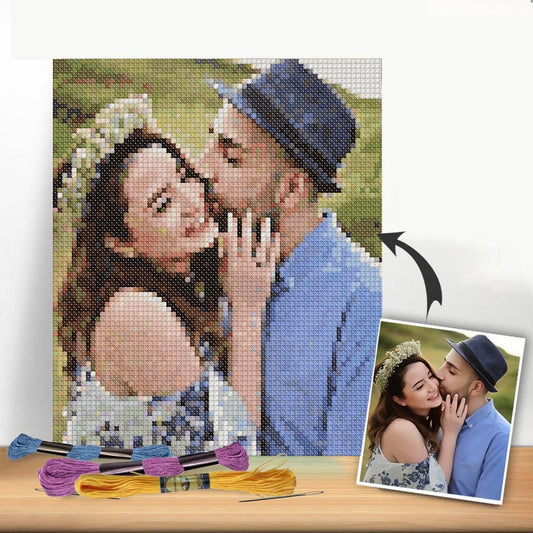
Ready to turn your own favorite memories into a one-of-a-kind stitching project? Head over to Cross Stitched and create a personalized kit from any photo you love! Find your next masterpiece at https://cross-stitched.com.