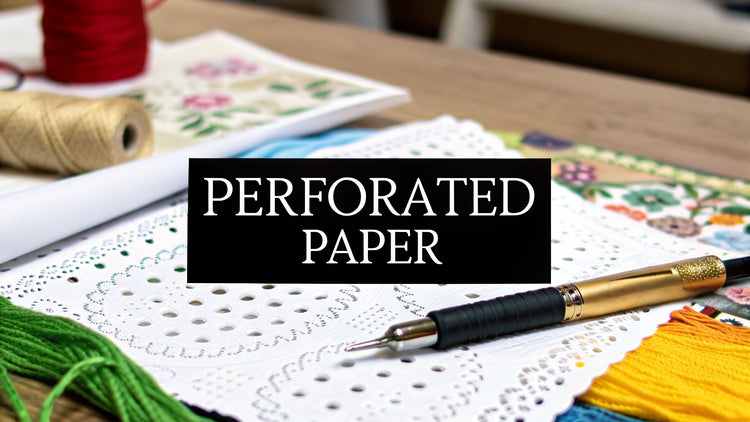
Ever find yourself wishing your cross stitch projects could stand on their own—literally? If you've ever wanted to make things like ornaments, bookmarks, or greeting cards without the hassle of fraying fabric, you need to meet perforated paper. It’s essentially a high-quality, sturdy cardstock punched with a perfect grid of holes, giving you a solid base for your stitching.
Think of it as the best of both worlds: the precision of counted cross stitch meets the structure of papercraft. It’s a game-changer for any project that needs to be rigid and three-dimensional.
Where Paper Shines in a Fabric World

Unlike soft fabrics like Aida or linen that need to be held taut in a hoop, perforated paper is firm right from the start. This built-in stability is its superpower. You can stitch "in hand" without worrying about the material warping or stretching, which many stitchers find way more comfortable and portable.
Another huge plus? No more fraying. The edges are always crisp and clean, giving your finished work a professional look right away.
What Does "Count" Mean for Paper?
Just like with fabric, you'll see perforated paper described by its "count." This number simply tells you how many holes (or stitches) you can fit into one inch of the paper.
The most popular size is 14-count, and for good reason. It hits that sweet spot between being easy to see and allowing for nice detail in your design. A higher number, like 18-count, means the holes are smaller and closer together, perfect for more intricate patterns.
If you're just starting out with perforated paper, 14-count is the perfect place to begin. The holes are big enough that you won't be squinting, and it’s very forgiving as you get the hang of it.
So, Why Ditch Fabric for Paper?
While I love my Aida and linen, sometimes a project just calls for something different. Perforated paper isn't a replacement for fabric, but rather a fantastic option for specific types of crafts where structure is key.
Here’s when it really comes into its own:
- No Hoop Required: Its natural stiffness means you don’t need a hoop or frame to keep it tight. Your stitching setup just got a whole lot simpler.
- Perfectly Clean Edges: You can cut the paper into any shape you can imagine, and the edges will never unravel. This is amazing for detailed cut-outs.
- Awesome 3D Projects: This is the material of choice for freestanding pieces. Think holiday ornaments, gift tags, needle minders, or even little decorative boxes.
- A Touch of Vintage Style: Perforated paper isn't new! It was incredibly popular during the Victorian era (1860-1900) for creating sentimental "mottos" and samplers. The standard 14 to 16 holes-per-inch count made needlework more accessible to everyone, sparking a huge crafting craze.
Perforated paper truly bridges the gap between needlework and papercraft, offering a fun and unique way to bring your stitched creations to life.
Perforated Paper vs Traditional Fabric At A Glance
To make it even clearer, let's break down the main differences between perforated paper and the fabrics you're probably more familiar with. This should help you decide which material is the right fit for your next idea.
| Feature | Perforated Paper | Aida Fabric | Linen Fabric |
|---|---|---|---|
| Material | Sturdy, high-quality cardstock | 100% cotton with a visible, blocky weave | 100% linen or linen blend with an uneven, fine weave |
| Stiffness | Rigid, self-supporting | Soft and flexible; requires a hoop for even tension | Very soft and drapey; requires a hoop for even tension |
| Best For | 3D items, ornaments, bookmarks, cards | Framed art, pillows, full-coverage pieces | Heirloom pieces, delicate designs, samplers |
| Fraying | No fraying; edges are clean when cut | Fraying is common; edges need finishing | Fraying is common and can be significant |
| Ease of Use | Excellent for beginners; easy to see and handle | Beginner-friendly; the grid makes counting easy | More advanced; requires stitching "over two" threads |
| Finishing | Can be cut, folded, or backed with felt/cardstock | Typically washed, ironed, and framed or sewn | Typically washed, ironed, and framed or sewn |
Ultimately, each material has its strengths. If you want something that will hold its shape and give you a clean, crisp finish for a special project, perforated paper is an incredible tool to have in your crafting arsenal.
Gathering Your Essential Stitching Tools
Working with perforated paper is a real treat, but having the right tools on hand makes all the difference. Think of it like a painter picking out the perfect brush—the right gear helps you get the best results from this unique material. The good news? You probably don't need to buy a whole new setup. Many of your favorite cross stitch supplies will work just fine.
The main idea is to put together a kit that protects the paper while helping you make those neat, even stitches we all love. Unlike fabric, which is pretty forgiving, paper can tear or get bent out of shape if you're not careful. A few smart tool choices can sidestep these problems completely, keeping your project looking sharp from start to finish. Let's get your kit sorted.
Selecting the Perfect Needle
Your needle is probably the most critical tool in your kit when stitching on paper. Sure, any needle can technically push thread through a hole, but the wrong kind can do some serious damage. A sharp-tipped embroidery needle, for example, is a recipe for disaster; it can easily catch and rip the edges of the tiny holes.
What you really want is a needle that’s designed to find the hole, not make one.
Your best friend here is a blunt-tipped tapestry needle. These needles have a rounded end that slides right into the pre-punched holes without snagging or scraping the paper. For most projects, a size 24 or 26 tapestry needle is the sweet spot.
A size 24 needle is just about perfect for 14-count paper, and the slightly thinner size 26 is ideal for 18-count paper. Sticking to the right size means the needle won't stretch the hole, which is crucial for keeping your whole project sturdy.
Choosing Your Thread and Floss
Once you've got your needle, it's time to think about thread. The goal is to create full, lush stitches that cover the paper nicely without being so thick that they start to look bulky. If you use too many strands, you can actually cause the paper to bend under the tension.
For standard 14-count perforated paper, a great place to start is with two strands of six-strand embroidery floss. This usually gives fantastic coverage and makes your colors look rich and solid.
- For 14-count paper: Two strands of floss is almost always the right call.
- For 18-count paper: You can stick with two strands for a standard look, or drop down to one strand if you're working on a very delicate or detailed area.
- For a bolder look: On 14-count paper, you could try using three strands, but just watch your tension so you don't warp the paper.
I always recommend doing a quick test on a scrap piece of paper first. It’s a simple way to see exactly how your stitches will look and make sure you’re happy with the coverage before you dive into the real thing. To learn more about other essential tools, check out our guide on must-have cross stitch accessories.
Finding the Right Paper Foundation
Last but not least, you need the paper itself! It's so much more than just a background—its color and count are a huge part of your final design. And these days, you can find a fantastic variety that goes way beyond plain white.
You can find perforated paper for counted cross stitch in a whole spectrum of colors, from soft pastels to rich jewel tones and even shiny metallics. This opens up so many creative doors, allowing you to pick a base that makes your thread colors pop or even leave parts of the paper unstitched as a design element.
Brands like Mill Hill offer sheets in the standard 14-count, which is a great all-rounder for most projects. You might also spot some newer PVC or vinyl versions; they look and feel like paper but are much more durable and tear-resistant. These are a brilliant choice for things that will get handled a lot, like ornaments or keychains. When you’re picking out your paper, just think about the final look you're going for and choose a color and count that will really show off your handiwork.
Mastering Your Stitching Technique On Paper
Stitching on perforated paper is a whole different ball game compared to fabric, but it's an incredibly satisfying one. You don't need to throw out everything you've learned on Aida or linen, but you will need to tweak your technique to work with the paper's stiffness. The absolute most important skill to master here is tension control.
Think of it like giving the paper a gentle hug with your floss. If you yank your stitches too tight, you risk warping the paper or, even worse, tearing the holes. That's a common fear for anyone trying this for the first time! But if you leave the stitches too loose, they'll look floppy and uneven, completely losing that sharp, clean look you're going for. Your goal is a Goldilocks tension: just right, where the floss lies flat and smooth without putting any strain on the paper.
This little diagram shows how the three key players—the paper, your needle, and the floss—all work together.

It’s a simple reminder of how each tool impacts the next, which is why a balanced technique is so crucial.
Starting and Ending Threads Without Knots
One of the best things about stitching on perforated paper for counted cross stitch is how incredibly tidy the finished piece can look. That all starts with ditching knots. Knots create bumps that you can see from the front, and they have a nasty habit of coming undone later on. Luckily, there are a few slick, knot-free methods that are perfect for paper.
The loop start is an absolute game-changer, especially when you're using an even number of strands (like the standard two). Here’s the magic:
- Cut a single strand of floss, but make it twice as long as you'd normally use.
- Fold it perfectly in half.
- Thread the two cut ends through your needle, which leaves a neat little loop at the other end.
- Bring your needle up from the back of the paper to start your stitch, but leave the loop hanging out on the back.
- As you make the first leg of your cross stitch, just pass your needle through that loop on the back and give it a gentle pull. Your thread is now anchored securely with zero bulk. It’s brilliant!
When you're ready to end a thread, just run the tail under three or four finished stitches on the back. They'll hold it in place perfectly.
Handling the Paper with Care
Here's the thing about paper: unlike fabric, you can't just wash and iron out a crease. Once it's there, it's there for good. That means you have to be gentle with your project from start to finish. Always make sure your hands are clean and dry before you pick it up to avoid leaving smudges or oils on the surface.
A good rule of thumb is to handle the paper by its edges, just like you would an old photograph. It’s a simple habit that goes a long way in preventing accidental bends or fingerprints right in the middle of your work.
If you need to put your project away, store it flat. A project bag or even a clean folder will do the trick, protecting it from getting bent or damaged.
Managing Confetti Stitches
We all know them: "confetti stitches." Those single, lonely stitches of a color that seem to be scattered randomly across a pattern. On fabric, they're a pain. On paper, they can be a real headache because they can compromise the paper's integrity. You definitely don't want to start and stop a new thread for every single one—it's a waste of time and makes the back of your work a hot mess.
A much better way is to carry your thread across the back, but only for very short distances. As a rule, don't jump more than two or three holes. For anything further than that, it’s safer to end the thread and start fresh. This avoids leaving long, dangly strands on the back that can get snagged or, worse, show through to the front. By managing your threads this way, the back of your perforated paper for counted cross stitch project will look almost as neat as the front, keeping it strong and stable for years to come.
Finishing Your Work: Where The Real Magic Happens
Stitching on perforated paper is fun, but the real payoff comes when you finish your project. This is where you see its true strength. The paper's built-in stiffness lets you create things you just can't with soft, drapey fabric. Suddenly, your stitched art can stand up, hang freely, and take on a life of its own in three dimensions.
Forget being stuck with flat, framed pieces. Perforated paper for counted cross stitch is a game-changer because it lets you build things. Your needlework transforms from a simple picture into a tangible, structural object, opening up a whole new world of crafting.

From Stitching To Construction
Your finished stitching is really just the starting point. The next phase is all about construction—cutting, folding, and assembling your piece into its final form. It's a cool blend of cross stitch precision and papercraft techniques, and you only need a couple of simple tools to get it right.
A sharp craft knife is an absolute must-have for getting those clean, crisp edges. When you're cutting out your design, always use a fresh blade on a self-healing mat to protect your table. You'll get way more control than with scissors, which is especially important for tricky shapes or cutting out small windows.
If you're making something that needs to be folded, like a gift box or a 3D stand-up figure, a bone folder will be your best friend. Scoring the fold lines with this tool before you bend the paper creates a professional-looking, sharp crease and stops the paper from cracking or buckling under pressure.
Creative Finishing Ideas For Your Paper Projects
Once you get the hang of the basic construction, a whole universe of project ideas opens up. The rigidity of perforated paper makes it the perfect choice for items that need to hold their shape without any extra support. It's an opportunity to move beyond traditional framing and think about how your stitching can interact with the world around it.
Here’s a summary of a few ideas to get you started:
| Project Type | Finishing Technique | Best For |
|---|---|---|
| Ornaments | Cut and join two pieces back-to-back with a hanging loop. | Creating lightweight, double-sided decorations that won't weigh down tree branches. |
| Gift Boxes | Stitch flat, then score, fold, and glue into a 3D box shape. | Adding a deeply personal, handmade touch to small gifts like jewelry. |
| Bookmarks | Cut into a simple rectangle and back with felt or cardstock. | Quick, practical gifts that show off your stitching and are sturdy enough for daily use. |
| Greeting Cards | Trim the stitched piece and mount it onto blank cardstock. | Making one-of-a-kind cards that feel more special than anything store-bought. |
| Stand-Up Figures | Design with a base or stand, then cut and fold for a 3D effect. | Displaying characters or seasonal figures on a shelf or mantlepiece without a frame. |
These are just a jumping-off point, of course. The real fun is in experimenting and seeing what you can create.
A Few More Project Ideas To Spark Your Imagination
The stiffness of the paper really lends itself to some wonderful, practical crafts.
Here are a few more tried-and-true ideas:
- Freestanding Holiday Ornaments: Create beautiful ornaments that are light enough for any tree. You can even stitch two identical pieces and join them back-to-back for a design that looks great from any angle. If you need some inspiration, check out our favorite cross stitch Christmas ornament patterns.
- Needle Minders and Scissor Fobs: Small accessories like these are fantastic projects for using up leftover scraps of paper and floss. They’re quick, useful, and make great gifts for fellow stitchers.
- Custom Gift Tags: Forget flimsy paper tags. A stitched tag is a gift in itself. Cut your finished piece into a simple shape, punch a hole, and you have an elegant tag that can be used again as an ornament.
The key is to think beyond the frame. If a project needs to be rigid, self-supporting, or have a clean, non-fraying edge, perforated paper is almost always the best choice for the job.
Polished Finishes For Flat Designs
Even if you aren't building a 3D masterpiece, perforated paper offers some wonderfully clean finishing options for flat pieces. Its neat edges make it incredibly easy to mount your work for a polished, professional look.
One of the most popular methods is creating custom greeting cards. Just stitch your design, trim it to the size you want, and use a strong craft glue or double-sided tape to mount it on a blank card. In minutes, you’ve created a unique piece of correspondence that feels incredibly special.
Another great trick is to back your finished piece with a layer of felt or decorative cardstock. Cut the backing material to the exact same shape as your stitched paper and glue it on. This neatly hides the "messy back" of your work and gives the item a satisfying, substantial feel—perfect for things like bookmarks or magnets.
The Victorian Roots of Perforated Paper
It might seem like a modern crafting invention, but perforated paper for counted cross stitch has a surprisingly long and storied past. Its roots go all the way back to the Victorian era. Long before we started using it for 3D ornaments, this sturdy, hole-punched paper opened up the world of needlework to just about everyone, regardless of their social standing. It wasn't just a new material—it was the very foundation of a massive cultural trend.
This explosion in popularity was fueled by what collectors now call the "motto craze." Picture Victorian homes filled with stitched sayings—everything from inspirational quotes and Bible verses to simple "Welcome" signs. Perforated paper was the perfect canvas for these sentimental pieces, and they quickly became a staple in home decor.
The Rise of the Motto Craze
In the mid-to-late 19th century, you could find pre-printed patterns on perforated paper sheets everywhere. These weren't the intricate, full-coverage scenes we see today, but rather bold, elegant lettering projects. Manufacturers saw a huge market for these moral and religious expressions and started churning out kits that were incredibly easy to stitch up and display.
Stitching these mottos became more than just a hobby. It was a heartfelt way for people to express their values and decorate their homes with personal, handmade art. Because the paper was so stiff, the finished pieces could be framed with minimal effort or even stand on their own, making them an affordable alternative to pricey paintings and prints.
The motto craze took needlework from a pastime reserved for the wealthy and turned it into a craft for the masses. It gave everyday people a way to create beautiful, meaningful art for their own homes.
The designs themselves were often stitched with vibrant wool threads, which created a wonderful, striking contrast against the paper. This simple craft connected stitchers from all walks of life, all of them working to bring a little bit of beauty and inspiration into their living spaces.
Why 14-Count Paper Was King
The wild success of the motto craze really came down to one small detail: the paper’s count. Most of these popular motto designs, which completely dominated the craft from 1870 to 1900, were printed on sheets with 14 to 16 holes per inch. This specific count was chosen for a reason—it was the sweet spot for creating bold, readable text. It was big enough to stitch easily but fine enough to print clearly, making it a favorite for mass manufacturing. By the 1870s, new printing technology turned this simple craft into a global sensation. You can dive deeper into the fascinating history of perforated paper motto designs and their cultural impact.
This particular count struck the perfect balance for a few key reasons:
- Legibility: The stitches were large enough to form clear, easy-to-read letters, even from across the room.
- Ease of Stitching: The holes were big enough for anyone, from a child to an expert, to work with comfortably.
- Production Efficiency: Sticking to a 14-count standard meant printers could mass-produce patterns with consistent, reliable quality.
This standardization was the secret ingredient to the craft's explosion in popularity. It meant that anyone, anywhere, could grab a pattern and create something lovely and uniform. So, the next time you stitch on 14-count paper, remember you're using a medium with over 150 years of history, connecting you to generations of crafters who found joy in the simple act of pulling thread through paper.
Troubleshooting Common Stitching Problems
Let's be honest—every stitcher, no matter how experienced, runs into a few snags. Perforated paper has its own unique quirks, but the good news is that nearly every problem has a simple fix. Think of these moments not as mistakes, but as part of the learning curve that makes you a better stitcher.
We've all been there: the dreaded paper tear or stitches that just won't lay flat. Don't worry. We'll walk through the most common issues and how to solve them, so you can get back to stitching with confidence.
Preventing and Repairing Tears
The number one fear when working with perforated paper? Tearing it. It usually happens when your needle catches the edge of a hole or when you pull your thread a bit too enthusiastically. The best way to avoid this is to use the right tool for the job: a blunt-tipped tapestry needle, like a size 24 for 14-count paper, which will find the hole instead of creating a new one.
But what if a tear happens anyway? It's not the end of the world.
- Stop immediately. Don't stitch another thing, as it will only weaken the area further.
- Reinforce the back. Grab a tiny piece of clear tape or use a dab of archival-safe paper glue to patch the tear from behind.
- Be patient. If you used glue, let it dry completely before you even think about stitching near that spot again.
This little fix gives the paper just enough strength to hold up, saving your project from the brink.
Pro Tip: Keep your tension even and gentle. Your thread should lie flat against the paper, not pull it tight. If you’re not sure what that feels like, practice on a scrap piece. A relaxed hand is a happy hand.
Managing Creases and Bends
Unlike fabric, you can't just iron a crease out of perforated paper. Once it's bent, that line is there to stay. Prevention is truly your best friend here. Always try to handle your project by the edges to keep it clean and flat. When you're not working on it, store it flat in a project bag or a simple folder.
If you do get a minor bend in a corner, you might be able to lessen it. Try placing the project under a stack of heavy books for a day or two. While it won't magically erase a sharp crease, it can often soften a slight bend enough to make it far less noticeable.
Correcting Uneven Stitches
Notice some of your stitches looking a little puffy while others seem tight and small? That's uneven tension, and it's a super common hurdle when you're getting used to a new material like perforated paper for counted cross stitch.
The solution is all about finding your rhythm. Try to pull each leg of your cross stitch with the same gentle pressure. It also helps immensely to make sure you're always crossing your stitches in the same direction (for example, bottom-left to top-right first, then bottom-right to top-left second). Before you know it, your hands will build muscle memory, and your stitches will look beautifully consistent.
Your Top Questions Answered
Diving into a new material like perforated paper always sparks a few questions. Let's tackle some of the most common ones that pop up, so you can start your project with confidence.
Can You Wash Perforated Paper?
This is a big one, and the short answer is a hard no. Remember, at the end of the day, it's still paper. Getting it wet will cause it to warp, soften, and possibly even disintegrate, which is the last thing you want after putting in all that stitching time.
Your best bet is to keep your hands clean while you work and store your project flat to avoid any accidental smudges or creases.
Now, if you're using one of the newer vinyl-based materials like Mill Hill's Perforated PVC, you have a bit more wiggle room. It’s way more water-resistant, but I’d still advise against soaking it to keep your threads looking their best.
The golden rule is to treat your perforated paper project like a delicate art print. Protect it from liquids and handle it gently, and it will last for years to come.
What Is The Best Needle For Stitching On Paper?
The right needle is non-negotiable here. You absolutely must use a blunt-tipped tapestry needle. A sharp needle will shred the paper between the holes, and that's a disaster you can't undo.
For the most common 14-count paper, a size 24 tapestry needle is your best friend. It glides through the holes without stretching them and carries the floss perfectly.
- For 14-Count Paper: Grab a size 24 tapestry needle.
- For 18-Count Paper: A slightly thinner size 26 tapestry needle is the way to go.
Using the correct needle is key to protecting the structure of your perforated paper for counted cross stitch, resulting in a much cleaner and more professional-looking piece.
Can You Use Perforated Paper In A Hoop?
Technically, yes, but you really don’t need to. One of the best things about perforated paper is its stiffness. It’s firm enough to stitch "in hand," which means no wrestling with frames or hoops. Many stitchers love how much more portable and comfortable this is.
If you're someone who just feels better using a frame, avoid traditional hoops at all costs. The intense pressure will leave permanent creases or dents in your paper. Instead, opt for something gentler like a scroll frame or a Q-snap that holds the edges without clamping down hard.
Ready to turn your favorite photos into timeless stitched art? At Cross Stitched, we create custom kits with everything you need to start your next masterpiece. Create your personalized cross stitch kit today!