When you first start cross-stitching, the term "fabric count" can feel a bit confusing. But once you get the hang of it, you'll see it's the key to controlling how your final project looks and feels. Think of it like a camera's resolution—a lower count gives you a bigger, bolder picture, while a higher count packs in more detail.
What Are Cross Stitch Fabric Counts
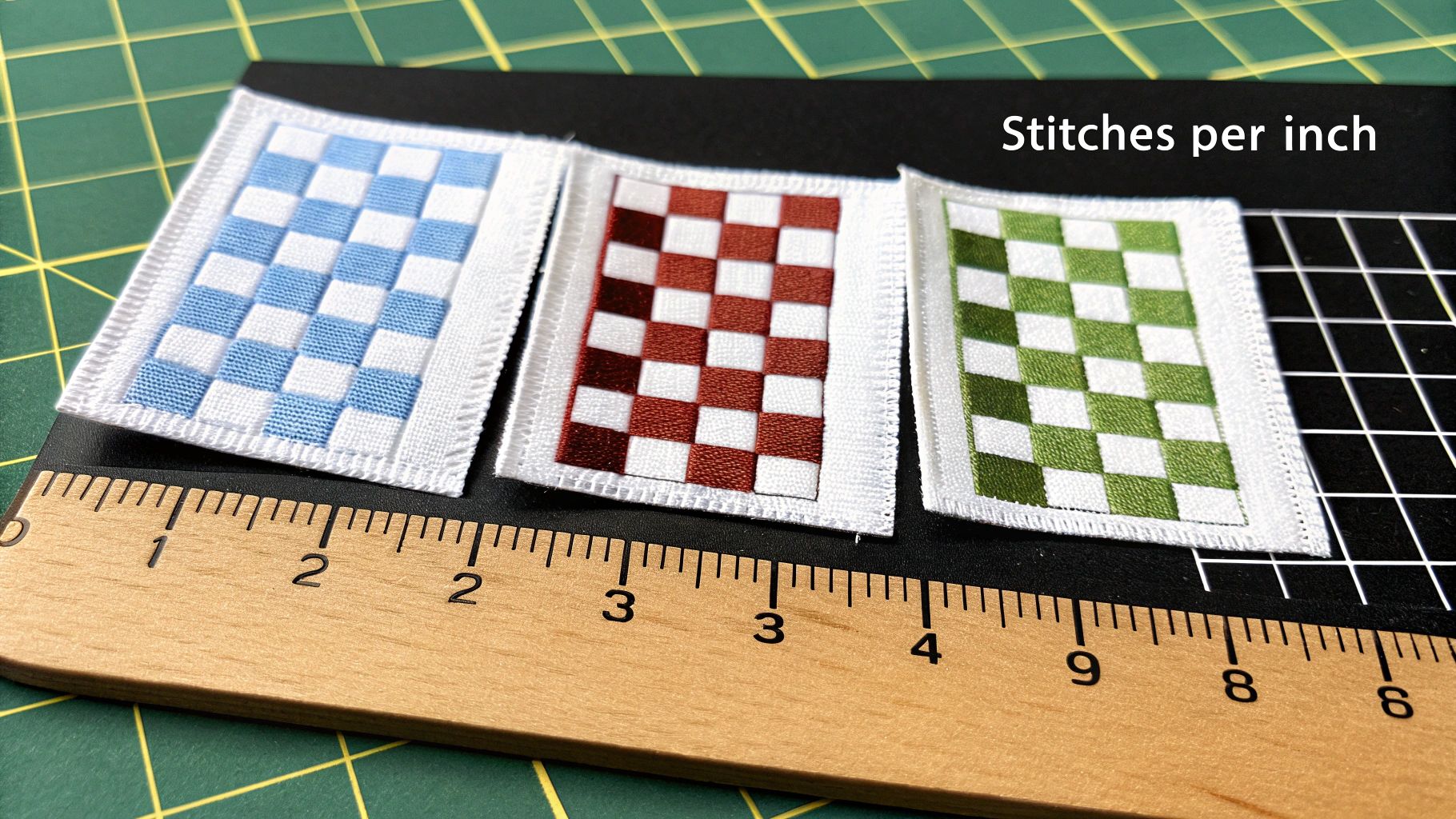
So, what does that number actually mean? The "count" simply tells you how many stitches you can fit into one linear inch of fabric. It’s the single most important detail that dictates the final size and level of detail in your work.
If you pick up a piece of 14-count Aida, it means there are 14 squares (or potential stitches) for every inch. Grab an 18-count piece, and you're squeezing 18 stitches into that same one-inch space. Right away, you can see how this changes everything—your stitches will be much smaller and tighter on the 18-count fabric.
The Impact on Detail and Size
This is where the real fun begins. A lower count, like an 11-count Aida, creates big, chunky stitches. This style is perfect for beginners because the holes are easy to see, and projects work up quickly. It's also great for kids' crafts or modern designs with a graphic, almost pixelated vibe.
On the other hand, a higher count fabric—say, 18-count or even 22-count—lets you pack stitches closely together. This allows for incredible detail, subtle shading, and smooth color blends. Your finished piece will look less like individual 'X's and more like a high-resolution photograph.
This infographic does a great job of showing the difference at a glance.
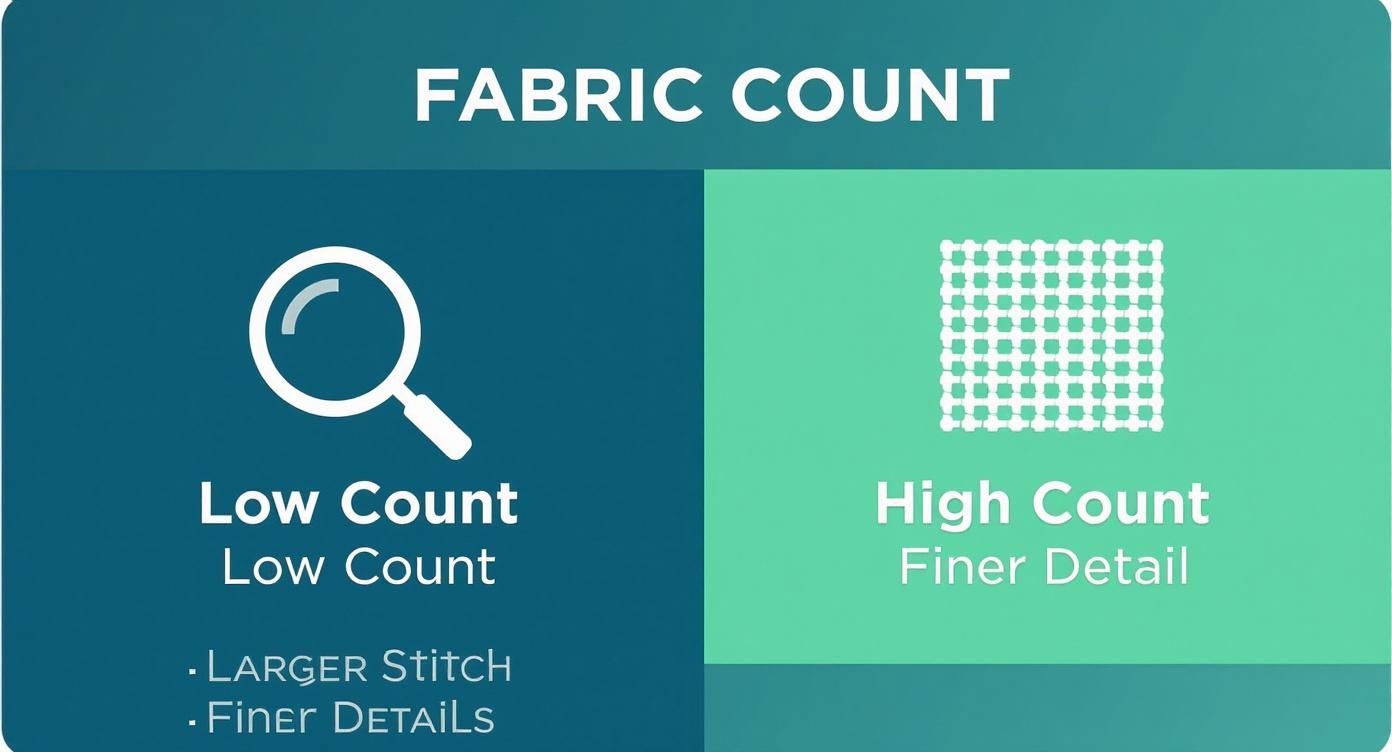
As you can see, lower counts give you those larger, more distinct stitches, while the higher counts are all about achieving that fine, intricate detail.
How Fabric Count Affects Project Size
To really see the difference, let’s look at how the same pattern changes size based on the fabric. The table below shows how a pattern that is 100 stitches wide by 100 stitches tall will look on different fabric counts.
| Fabric Count | Stitches Per Inch | Finished Size (100x100 stitches) | Best For |
|---|---|---|---|
| 11-count | 11 | 9.1" x 9.1" | Kids, beginners, quick projects, bold designs |
| 14-count | 14 | 7.1" x 7.1" | Standard projects, most kits, good detail |
| 18-count | 18 | 5.6" x 5.6" | Detailed patterns, full coverage, fine art |
| 22-count | 22 | 4.5" x 4.5" | Advanced stitchers, intricate portraits |
It’s pretty clear how much the final dimensions can change! A project that’s over 9 inches on 11-count fabric shrinks to less than half that size on 22-count. This is crucial when you're planning to fit your piece into a specific frame or hoop.
A Numbers Game
The math really brings it home. It’s not just about linear inches; it’s about stitch density. For instance, a 14-count fabric gives you 196 stitches per square inch (14x14). Bump that up to an 18-count fabric, and you suddenly have 324 stitches per square inch (18x18). That's a massive jump in the amount of detail you can pack in. You can explore more on the growing popularity of this craft in market analyses from sources like Business Research Insights.
Let’s take a practical example to make it stick.
Example: A pattern that is 100 stitches wide and 100 stitches tall.
- On 14-count Aida: The finished piece would be about 7.1 inches square (100 stitches ÷ 14 stitches/inch).
- On 18-count Aida: The same pattern shrinks down to just 5.6 inches square (100 stitches ÷ 18 stitches/inch).
That inch-and-a-half difference might not sound like much, but it can be the make-or-break factor for your project. Getting a handle on this simple concept is the first real step toward choosing the perfect fabric and bringing your creative vision to life.
A Practical Look at Popular Fabric Counts
 Aida fabric in different colors and counts stacked on a table.">
Sure, the numbers are useful, but you only get a feel for a fabric’s true personality when you actually start stitching on it. Each count offers a totally different experience, influencing everything from how fast a project takes shape to the look and feel of the finished piece.
Let's dive into the most popular Aida counts out there—11, 14, 16, and 18-count—so you can see which one might be the perfect partner for your next creation.
The Beginner-Friendly 11-Count Aida
Think of 11-count Aida as the perfect starting block. The holes are large and incredibly easy to see, which is why it’s a go-to for kids, first-time stitchers, or anyone who might find smaller weaves a bit tricky on the eyes.
Because the weave is so open, the stitches are big and bold. This means projects come together surprisingly fast! The downside? You'll need a bit more floss to get those full, plush stitches that completely cover the fabric.
- Best For: Projects with kids, quick weekend crafts, and patterns with a bold, graphic look.
- Recommended Floss: Use 3 strands of embroidery floss for nice, solid coverage.
The All-Rounder 14-Count Aida
There's a good reason this one is the gold standard. 14-count Aida is easily the most common fabric you'll find in cross-stitch kits all over the world. It hits that sweet spot, striking a perfect balance between being easy to work with and showing a good amount of detail.
The holes are still quite clear, but the stitches are small enough to create a more refined, polished image. If you ever have a pattern that doesn't specify a fabric, 14-count is almost always a safe and reliable bet. It's the trusted workhorse of the cross-stitch community.
The sheer popularity of 14-count Aida is undeniable. Just look at large-scale stitch-alongs and community projects—many organizers default to 14-count to make the event as accessible as possible for everyone, regardless of skill level.
The Detail-Oriented 16-Count Aida
When you move up to 16-count Aida, you'll immediately notice the shift toward finer detail. The stitches are smaller and sit much closer together, which creates a smoother, less "pixelated" finish.
It's a fantastic choice when you want your finished piece to look more like a picture and less like a collection of individual X's, but without the potential eye strain that comes with even higher counts. Many stitchers who have a few projects under their belt naturally gravitate to this count when they're ready to tackle something more intricate.
- Best For: Patterns with lots of shading, blended colors, and more complex elements.
- Recommended Floss: 2 strands of floss will give you perfect coverage without making the stitches look crowded.
The Expert's Choice 18-Count Aida
When every last bit of detail is your top priority, 18-count Aida is the answer. The weave is much tighter, producing tiny, delicate stitches that are absolutely ideal for complex and realistic patterns—think portraits, detailed landscapes, or anything with subtle gradients.
Projects stitched on 18-count fabric have a beautiful, almost painted quality to them. Be warned, though: working on this count really calls for good lighting and can be more demanding on your eyes. For many stitchers, however, the stunningly detailed result is more than worth the extra effort.
- Best For: Advanced patterns, full-coverage pieces, and creating heirloom-quality projects.
- Recommended Floss: Usually 1 or 2 strands. Using one strand gives a very delicate, tapestry-like feel, while two strands provide a fuller, more traditional look.
How Fabric Count Shapes Your Final Design
When you're planning a new cross-stitch project, the fabric you choose is probably the single most important decision you'll make. It directly controls the final size of your piece and how detailed it looks. This choice is what separates a bold, graphic design from one that looks more like a delicate painting.
Think of it like setting the resolution for a picture. A lower-count fabric, like 11-count Aida, gives you big, chunky stitches. This creates a charming, almost pixelated look that’s fantastic for modern patterns or projects you want to stitch up quickly. On the other hand, a higher count like 18-count packs the stitches tightly together, making the individual 'X's almost disappear and blend into a smooth, seamless image.
Calculating Your Project Dimensions
One of the best skills you can learn in cross-stitch is how to figure out the exact finished size of your work before you even start. No more guessing games or realizing your design won't fit the frame you bought! Thankfully, the math is incredibly simple.
To get the final dimensions in inches, just follow this formula:
- Stitch Count (Width) ÷ Fabric Count = Finished Width in Inches
- Stitch Count (Height) ÷ Fabric Count = Finished Height in Inches
So, let's say your pattern is 140 stitches wide. If you stitch it on 14-count Aida, your design will be exactly 10 inches wide (140 ÷ 14 = 10). But if you stitched that same 140-stitch pattern on 18-count Aida, it would shrink down to just 7.8 inches wide (140 ÷ 18 = 7.8).
This simple calculation is your secret weapon for planning. It helps you cut the right amount of fabric every time and gives you the confidence to switch between fabric counts to get the perfect size and look for your project.
Historically, fabric counts have ranged from 11 all the way up to 40. For decades, 14-count and 18-count have really dominated the scene, with 14-count being a go-to for beginners and 18-count a favorite for more experienced stitchers. In fact, if you look at the cross stitch industry back in the early 2000s, most kits sold in Europe and North America came with 14-count Aida because it strikes that perfect balance between being easy to see and allowing for good detail.
Tools to Make Planning Easy
While the math is straightforward, you don't have to pull out a calculator every single time. Using an online tool is a great way to save a few minutes and avoid any simple calculation mistakes, especially when you're mapping out a bigger, more complex piece.
To make things a breeze, just plug your numbers into our handy cross stitch size calculator. It instantly tells you the finished dimensions for any fabric count, completely taking the guesswork out of your setup. Knowing your final size before you make that first stitch is the key to a stress-free and successful project.
Choosing the Right Fabric for Your Project

Alright, you've got the basics of fabric counts down. Now comes the fun part: picking the perfect canvas for your next masterpiece. This isn't just a technical decision; it's a creative one that will shape everything from how your finished piece looks to how much you enjoy the process of stitching it.
Think about the personality of your project. Are you stitching something big and modern, maybe a wall hanging with bold, graphic colors? If so, a lower-count fabric like 11-count or 14-count Aida is probably your best bet. The stitches will be bigger, making those colors really pop and helping you finish the project faster. It’s perfect for creating something with a strong visual impact from across the room.
On the other hand, if you’re aiming for a delicate, heirloom-quality piece filled with intricate details and subtle shading, you’ll want to reach for a higher count. An 18-count or even 22-count fabric will give you those tiny, refined stitches that make your work look almost like a painting up close. This is where the fine details truly get to shine.
Key Factors for Your Decision
Before you even think about threading your needle, it pays to run through a quick mental checklist. Balancing these factors will help you land on the perfect fabric and save you a lot of potential frustration down the road.
- Pattern Complexity: Take a good look at your chart. Is it loaded with backstitching, fractional stitches, or tons of confetti (those single, scattered stitches)? All of these are much, much easier to manage on a higher-count fabric where the grid is tighter.
- Desired Final Size: Have a specific frame in mind? Remember, the fabric count is the main dial you can turn to control the final dimensions of your project. A quick calculation beforehand can ensure a perfect fit.
- Your Personal Comfort: This one is huge. Be honest with yourself about your eyesight and patience level. High-count fabrics can produce breathtaking results, but they can also be a real challenge to work with. The goal is to enjoy the journey, so pick a count that feels comfortable for you.
Your choice of fabric is the foundation of your project's success. It’s far better to spend five minutes planning your fabric strategy than to spend hours stitching on a count that frustrates you or doesn't do your pattern justice.
Considering Specialty Threads
Don't forget to think about the thread you'll be using! Standard cotton floss is pretty straightforward, but specialty threads—like metallics, silks, or even glow-in-the-dark floss—can behave very differently depending on the fabric.
Metallic threads, for instance, are infamous for snagging and fraying. Trying to pull them through the larger holes of a lower-count fabric can make the experience so much less of a headache. In contrast, a delicate silk thread might look a bit sparse on an open weave but will glide like a dream and provide beautiful coverage on a high-count fabric.
Thinking through these little details is what takes a project from good to great. For a deeper dive into all the options out there, check out our guide to the best fabric for cross stitch.
Exploring Fabrics Beyond Standard Aida
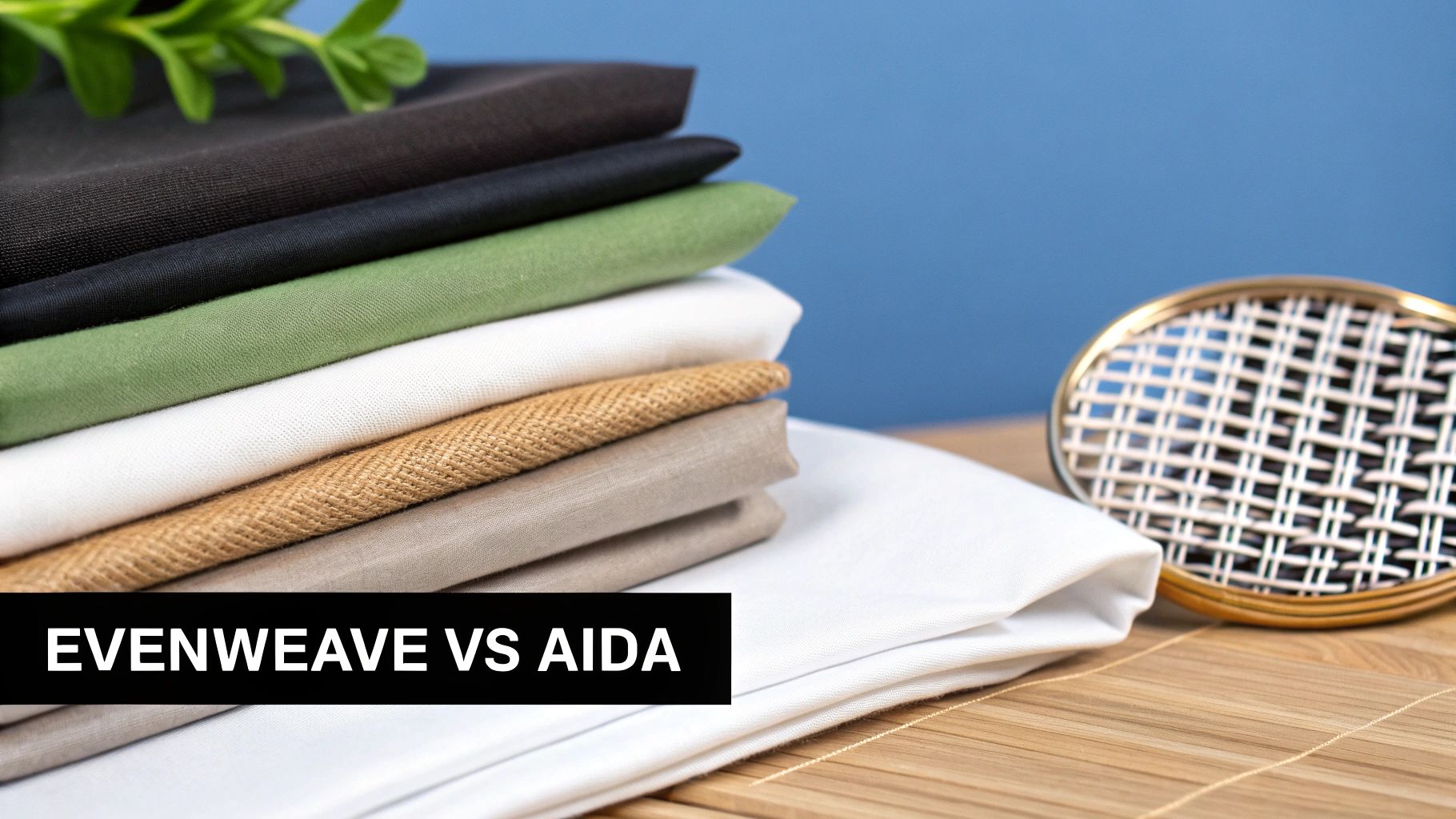
Once you've gotten the hang of Aida's perfect grid, you'll discover a whole new world of fabrics waiting for you. Let's talk about evenweaves and linens—the secret to getting that traditional, seamless finish where your stitches look like they're floating on the fabric.
Unlike the blocky weave of Aida, evenweaves like Jobelan and Lugana have a much softer, more delicate feel. They're woven with single threads going over and under each other, creating a high thread count. Linens are similar but have a lovely, natural variation in thread thickness that gives your finished piece a wonderfully rustic charm.
The Art of Stitching Over Two Threads
The trick to working with these fabrics is a technique called "stitching over two threads." It sounds complicated, but it's not. Instead of making your 'X' in a single Aida square, you simply make your stitch over a space of two vertical and two horizontal fabric threads.
This small change makes a huge difference. For example, a 28-count evenweave stitched "over two" gives you the exact same stitch size as 14-count Aida. The dimensions of your finished project will be identical, but the background fabric will be far less noticeable and much smoother.
Pro Tip: When you stitch "over two," you effectively cut the fabric count in half. So, 32-count linen acts just like 16-count Aida, and 36-count linen stitches up the same as 18-count Aida. This handy trick lets you swap these beautiful fabrics into almost any pattern originally designed for Aida.
It's no surprise that 14-count fabric is such a common starting point. Back in 2010, industry data showed that a whopping 65% of all cross-stitch kits made worldwide used 14-count Aida. This makes its "over two" equivalent, 28-count evenweave, the perfect next step for anyone looking to try a new fabric. You can find more details about the cross stitch market on businessresearchinsights.com.
Benefits and Challenges of Evenweave
Switching to evenweave is a fantastic way to level up your stitching, but it does come with a small learning curve. The payoff is a more professional and refined look that's totally worth it.
Benefits of Evenweave and Linen:
- Smoother Background: Your finished work has a less "pixelated" or "gridded" look, letting your beautiful stitches take center stage.
- Fractional Stitches: Those tricky quarter and three-quarter stitches become so much easier because you can pop your needle right through the center of the four-thread intersection.
- Traditional Finish: These fabrics give projects a timeless, heirloom quality that’s just perfect for samplers or detailed art pieces.
The main challenge when you're starting out is simply counting the threads. It takes a little more focus than just finding the next hole on Aida fabric. But trust me, after just a few stitches, you'll find the rhythm and it will feel completely natural.
If you need a quick refresher on how Aida works, feel free to check out our complete guide on what is Aida fabric. Trying an evenweave is an excellent next step in your stitching journey.
Your Cross Stitch Fabric Questions Answered
The more you stitch, the more questions you'll have. It's just a natural part of growing as a crafter! When it comes to things like fabric counts, floss strands, and tweaking patterns, things can seem a little confusing at first. But don't worry, the answers are usually much simpler than they appear.
Let's dive into some of the most common questions stitchers ask. Think of this as your personal cheat sheet for making those little decisions that make a big difference in your projects.
Can I Use a Different Fabric Count Than a Pattern Suggests?
Absolutely! This is one of the most common and easiest ways to make a project your own. But there’s a crucial thing to remember: changing the cross stitch fabric counts will change the final size of your stitched piece.
If you switch to a higher count (say, from 14-count to 18-count), your stitches will be smaller, and the finished design will shrink. Go the other way with a lower count, and your project will end up bigger. The golden rule is to always recalculate your fabric size before you make that first stitch. This ensures you buy enough fabric to fit the entire design, and you'll also want to think about adjusting your floss strands for the best coverage.
How Many Strands of Floss Should I Use for Each Count?
This is where personal taste comes in, but there are definitely some trusted guidelines to get you started. The aim is for perfect coverage—where the floss looks full and lush, but not so thick that it's bunching up or distorting the fabric.
Here’s a great starting point for Aida fabric:
- 11-Count Aida: Use 3 strands of floss. This gives you that nice, solid look.
- 14-Count Aida: 2 strands is the gold standard here. It's almost always the right choice.
- 16-Count Aida: 2 strands works beautifully for this count, too.
- 18-Count Aida: You have options. 1 strand will give you a delicate, almost tapestry-like finish. 2 strands will provide that classic, fuller coverage.
When in doubt, do a quick test. Just stitch a few X's in a corner of your fabric to see which look you prefer before you dive into the main event.
What Does Stitching "Over Two Threads" Mean?
If you've ever ventured into the world of evenweave or linen fabrics, you've probably heard this term. Unlike Aida, these fabrics don't have distinct blocks. So, instead of making your 'X' in one square, you make it over a grid of two fabric threads horizontally and two fabric threads vertically.
Stitching "over two" is a simple trick that effectively halves the fabric's count. For example, stitching over two on 28-count linen gives you stitches that are the exact same size as those on 14-count Aida (28 ÷ 2 = 14). It's the perfect way to get the smoother, more refined background of linen while keeping the same project size.
Is a Higher Fabric Count Always Better?
Nope, not at all! There's no such thing as a "better" count, only the right count for your specific project and your personal preference.
Higher counts are fantastic for highly detailed, photorealistic patterns where every tiny stitch matters. The trade-off is that it can be a bit more of a strain on the eyes.
Lower counts, on the other hand, are your best friend for bold, graphic designs or projects for kids and beginners. They're also perfect for when you just want a quick, relaxing project. Ultimately, the best choice is always the one that makes you happy to sit down and stitch.
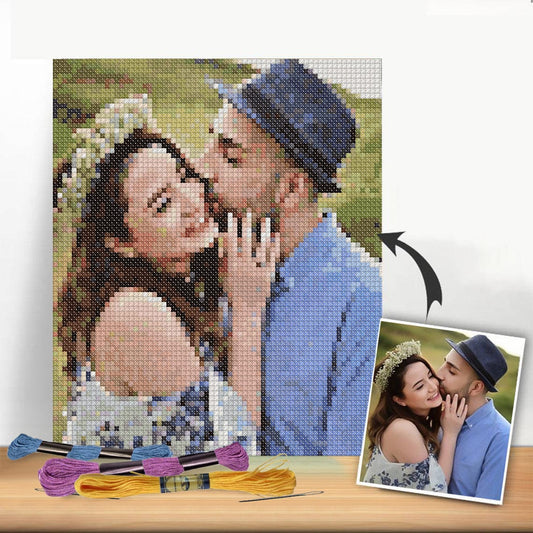
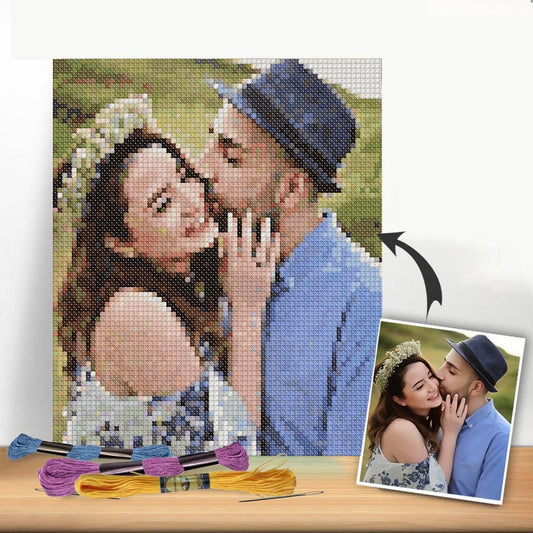
Ready to turn your favorite photos into a timeless work of art? At Cross Stitched, we make it easy to create a custom cross stitch kit from any picture. Explore our personalized kits and find all the high-quality supplies you need to start your next project today.