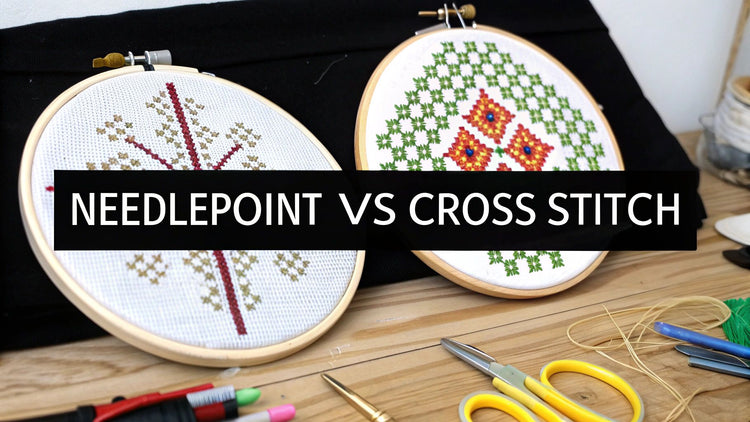
Quick answer: Cross stitch uses X-shaped stitches on even-weave fabric (Aida or linen) and follows a separate chart. Needlepoint uses tent/continental stitches to completely cover an open-mesh canvas. The key differences are: fabric (weave vs canvas), stitch type (X vs diagonal), and coverage (partial vs full-coverage of the base material).
Frequently asked questions
What is the difference between needlepoint and cross stitch?
Cross stitch is worked on woven fabric with X-shaped stitches, following a separate chart and often leaving background fabric unstitched. Needlepoint uses diagonal stitches to completely cover an open-mesh canvas, with no exposed canvas in the finished piece.
Is needlepoint harder than cross stitch?
Both crafts have similar entry-level difficulty. Needlepoint typically uses more thread to cover the canvas fully and the mesh can be less forgiving of counting errors. Cross stitch is generally considered easier for beginners due to the structured grid of Aida fabric.
Can you use the same materials for needlepoint and cross stitch?
No. They require different fabrics: cross stitch uses Aida or linen evenweave, while needlepoint uses mono or interlock canvas. Thread types also differ — cross stitch uses stranded cotton floss, while needlepoint commonly uses wool or heavier cotton thread to cover the canvas.
Is cross stitch or needlepoint more popular?
Cross stitch has a larger modern following, particularly driven by the popularity of charted kits and digital pattern designs. Needlepoint remains popular in the United States and for decorative cushion and belt designs.
At their heart, the main difference between needlepoint and cross-stitch comes down to the stitches and the fabric you use. Needlepoint relies on a whole family of diagonal stitches worked on a stiff, open-mesh canvas to create a solid, dense fabric. Cross-stitch, however, uses its trademark X-shaped stitches on softer, even-weave fabrics like Aida, resulting in a look that’s almost like a pixelated image.
Understanding the Core Differences
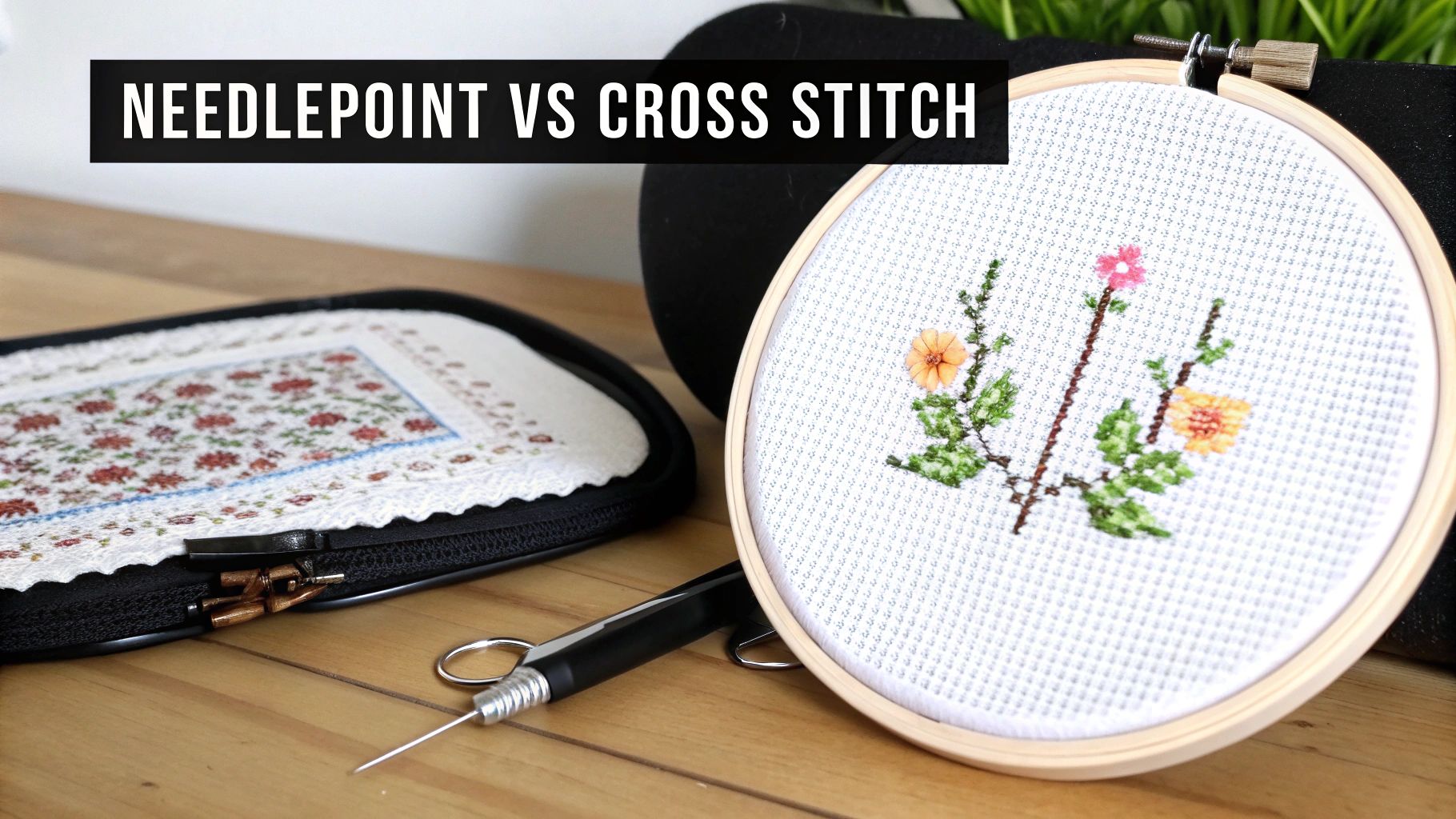
If you're dipping your toes into the world of needlecraft, you've probably heard "needlepoint" and "cross-stitch" used almost interchangeably. While they're cousins in the embroidery family, they are definitely not twins. Each has its own feel, its own materials, and its own best uses. Figuring out which is which is the best first step to picking the right project for you.
Cross-stitch is what’s known as counted-thread embroidery, and its signature move is the simple, uniform X-shaped stitch. This technique builds images that look gridded and pixelated, which is why it's so fantastic for creating pictures with a lot of detail, lettering, and complex patterns. You work from a chart, literally counting the squares on the fabric to place each "X" perfectly. We dive much deeper into this in our guide on what is cross stitch.
Needlepoint, by contrast, is a type of canvas work. Instead of making Xs, you use various "tent stitches"—which are small, diagonal stitches—to completely cover the intersections of a stiff canvas mesh. The result is a tough, fully covered fabric that’s incredibly durable, making it perfect for things that will see some wear and tear, like pillows, belts, and even small rugs.
Think of it this way: Cross-stitch is about counting threads to create an image on top of fabric, often with the background fabric showing through. Needlepoint is about covering a canvas completely with stitches to create a new, dense piece of fabric.
This single difference in approach influences everything else—the fabric, the thread, and the types of projects each craft is suited for. Let's lay it all out for a quick comparison.
Needlepoint vs Cross Stitch At a Glance
To see the key differences side-by-side, here's a quick breakdown of how these two crafts stack up against each other.
| Feature | Cross Stitch | Needlepoint |
|---|---|---|
| Primary Stitch | The "X" stitch, made from two diagonal stitches crossing over each other. | The Tent Stitch, a single diagonal stitch that has several variations (like half-cross or continental). |
| Fabric Used | Softer, even-weave fabrics like Aida or linen. | Stiff, open-mesh mono canvas. |
| Typical Thread | Divisible 6-strand cotton or silk embroidery floss. | Thicker, non-divisible wool, silk, or cotton tapestry yarn. |
| Appearance | A gridded, pixelated look great for detailed pictures. | A dense, woven texture with full canvas coverage. |
| Best For | Wall art, greeting cards, ornaments, and samplers. | Pillows, belts, rugs, upholstery, and other durable home decor. |
This table gives you a great starting point, but as we'll see, the experience of actually doing each craft is where the real differences shine.
A Look Back: The Historical Threads of Each Craft
To really get a feel for the differences between needlepoint and cross-stitch, you have to look at where they came from. It's a surprisingly fascinating story. While both use a needle and thread, their histories took completely different turns, shaping everything from the stitches we use to the projects we make. One was born from a need for durable furnishings, the other became a classroom tool.
Both crafts have ancient roots, but they really started to go their separate ways in the 16th century. Needlepoint’s story starts with pure function. There’s evidence that ancient Egyptians, as far back as 1500 BC, used small, slanted stitches to sew together heavy canvas for tents. Right from the start, needlepoint was all about creating a tough, functional fabric.
Cross-stitch also has a long history, with pieces found in Egyptian tombs from around 600 BC. But its path to becoming a household name was a bit slower and waited for a major technological leap.
How Needlepoint Took Over European Decor
When needlepoint made its way from Egypt to Europe, it was quickly adopted by the wealthy. By the 1500s, it was the top choice for creating textiles that could take a beating. The classic tent stitch, which blankets the entire canvas, results in a dense, strong fabric perfect for chair seats, cushions, and heavy curtains.
This was painstaking, expensive work, often done with wool or silk threads on intricate patterns. A piece of needlepoint furniture wasn't just a chair—it was a status symbol. It was a way to show off your wealth and taste with something that would last for generations. This focus on durability and artistry is why needlepoint has always been seen as a high-end craft for creating heirloom-quality home goods.
The simplest way to think about their historical split is this: Needlepoint was invented to create a new, sturdy fabric by covering a canvas. Cross-stitch was designed to decorate an existing fabric, leaving the original material visible.
This is why, even now, needlepoint pieces feel so substantial and textured. Cross-stitch projects, on the other hand, often look more like detailed pictures. One was meant to be sat on; the other was meant to be hung on a wall.
Cross-Stitch and the Power of the Printed Pattern
The big moment for cross-stitch came with the invention of the printing press. When the first printed cross-stitch patterns emerged in the late 1500s, it changed everything. No longer were patterns precious, hand-me-down treasures. They were suddenly available to almost everyone. By the late 1600s, you could walk into a sewing shop in Europe and buy a printed chart.
This newfound accessibility turned cross-stitch into a powerful educational tool. In the 1700s, it became a key part of a young woman's education. Girls would create "samplers" to practice their alphabet, numbers, and moral verses. These samplers were both a stitching exercise and proof of a girl’s skill and hard work. The Victoria & Albert Museum now has a collection of over 700 of these samplers, offering a glimpse into this tradition. You can learn more about this part of history by exploring needlework in 19th-century girlhood on museumsvictoria.com.au.
This history is exactly why cross-stitch is still so perfect for beginners. The whole idea of working from a clear, gridded chart is woven right into its past, making it an incredibly welcoming entry point for anyone curious about needlecraft today.
Of course. Here is the rewritten section with a more human, expert tone, while preserving all the original requirements.
The Stitches and Supplies That Define Each Craft
History tells us why these two crafts developed, but the real magic—and the key differences—are found in the tools you use every day. The specific stitch you make, the canvas you choose, and the thread you pull through it aren't just minor details. They fundamentally shape the entire creative process and the look of your finished piece. Getting a feel for these materials is the best way to figure out which craft is right for you.
At the heart of it all is the primary stitch for each discipline. While both use a needle and thread, the way that thread is laid onto the fabric creates two completely different results.
This visual gives you a quick rundown of how far back the roots of each craft go.
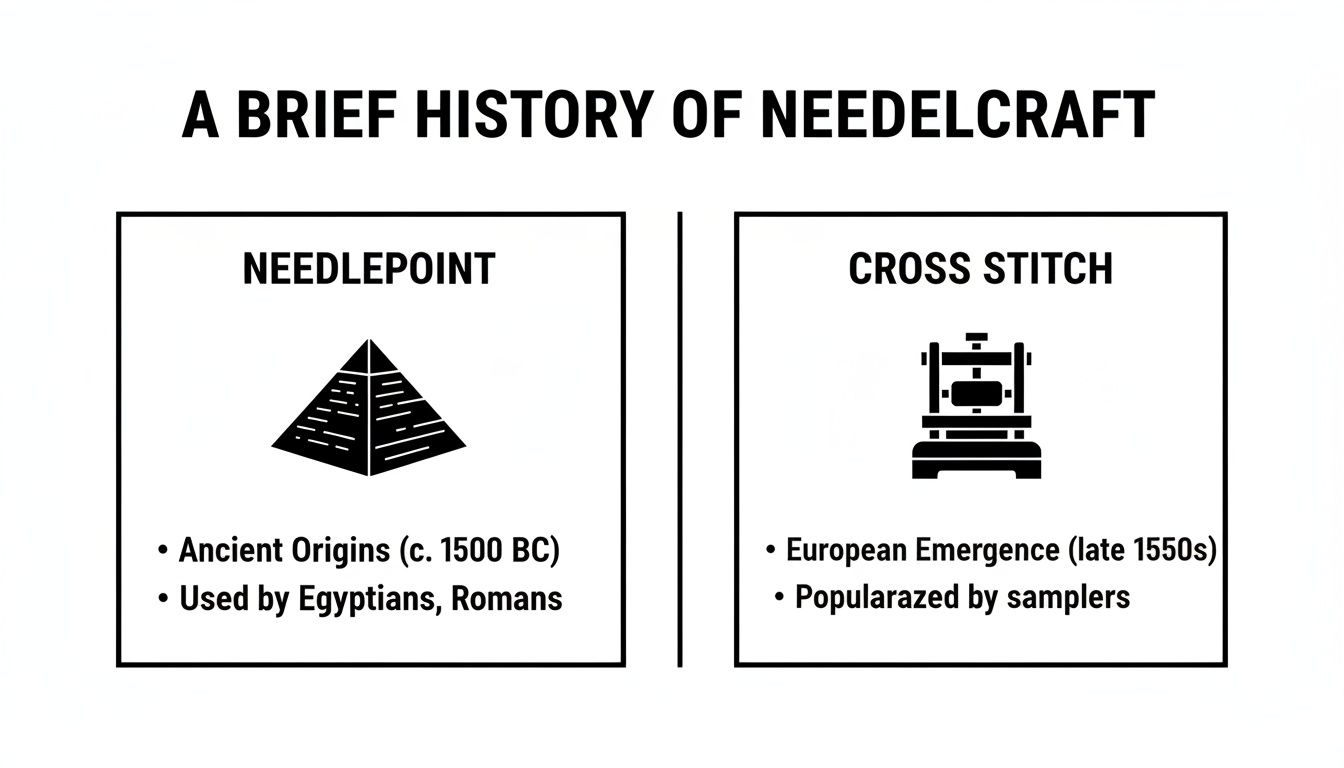
As you can see, needlepoint's origins were deeply practical, born from ancient tent-making. Cross-stitch came along later, finding its footing as a more decorative and educational art form.
The Defining Stitches
Cross-stitch couldn't be more aptly named—it’s all about the cross stitch. This is a simple, two-step stitch that creates a tiny "X" over one square of the fabric. You make one diagonal half-stitch from corner to corner, then cross back over it with another diagonal stitch going the other way.
The elegance of this method is its uniformity. Every stitch is the same, which builds up into a clean, pixel-like image perfect for following detailed charts. This consistency is a huge reason why beginners take to cross-stitch so quickly. If you want a closer look at the mechanics, we break it all down in our guide to essential cross stitch stitches.
Needlepoint, on the other hand, revolves around the tent stitch. This is a single, short diagonal stitch that slants over the intersection of one horizontal and one vertical thread of the canvas. It seems simple enough, but there are a few key variations you'll encounter:
- Half-Cross Stitch: This is the most basic version, worked in rows. It's quick, but it has a notorious reputation for pulling the canvas out of shape.
- Continental Stitch: A much sturdier stitch that provides better coverage on the back of the canvas, making the final piece far more durable.
- Basketweave Stitch: Most needlepointers consider this the gold standard. You work the stitches in diagonal rows, which creates a woven texture on the back that keeps the canvas perfectly square and prevents warping.
The core difference is this: a cross stitch is a two-part "X" that sits on top of the fabric grid. A needlepoint tent stitch is a single diagonal slash that becomes part of the canvas, aiming for total coverage.
This single difference in stitching philosophy leads directly to the next major point of comparison: the fabrics themselves.
Fabric Face-Off: Aida Cloth vs. Mono Canvas
You can't just swap fabrics between these two crafts. Each one has a specific foundation material that is perfectly suited to its stitching style.
For cross-stitch, the undisputed champion is Aida cloth. It’s a cotton fabric woven with evenly spaced holes, creating a very obvious grid. That grid makes counting and placing your "X" stitches incredibly simple. Aida is also soft and pliable, which is why you almost always see it stretched in an embroidery hoop to maintain even tension.
Needlepoint demands something much tougher: mono canvas. This is a stiff, rigid mesh, usually made of cotton or linen, with a very open weave. The stiffness isn't a flaw; it's a feature. It provides the structural support needed for the dense stitches that will eventually cover every inch of its surface. Because it's so rigid, you can often work on it without a hoop, though larger projects benefit from stretcher bars to keep things from warping.
Here’s a quick breakdown of the materials:
| Feature | Cross Stitch Materials | Needlepoint Materials |
|---|---|---|
| Fabric | Soft, flexible Aida cloth with a clear grid for counting. | Stiff, rigid mono canvas with an open mesh for coverage. |
| Thread | Divisible six-strand cotton floss for fine detail and blending. | Thicker, non-divisible wool or silk tapestry yarns. |
| Needle | Tapestry needle with a blunt tip and a large eye, size varies by fabric count. | Tapestry needle with a blunt tip and a large eye, typically a larger size to accommodate thicker yarn. |
A Tale of Two Threads: Floss vs. Yarn
Just as the fabrics are different, so are the threads. Cross-stitchers use six-strand embroidery floss, which is almost always cotton. The key here is that it's divisible. You can separate those six strands and use just one or two for fine, delicate details, or use more for bolder coverage. This gives you amazing control over shading and color blending.
Needlepoint needs something with more heft to get that signature full-coverage look. That's where non-divisible tapestry yarn comes in. It's often made of wool but also comes in silk, cotton, and other fibers. This thicker yarn fills the canvas holes quickly, creating the durable, textured fabric that makes needlepoint so unique. The goal isn’t subtle detail; it's about building a rich, solid surface.
Matching the Craft to Your Project
So, needlepoint or cross-stitch? The best way to decide is to think about what you actually want to make. Each craft has its own strengths, from the stitches themselves to the fabric you use, making them a better fit for different types of projects. Getting this match right from the start is the real secret to a project you'll be proud of.
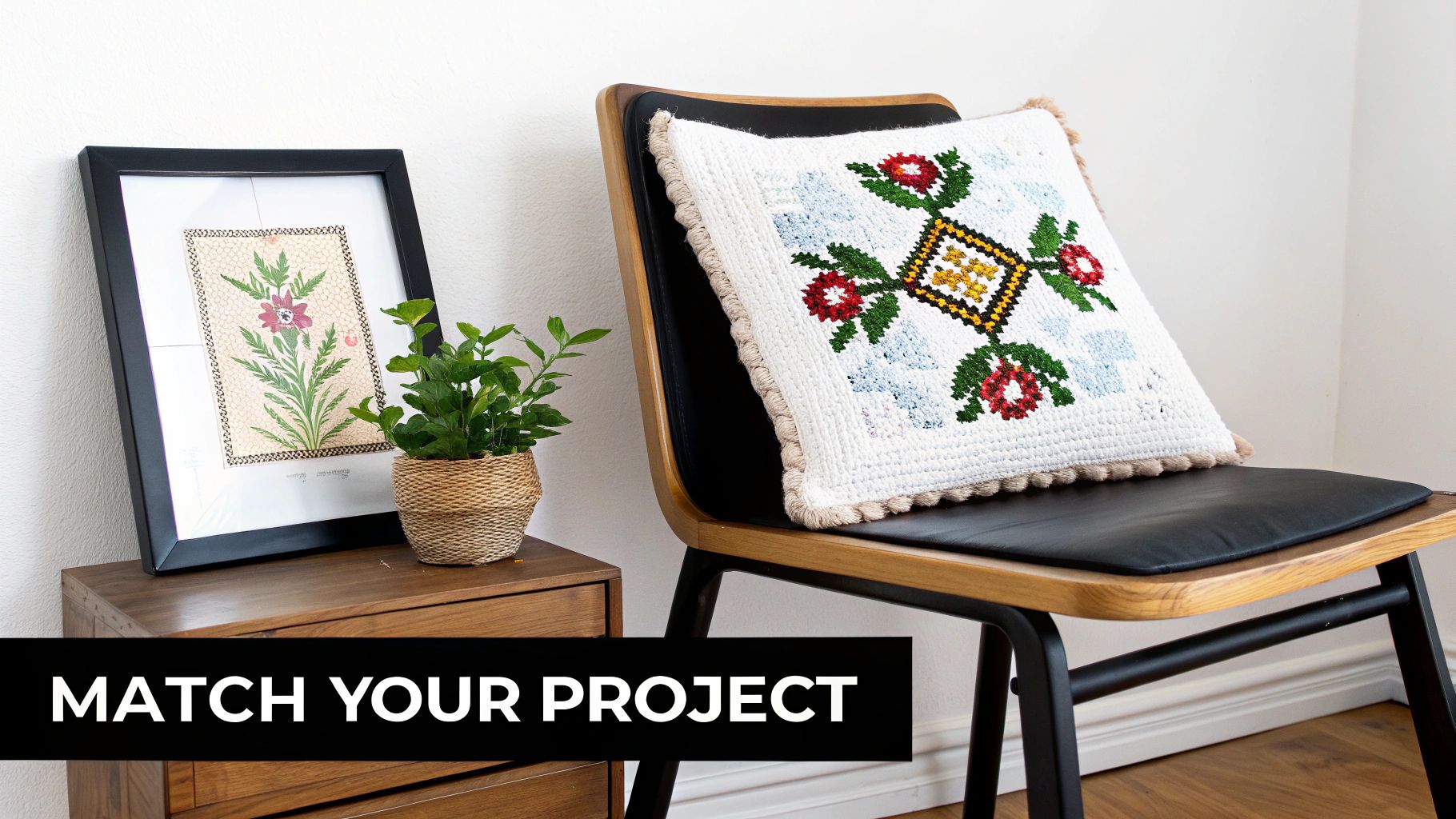
I like to think of cross-stitch as painting by number, but with thread. Its neat little "X" stitches create a pixelated look, which is absolutely perfect for detailed pictures, complex patterns, and crisp lettering. It’s no wonder it’s the top choice for pictorial art.
Needlepoint, on the other hand, is all about creating a new, solid piece of fabric. You completely cover the canvas with yarn, resulting in a thick, durable textile that can really take a beating. This quality makes it the clear winner for functional items you want to use every day.
When to Choose Cross-Stitch
Cross-stitch really shines when detail and imagery are your top priorities. The grid-based fabric is the perfect foundation for patterns that need precision and lots of subtle color shifts.
You'll want to go with cross-stitch for projects like:
- Framed Wall Art: It’s brilliant for recreating images with that classic pixel-art accuracy, whether you're stitching a traditional sampler or a modern pop-culture design.
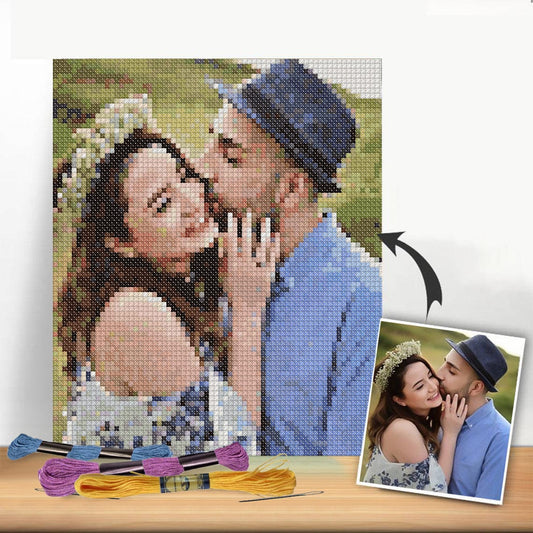
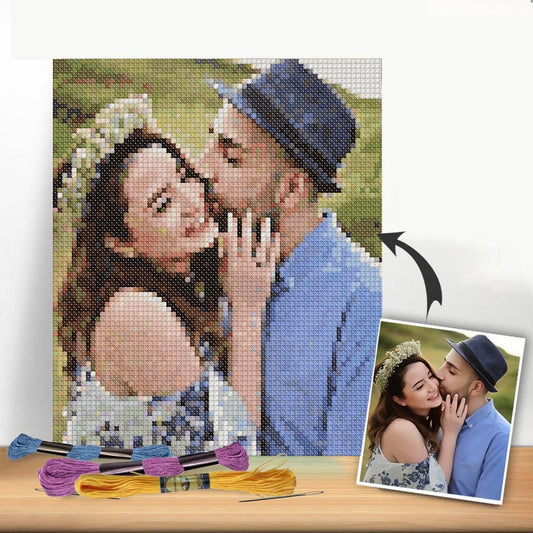
- Custom Photo Projects: This is where cross-stitch becomes something truly special. Turning a favorite photo into a stitched pattern is a beautiful way to preserve a memory.
- Ornaments and Greeting Cards: Because you can use just a few strands of floss, you can achieve incredibly fine details for small, intricate designs that look sharp and professional.
- Keepsakes and Gifts: Think birth announcements or wedding samplers. The clean lettering and delicate motifs that are hallmarks of cross-stitch make these items extra special.
If your goal is to create a visual masterpiece for the wall or a delicate keepsake, cross-stitch is almost always the way to go. Its structured nature is its greatest strength, letting you achieve a level of detail that’s tough to replicate with needlepoint.
The ability to control shading by varying the number of floss strands gives your work a sense of depth and realism, especially in portraits and landscapes. It's the ideal medium for transforming a personal photo into a lasting piece of art.
When to Choose Needlepoint
When it comes to durability, needlepoint is the undisputed champ. If you’re making something that needs to be more than just pretty, the dense, interlocking fabric created by tent stitches gives it the toughness for real life. Using sturdy wool or silk yarn just adds to its staying power.
Consider needlepoint for these kinds of high-use, functional items:
- Decorative Pillows and Cushions: The finished fabric is tough. It holds its shape incredibly well and can handle being squashed on the sofa day in and day out.
- Belts, Wallets, and Key Fobs: These accessories see a lot of wear and tear, and the sturdy canvas of needlepoint is built for it.
- Upholstery: For smaller pieces like a footstool or a dining chair seat, needlepoint offers a covering that is both luxurious and exceptionally hard-wearing.
- Rugs and Tapestries: It's a huge undertaking, but needlepoint rugs are gorgeous and practically indestructible. To get a feel for this kind of project, you can learn more about how to make tapestries and the techniques involved.
Basically, if you can sit on it, walk on it, or toss it around, needlepoint is the craft for the job. It’s designed for function first, creating a wonderfully tactile and resilient item that’s both beautiful and practical. The rich texture of the yarn adds a warmth and dimension that is unique to this craft, making it a favorite for home decor that is meant to be touched and used.
Cost, Time, and Learning: What to Expect
When you're trying to decide between needlepoint and cross-stitch, the practical side of things—money, time, and how hard it is to learn—often makes the decision for you. It's one thing to love the look of a craft, but it's another to find one that actually fits into your life without causing more stress. Generally speaking, cross-stitch is the friendlier option for beginners, while needlepoint can ask for a little more from your wallet and your patience.
This isn't a new development. Cross-stitch has a long history of being teachable. Back in the 1700s, young girls learned their ABCs and numbers by creating cross-stitch samplers. Needlepoint, on the other hand, was always more about creating lavish home decor, so it never really had that educational, beginner-focused role. This history is why modern cross-stitch kits are so good at getting people started. You can dive deeper into needlepoint's decorative past over at Britannica.com.
The Learning Curve: Which is Easier to Start?
For most people just dipping their toes in, cross-stitch is the way to go. The whole craft is built around one simple, repeatable stitch: the "X". The Aida fabric, with its built-in grid, makes following a pattern a breeze. You're essentially just counting squares and making Xs—it’s a very structured process that feels a bit like paint-by-numbers, which is great for building confidence right away.
Needlepoint can feel a little more demanding at first, mostly because there are more stitches to learn. You can get by with a basic tent stitch, but to stop your canvas from warping out of shape, you really need to get the hang of the continental or basketweave stitch. That takes a bit of practice. Plus, many needlepoint canvases come hand-painted instead of with a separate chart, giving you more artistic freedom but also less direct guidance, which can be daunting for a total beginner.
Key Takeaway: If you thrive on clear instructions and a predictable outcome, start with cross-stitch. If you're drawn to a more freeform, textural experience and don't mind a bit of a learning challenge, needlepoint will be incredibly rewarding.
Comparing Time Commitment
So, which one is faster? The answer isn't as simple as you'd think. A single needlepoint tent stitch is technically quicker to make than a complete cross-stitch. But here's the catch: needlepoint projects almost always demand 100% canvas coverage. Every single intersection of the canvas has to be filled with yarn, which means even a small piece can take a surprising amount of time.
Cross-stitch, however, often uses the blank fabric as part of the design. Many patterns strategically leave the background Aida cloth exposed, which drastically cuts down on the total stitch count. So, if you're comparing two projects of the same size, the cross-stitch piece with a lot of that "negative space" will almost always be finished faster than the fully-covered needlepoint piece.
A Breakdown of Potential Costs
The initial cost is one of the biggest differences in the needlepoint vs. cross-stitch showdown. Cross-stitch is definitely the more budget-friendly hobby to get into. You can find all-in-one kits everywhere that include the fabric, pre-sorted floss, a needle, and the pattern for one set price.
Needlepoint tends to have a higher price tag right from the start. The main costs come from two places:
- The Canvas: A beautiful, hand-painted needlepoint canvas is a work of art on its own and can easily cost more than an entire cross-stitch kit.
- The Yarn: You’ll typically use specialty fibers like wool or silk, which are pricier than the standard cotton floss used in cross-stitch. And since you have to cover the whole canvas, you'll need a lot more of it.
You can find more affordable printed needlepoint canvases, but the craft usually involves buying your materials separately, and those costs add up. For anyone on a tight budget, a cross-stitch kit is the most accessible way to get stitching right away.
So, Which One Is Right for You?
Choosing between needlepoint and cross-stitch really boils down to what you want to make and what kind of creative process you enjoy most. Both are fantastic ways to make something beautiful by hand, but they scratch different creative itches. The best choice is the one that gets you excited about both the journey and the finished piece.
A good way to think about it is like choosing between painting and mosaic art. Needlepoint is a lot like painting with yarn. You're building a rich, dense fabric stitch by stitch, creating a very tactile, textured surface. Cross-stitch, on the other hand, is more like assembling a mosaic, where you carefully place tiny, uniform "pixels" of thread to build a detailed picture.
Finding Your Perfect Fit
To cut through the needlepoint vs. cross-stitch chatter, let's see which of these sounds more like you.
You might be a cross-stitcher if:
- You're brand new to needlecrafts and want something structured and easy to pick up.
- You love detailed, picture-like designs and dream of turning a favorite photo into art.
- You find satisfaction in following a precise chart and watching an image appear on the grid.
- You're looking for an affordable hobby and love the idea of an all-in-one kit.
You might be a needlepointer if:
- You want to create durable, functional pieces for your home, like pillows, belts, or even chair covers.
- You're drawn to the feel of wool or silk and prefer a more freeform, tactile experience.
- You'd rather work on a pre-printed canvas than count stitches from a separate chart.
- You're up for a slightly steeper learning curve that pays off in lush, heirloom-quality creations.
The modern needlecraft boom has really spotlighted cross-stitch's accessibility. A lot of that is thanks to convenient kits and huge online communities. Standardized materials like Aida fabric and DMC thread have made it incredibly easy to follow counted patterns. This simplicity is a big reason why businesses like Cross Stitched can ship custom kits all over the world, making it a go-to for beginners and gift-givers. You can read more about the history and modern appeal of cross-stitch on simplesimonandco.com.
At the end of the day, if your heart is set on turning a precious photo into a stitched keepsake, cross-stitch is your ideal starting point. Its grid-based system is perfectly suited for capturing the details of a photograph, and custom kits take all the guesswork out of it. But if you're dreaming of creating textured, functional home decor with a luxurious feel, needlepoint is a fantastic path to take.
Whichever you choose, you're starting a wonderfully rewarding creative journey.
Frequently Asked Questions
Even after a side-by-side comparison, a few practical questions usually pop up when you're trying to choose between needlepoint and cross-stitch. Let's tackle some of the most common ones to help you make your final call.
Can You Use a Cross Stitch Pattern for Needlepoint?
You absolutely can, but with a few key adjustments. The core idea is to treat each "X" on the cross-stitch chart as a single diagonal tent stitch on a needlepoint canvas. It's a pretty straightforward conversion.
The real difference-maker is the thread. You'll need to ditch the fine cotton floss used in cross-stitch and pick up a thicker needlepoint yarn—think wool or silk. This is non-negotiable if you want that classic, plush look where the canvas is completely covered. The pattern will work, but the final piece will have a totally different texture and feel.
Which Craft Is Faster to Complete?
This is the classic "it depends" answer, but for good reason. On a stitch-by-stitch basis, a single needlepoint tent stitch is faster to make than the two-step motion of a cross-stitch. But the overall project time is a whole different story.
A huge factor is canvas coverage. Needlepoint projects almost always involve stitching the entire canvas, background and all. That takes time. Many cross-stitch designs cleverly leave parts of the fabric unstitched, using that negative space as part of the design, which can dramatically cut down on the total stitching time.
For someone just starting out, the simple, repetitive rhythm of counted cross-stitch can often feel quicker and more rewarding. A detailed, full-coverage needlepoint piece can easily take just as long—or even longer—than a cross-stitch project of the same size.
Is Needlepoint More Expensive Than Cross Stitch?
In most cases, yes. Needlepoint tends to have a higher price tag right from the start. The materials themselves just cost more. For instance, beautifully hand-painted needlepoint canvases are a joy to work with, but they can be a serious investment before you've even made a single stitch.
The specialty yarns used for needlepoint, like wool and silk, are also typically pricier than the standard cotton embroidery floss you find in cross-stitch. Cross-stitch is generally easier on the wallet, especially because all-in-one kits are so common. These kits pack everything you need—fabric, thread, needle, and pattern—into one affordable package, making it a much more accessible starting point for new crafters.
Ready to turn a cherished photo into a handmade keepsake? At Cross Stitched, we take the guesswork out of getting started. Just upload your picture, and we’ll send you a custom, all-inclusive kit with everything you need to create a stunning, personalized cross-stitch piece. Explore custom kits and start stitching today!