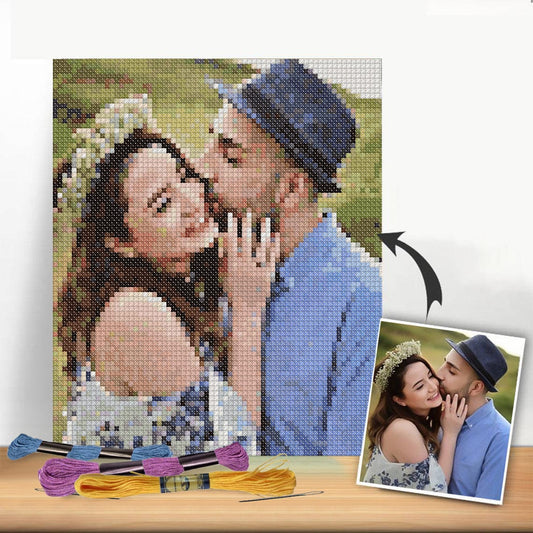
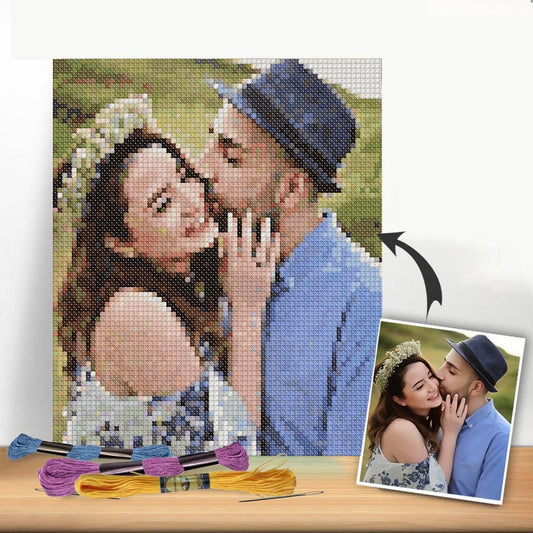
Welcome to the world of embroidery, a timeless craft where every stitch tells a story. While many begin with the classic cross stitch, a whole universe of textures, lines, and effects is waiting to be discovered. Understanding the different kinds of embroidery stitches is the key to transforming a simple pattern into a work of art with depth, personality, and a professional finish.
This guide is designed to be your comprehensive resource, whether you're just starting your first guided kit or you're an experienced crafter looking to expand your skills. We'll explore ten essential stitches, from foundational techniques to more decorative options. For each one, we will detail its unique characteristics, ideal applications, and provide actionable tips to help you master it with confidence.
From creating crisp outlines with a backstitch to adding dimensional texture with a French knot, you'll learn how to elevate your projects and bring your creative visions to life. Mastering these individual stitches is the first step; soon you’ll be ready to tackle complex, personalized projects. Beyond learning individual stitches, you can truly unlock your creative potential by exploring resources like a complete Graduation Sash Embroidery Guide, which delves into choosing materials and creating stunning custom designs. This directory will provide the foundational skills you need to approach any project, no matter how ambitious. Let's thread the needle and dive into the stitch-by-stitch breakdown that will build your confidence and expand your creative toolkit.
1. Cross Stitch
Cross stitch stands as a cornerstone among the different kinds of embroidery stitches, celebrated for its simplicity and pixel-like precision. This technique is a form of counted-thread embroidery where X-shaped stitches are used to form a picture. The process involves creating a row of diagonal stitches (e.g., lower-left to upper-right) and then crossing them on the return journey (e.g., upper-left to lower-right), resulting in a uniform, tiled appearance.

Because each 'X' occupies a single square on the fabric grid, it’s the perfect medium for recreating digital images with stunning accuracy. This is the foundational technique used in modern innovations like Cross Stitched’s custom photo-to-pattern kits, which transform cherished photographs into tangible, stitched art.
Best Uses and Project Ideas
The grid-based nature of cross stitch makes it ideal for patterns requiring clear definition and color blocking. It’s particularly effective for creating custom portraits from photos, seasonal ornaments, and detailed pet memorial pieces. The clean, uniform stitches lend themselves to both intricate, multi-color designs and simple, graphic motifs.
Actionable Tips for Perfect Stitches
To achieve a professional finish, consistency is key. Following a few core principles will elevate your work:
- Fabric Choice: Start with Aida fabric, as its clearly defined woven squares make counting stitches straightforward for beginners.
-
Stitch Direction: For a smooth, even texture, ensure all your top stitches face the same direction throughout the entire project. For example, always complete the
\stitch before the/stitch. - Thread Tension: Maintain even tension on your DMC threads. Pulling too tightly will pucker the fabric, while loose stitches can look messy and snag easily.
- Pattern Adherence: When working with detailed kits, use the provided color chart religiously. Outlining your finished sections with back stitches, as indicated in the pattern, will create crisp, clean edges.
Cross stitch is a fantastic entry point into the world of needlework, offering a structured yet creative way to produce beautiful, personalized art. For a deeper dive and a helpful reference, you can download a printable embroidery stitch guide to keep on hand.
2. Backstitch
Backstitch is a foundational outline stitch, revered for its ability to create clean, continuous lines. Among the different kinds of embroidery stitches, it serves as the artist's pen, perfect for defining shapes and adding intricate details. The technique involves bringing the needle up through the fabric a short distance from the start of the line, then taking a step "back" to insert the needle at the beginning point. The next stitch emerges ahead of the first, again stepping back to the end of the previous stitch, forming a solid, unbroken line.
This stitch is indispensable in counted-thread embroidery, especially in cross-stitch projects. After the main 'X' stitches create blocks of color, backstitching is applied to add clarity and dimension. It transforms a pixelated image into a sharp, well-defined piece, making it a critical final step in custom photo-to-pattern kits where capturing detail is paramount.
Best Uses and Project Ideas
Backstitch excels wherever sharp definition is needed. It’s the go-to stitch for adding text and lettering on personalized gift ornaments, creating crisp border outlines on seasonal designs, and rendering fine details like whiskers and facial features in pet portrait cross-stitches. Its linear nature makes it ideal for any element that needs to stand out with precision.
Actionable Tips for Perfect Stitches
To make your details pop, executing a clean backstitch is crucial. Follow these tips for a polished look:
- Order of Operations: Always add backstitching as the final layer, after all the cross stitches are complete, to ensure the outlines sit neatly on top.
- Thread Count: Use a single strand of DMC thread for the finest, most delicate details. For a bolder line, you can use two strands, but be consistent.
- Stitch Length: Maintain a consistent stitch length for a smooth, even line. For curves, use shorter stitches to prevent a jagged or angular appearance.
- Tension Control: Keep your thread tension even. Pulling too hard can cause the fabric to pucker, particularly on long, straight lines.
- Create Contrast: Use a thread color that is darker than the surrounding cross stitches to make your outlines bold and clearly visible.
3. Half Stitch (Half Cross)
The half stitch is an essential building block among the different kinds of embroidery stitches, acting as a simplified version of its full cross stitch counterpart. This technique involves creating only the first diagonal leg of a cross stitch, resulting in a single slanted stitch (e.g., lower-left to upper-right). The result is a lighter, less dense texture that offers remarkable versatility in creating depth and nuance.
This stitch is particularly powerful for shading and creating smooth gradients, as it allows for subtle color transitions that mimic painterly effects. Its reduced visual weight makes it a go-to technique in advanced photo-to-pattern conversions, where capturing delicate variations in light and shadow is crucial for achieving realism.
Best Uses and Project Ideas
The half stitch shines in applications where shading and subtle color blending are key. It is perfect for creating soft backgrounds, gentle gradients in landscapes, and realistic skin tone variations in custom photo portraits. When combined with full cross stitches, it adds dimension and prevents the design from looking flat, making it invaluable for detailed pet portraits and intricate art reproductions.
Actionable Tips for Perfect Stitches
To master the half stitch and use it effectively, focus on consistency and strategic planning. These tips will help you create a polished, professional look:
- Consistent Direction: Decide on a single direction for all your half stitches (e.g., all leaning from bottom-left to top-right) and maintain it throughout the entire piece. This consistency is vital for a smooth, uniform appearance.
- Blend Seamlessly: When using half stitches for shading, choose DMC thread colors in similar tones. This ensures the transition between shades is gradual and natural-looking, enhancing the overall realism.
- Create Contrast: Use half stitches alongside full cross stitches to create a clear distinction between the foreground and background elements. The textural difference will make key parts of your design pop.
- Work Systematically: Stitch one color at a time, especially in complex areas with multiple similar shades. Following the pattern chart methodically will help prevent mistakes and ensure accurate color placement.
4. French Knot
The French knot is a highly decorative embroidery stitch that creates small, raised dots on the fabric's surface, adding texture and dimension. It is executed by wrapping thread around the needle before pushing it back through the fabric near the original entry point. This technique, while sometimes intimidating for beginners, is invaluable for creating intricate details and embellishments that make a design pop.

Popularized in 19th-century French needlework, this stitch has become a staple for adding texture to both traditional embroidery and modern cross-stitch projects. It transforms flat designs into tactile art, allowing for a level of detail that other stitches cannot easily replicate. Mastering it unlocks a new level of creativity in your needlework.
Best Uses and Project Ideas
French knots are the go-to stitch for creating small, dimensional details. They are perfect for adding pupils to the eyes in personalized animal portraits, creating tiny flower centers in botanical designs, or scattering decorative dots on seasonal ornaments. They can also be clustered together to create textured areas in landscapes, such as fluffy clouds or dense foliage.
Actionable Tips for Perfect Stitches
Achieving a neat and secure French knot is all about controlling the thread tension and needle placement. A few key practices can help you perfect this essential technique:
- Wrapping the Needle: For a small, delicate knot, wrap the thread around your needle once. For a bolder, more pronounced dot, wrap it two or three times. Avoid wrapping more than three times, as it can make the knot unstable.
- Maintain Tension: As you push the needle back through the fabric, keep the wrapped thread taut with your non-dominant hand. This tension is crucial for forming a tight, uniform knot.
- Needle Placement: Insert the needle back into the fabric adjacent to where it came up, but not in the exact same hole. This prevents the knot from slipping through to the back of your work.
- Thread Count: Use a single strand of DMC thread for fine details or 2-3 strands for more prominent, textured knots. Practice on a scrap piece of Aida fabric to see what effect you prefer.
The French knot is one of the most versatile and beautiful of all the different kinds of embroidery stitches. For a step-by-step visual tutorial, you can learn exactly how to make a French knot and add this wonderful skill to your repertoire.
5. Split Stitch
The split stitch is one of the more textured and decorative linear kinds of embroidery stitches, creating a fine chain-like or braided line. The technique involves bringing the needle up from the back of the fabric, making a single straight stitch, and then bringing the needle up again from the middle of that very stitch, splitting the thread fibers. This continuous splitting action forms a distinctive, rope-like line perfect for outlines and lettering.
Unlike the smoother backstitch, the split stitch offers a raised, dimensional quality that adds visual interest and a tactile feel to any piece. Its ability to create delicate, flowing curves makes it a favorite for outlining organic shapes, filling in small areas, and adding sophisticated detail to various embroidery projects, including mixed-media designs that combine it with cross stitch.
Best Uses and Project Ideas
The split stitch excels in creating detailed and textured lines. It's ideal for lettering that needs a bit of dimension, outlining flower stems and vines, or adding intricate borders to a finished cross-stitch piece. Its texture makes it a great choice for defining the edges of filled areas in crewelwork or adding a subtle, artistic flourish to seasonal designs.
Actionable Tips for Perfect Stitches
Achieving a clean, consistent split stitch line requires precision and patience. Following these tips will help you master this valuable stitch:
- Thread Count: Use a thread count of 2-3 strands of DMC floss. This amount is thick enough to split effectively without becoming bulky or difficult to pierce.
- Central Split: Aim to bring your needle up through the exact center of the previous stitch. This ensures the "braid" looks even and uniform along its entire length.
- Slow and Steady: Work slowly and deliberately to ensure your needle successfully catches and splits the thread fibers rather than just pushing them aside. Good lighting is essential.
- Post-Fill Outlining: When using split stitch to outline a cross-stitched area, complete all your cross stitches first. This prevents the outline from being distorted by the fill stitches.
- Curved Lines: For smooth curves, use slightly shorter stitches. This will help the line flow naturally around bends without creating sharp, angular points.
The split stitch is a versatile and elegant addition to any embroiderer's skill set, offering a beautiful way to introduce texture and definition into your work.
6. Satin Stitch
The Satin Stitch is a foundational filling stitch renowned for its ability to cover areas with a smooth, lustrous, and solid block of color. This technique involves placing a series of straight stitches parallel and extremely close to one another, completely concealing the fabric beneath. The result is a seamless, flat surface with a silk-like sheen, making it one of the most elegant and impactful kinds of embroidery stitches for creating polished designs.

This stitch's primary function is to create solid fills that stand out with a glossy texture, contrasting beautifully with the matte, pixelated look of cross stitches. It's an excellent choice for adding depth and variety to a mixed-media piece, allowing certain elements like ribbons, banners, or smooth backgrounds in custom photo patterns to pop with vibrant, uninterrupted color.
Best Uses and Project Ideas
The Satin Stitch excels in projects where a smooth, solid surface is desired. It is perfect for filling in lettering, flower petals, and clothing details on embroidered characters. In the context of custom kits, it can be used to create smooth background fills in photo-based designs, render solid color blocks in seasonal ornaments, or add sleek ribbon and banner elements to a commemorative piece.
Actionable Tips for Perfect Stitches
Achieving a flawless satin stitch requires patience and precision. The goal is a uniform surface without gaps or puckering.
- Create an Outline: Before you begin, outline the shape you intend to fill using a Split Stitch or Backstitch. This creates a raised, clean edge that helps guide your satin stitches and keeps them neat.
- Plan Your Angle: Decide on the angle of your stitches before you start. A slight diagonal (around 45 degrees) often produces the most visually appealing sheen, but the angle should complement the shape you are filling.
- Maintain Even Tension: Consistent thread tension is crucial. Pulling stitches too tight will cause the fabric to pucker, while stitches that are too loose can look sloppy and snag. Aim for a gentle, firm pull that allows the thread to lie flat.
- Work Systematically: Start at one end of the shape and work your way across in systematic rows. This helps ensure your stitches remain parallel and evenly spaced, preventing gaps and creating a uniform, professional finish.
7. Stem Stitch
Stem stitch is one of the most fundamental linear stitches in embroidery, renowned for its ability to create a slightly twisted, rope-like line. The technique involves forming overlapping, angled stitches that twist around a central line, giving it a delicate texture and dimension. This stitch is executed by bringing the needle up and then making a short, straight stitch, but the next stitch emerges slightly to the side of the previous one, creating the signature twist.
This stitch adds a sense of organic movement and flow that is difficult to achieve with more rigid stitches. Popularized through Victorian botanical embroidery and still favored by contemporary textile artists, stem stitch is essential for any embroiderer's toolkit, especially for designs inspired by nature.
Best Uses and Project Ideas
The natural, flowing quality of the stem stitch makes it perfect for outlining shapes and creating smooth curves. It is the go-to choice for embroidering flower stems, vines, and branches in botanical designs, as it mimics the look of real plant life. It is also highly effective for creating elegant, curved borders, delicate scrollwork, and outlining text for a hand-scripted appearance.
Actionable Tips for Perfect Stitches
To master this essential stitch, focus on consistency and the placement of your needle. A few key tips will help you create beautiful, uniform lines:
- Consistent Angle: Always bring your needle up on the same side of your previous stitch. This ensures the twist in your rope-like line remains uniform.
- Stitch Direction: It is often easiest for right-handed stitchers to work from left to right. Experiment to find the most comfortable direction for you.
- Thread Choice: Using two or three strands of DMC thread provides a balanced line width that is substantial yet still delicate.
- Navigating Curves: When working around tight curves, use smaller stitches. This will help you maintain a smooth, graceful line without creating sharp angles.
- Even Tension: Keep your thread tension steady and even. Pulling too tightly will pucker the fabric, while loose stitches will disrupt the twisted effect.
Stem stitch is a versatile and elegant technique among the different kinds of embroidery stitches, ideal for adding graceful, flowing lines to any project.
8. Long Stitch
The long stitch is a deceptively simple yet powerful technique among the different kinds of embroidery stitches. It consists of a single straight stitch that spans multiple threads or squares of fabric, either vertically or horizontally. Unlike the compact cross stitch, its extended form is used to quickly fill areas, create bold lines, and introduce a strong sense of direction and movement into a piece.
Popularized by modern textile designers and contemporary pattern creators, the long stitch excels in geometric and minimalist designs. By varying the length and direction of the stitches, artists can create dynamic textures and patterns, making it a valuable tool for adding structural elements and visual rhythm to both standalone embroidery and mixed-media projects, such as those combining cross stitch and surface work.
Best Uses and Project Ideas
The long stitch is perfect for creating impactful, graphic effects with minimal effort. It is ideal for filling in geometric shapes in abstract or modern patterns, creating grid and line work, and adding directional emphasis to suggest things like sun rays, wood grain, or flowing water. In custom cross-stitch kits, it can be used to render backgrounds or add stylized details that contrast with the pixelated texture of the main subject.
Actionable Tips for Perfect Stitches
To ensure your long stitches look clean and intentional, precision is crucial. Applying these tips will help you master the technique for a polished and durable result:
- Secure Your Stitches: To prevent long stitches from becoming loose or snagging, keep them relatively short, ideally spanning no more than 3-4 squares of Aida fabric at a time. For longer spans, consider couching them down with a tiny perpendicular stitch in the center.
- Plan Directionality: Before starting, decide on the direction your stitches will follow. A consistent or intentionally varied direction is key to achieving a cohesive, rhythmic pattern rather than a chaotic one.
- Maintain Even Tension: Consistent tension is vital. Pulling the thread too tight will cause the fabric to pucker, while stitches that are too loose will sag and look messy. Aim for a smooth, flat lay against the fabric.
- Combine for Contrast: Use long stitches alongside cross stitches to create a fascinating textural contrast. This technique can make specific elements of your design stand out with a different sheen and feel.
9. Blending and Shading Stitches
Blending and shading are not single stitches but rather a sophisticated technique combining various stitch types and colors to create smooth gradients and photorealistic depth. This approach, often used in counted-thread embroidery, strategically combines full cross stitches, half stitches, and subtle color transitions to mimic the effects of light and shadow. The goal is to eliminate harsh color blocking and achieve a painterly quality, which is fundamental for turning photographs into detailed, lifelike art.
This advanced method is the driving force behind modern innovations like Cross Stitched's custom photo-to-pattern kits. By meticulously mapping a photo's pixels to corresponding DMC thread colors, the resulting patterns guide the stitcher in creating compelling, gallery-quality portraits and landscapes with incredible dimension and realism.
Best Uses and Project Ideas
Blending and shading are essential for any project that aims for realism and detail. This technique is perfectly suited for creating custom portraits from photos, realistic pet memorial pieces, and intricate landscape designs. It transforms a standard cross-stitch project into a nuanced work of art, capturing the subtle tonal shifts that bring a subject to life.
Actionable Tips for Perfect Stitches
Achieving seamless gradients requires careful planning and execution. Mastering this technique will dramatically elevate your embroidery projects:
- Study Your Reference: Before starting, carefully analyze your reference photo and the provided color chart to understand where light and dark values fall.
- Mix Your Stitches: To create a smooth transition between two adjacent colors, use half stitches of each shade within the same fabric square. This "blends" the colors visually from a distance.
- Work in Layers: Begin by stitching the darkest color areas within a section, then move to the mid-tones, and finish with the lightest highlights. This helps build realistic depth.
- Assess from a Distance: Frequently step back from your work to view it as a whole. This helps you see how the colors are blending and if the overall shading effect is successful.
- Practice First: Before tackling a large, detailed project, practice blending techniques on a small piece of scrap Aida fabric to get a feel for how different colors and stitch types interact.
This technique is a cornerstone of photorealistic needlework. To explore this and other methods further, you can review some advanced cross-stitch techniques for more detailed guidance.
10. Running Stitch
The running stitch is the most fundamental of all the different kinds of embroidery stitches, acting as the building block for countless needlework techniques. It is characterized by its simplicity and speed, created by passing the needle in and out of the fabric in a straight line. This motion results in a dashed or dotted line effect, perfect for creating outlines, borders, and subtle textures without overwhelming a design.
Often used in traditional hand-sewing and quilting, the running stitch has been adopted by contemporary textile artists for its minimalist aesthetic. Its straightforward nature makes it an excellent introductory stitch for beginners, allowing them to practice needle control and spacing before moving on to more complex techniques. It also serves as a fantastic secondary detail stitch, complementing bolder stitches like cross stitch by adding delicate, linear elements.
Best Uses and Project Ideas
The running stitch is exceptionally versatile due to its simplicity. It is ideal for creating subtle border lines on cross-stitch projects, adding delicate details to ornaments, or sketching out quick, temporary guidelines for more intricate patterns. In minimalist designs, it can be the primary stitch, used to draw figures, create patterns, or add gentle texture to a piece. Its speed also makes it practical for basting fabric layers together.
Actionable Tips for Perfect Stitches
Achieving clean, uniform running stitches is about rhythm and consistency. Mastering this simple stitch lays the groundwork for more advanced embroidery.
- Even Spacing: The key to a beautiful running stitch is consistency. Aim to make both the stitches and the spaces between them the same length, typically covering 1-2 fabric squares on Aida cloth.
- Thread Weight: For a very delicate effect, use a single strand of DMC thread. To create a bolder, more defined line, you can use more strands or stitch multiple parallel rows of running stitches.
- Work Direction: For consistency, work systematically from one direction to another, such as right to left. This helps maintain an even tension and a straight line.
- Foundation for Detail: Use the running stitch as a foundation to add layered detail. For example, you can create a simple outline with a running stitch before filling the area with cross stitches, giving your design a subtle, textured border.
The running stitch is an indispensable tool in any stitcher's arsenal, proving that the simplest techniques are often the most effective and versatile.
10-Point Embroidery Stitch Comparison
| Technique | 🔄 Complexity | ⚡ Resources & Efficiency | ⭐📊 Expected outcomes | 💡 Ideal use cases | ⭐ Key advantages |
|---|---|---|---|---|---|
| Cross Stitch | 🔄 Medium — counted, methodical | ⚡ Moderate time; Aida + DMC threads | 📊 Consistent, pixelated images; durable finish | 💡 Photo-to-pattern kits, personalized keepsakes | ⭐ Beginner-friendly, scalable, vibrant results |
| Backstitch | 🔄 Low — linear, repeatable | ⚡ Low materials; moderate time for long lines | 📊 Clean, sharp outlines that define details | 💡 Outlines, text, facial features, final detailing | ⭐ Adds clarity and professional polish |
| Half Stitch (Half Cross) | 🔄 Medium — directional planning needed | ⚡ Efficient: less thread & faster than full cross | 📊 Lighter coverage for smooth shading/transitions | 💡 Shading, gradients, subtle portrait tones | ⭐ Better drape, finer blending, faster coverage |
| French Knot | 🔄 High — precise tension control | ⚡ Low material cost; time-consuming practice | 📊 Small raised texture; focal accents | 💡 Flower centers, eyes, decorative dots | ⭐ Adds dimensional, tactile accents |
| Split Stitch | 🔄 Medium — requires splitting previous stitch | ⚡ Moderate materials; slower than backstitch | 📊 Textured, slightly raised lines with depth | 💡 Curved outlines, textured borders, lettering | ⭐ Forgiving on curves; rich stitched texture |
| Satin Stitch | 🔄 High — consistent angle & tension critical | ⚡ High thread use; very time-intensive | 📊 Smooth, glossy full-coverage fills | 💡 Solid color blocks, backgrounds, silk-like effects | ⭐ Polished, professional solid coverage |
| Stem Stitch | 🔄 Medium — consistent overlap & direction | ⚡ Moderate, steady pace | 📊 Twisted, rope-like organic lines | 💡 Vines, stems, flowing borders, botanical motifs | ⭐ Natural-looking curves with subtle dimension |
| Long Stitch | 🔄 Low–Medium — simple but needs tension | ⚡ Efficient coverage; less thread than crosses | 📊 Directional emphasis and geometric rhythm | 💡 Modern/geometric designs, structural elements | ⭐ Fast area coverage; striking directional effect |
| Blending & Shading Stitches | 🔄 Very high — combines multiple techniques | ⚡ High resource and time demands; many colors | 📊 Photorealistic depth and professional impact | 💡 Portraits, premium photorealistic kits, gallery work | ⭐ Produces the most realistic, high-impact results |
| Running Stitch | 🔄 Very low — simplest linear stitch | ⚡ Minimal materials; fastest linear technique | 📊 Subtle dashed lines; low visual weight | 💡 Beginners, quick outlines, guide lines, delicate borders | ⭐ Fast, easy, and low-cost foundational stitch |
Start Stitching Your Story Today
We've journeyed through a foundational collection of the most essential and expressive embroidery stitches, from the structured simplicity of the Cross Stitch to the delicate texture of the French Knot. You've seen how the clean lines of a Backstitch define an image, while the smooth, lustrous finish of a Satin Stitch fills it with vibrant life. Each stitch in your toolkit is more than just a technique; it's a building block for artistic expression.
This exploration has equipped you with the knowledge to not only follow a pattern but to truly understand it. You now recognize that a Stem Stitch is chosen for its rope-like texture perfect for plant stems, and a Running Stitch is used for its speed and simplicity in creating borders or quilting effects. This deeper comprehension is what separates a novice from a confident crafter, allowing you to make intentional choices that elevate your finished piece.
From Individual Stitches to a Cohesive Masterpiece
The true artistry of embroidery unfolds when you begin to combine these different kinds of embroidery stitches. Imagine a landscape where Long Stitches create a dramatic sunset, Split Stitches form the rugged bark of a tree, and delicate French Knots are scattered like distant stars. Your needle becomes a paintbrush, and your thread is the palette.
Think of your project as a symphony:
- Melody: The main outlines and defining shapes, often created with a strong Backstitch or Stem Stitch.
- Harmony: The color fields and fills, achieved with the smooth coverage of the Satin Stitch or the textured grid of the Cross Stitch.
- Rhythm: The repeating elements and decorative accents, like the consistent dashes of a Running Stitch or the playful dots of French Knots.
This mental framework helps you visualize how each stitch contributes to the whole, transforming a simple piece of fabric into a cohesive and dynamic work of art. The key takeaway is to view these stitches not in isolation, but as a versatile language for telling your visual story.
Your Path Forward: Practice and Personalization
Knowledge is the first step, but mastery comes from practice. The best way to internalize these techniques is to pick up a needle and start stitching. Don't be afraid to experiment. Try using a thicker thread for your Split Stitch to see how it changes the texture. Practice your Satin Stitch on a small swatch until you can lay the threads perfectly parallel. Every stitch you make builds muscle memory and confidence.
As your skills grow, you can venture beyond traditional hoops and fabrics. The precision required for these embroidery stitches translates beautifully to other mediums. Once you're confident in your line work and control, you can apply these skills to create intricate and personal designs on unique items, such as beautifully monogrammed leather accessories, turning everyday objects into bespoke treasures.
The journey you've embarked on is one of continuous learning and creation. You've moved beyond simply knowing what a stitch is to understanding why and when to use it. Armed with this comprehensive guide to different kinds of embroidery stitches, you are now ready to tackle more ambitious projects, adapt patterns to your liking, and even design your own creations from scratch. Every thread you pull is a step toward making something uniquely yours.
Ready to put your new skills to the test with a project that’s both beautiful and achievable? Cross Stitched transforms your favorite photos into custom, all-in-one cross-stitch kits, providing everything you need to start creating a personal masterpiece today. Explore our collections or upload your own image to begin stitching your most cherished memories at Cross Stitched.