Quick answer: Aida fabric is a stiff, open-weave cotton cloth woven in a regular grid pattern, used almost universally as the beginner fabric for counted cross stitch. It is sold by 'count' — the number of holes per inch — with 14-count being the most common, offering a stitch size of approximately 2mm.
Frequently asked questions
What is Aida fabric?
Aida is a cotton evenweave fabric with a basket-weave structure that creates a clear grid of holes. It is the standard fabric for counted cross stitch and is named after the Verdi opera. Each intersection on the grid corresponds to one cross stitch.
What count Aida fabric should a beginner use?
14-count Aida is recommended for beginners. The 14 count means there are 14 stitches per inch, giving a comfortable hole size that is easy to see and work with. Lower counts (e.g. 11-count) have even larger holes and are ideal for children.
What is the difference between 14-count and 18-count Aida?
14-count Aida has 14 stitches per inch, producing larger, more visible stitches. 18-count has 18 stitches per inch, resulting in smaller, finer stitches and a more detailed finished piece, but it is harder to see and requires more accuracy.
Can you wash Aida fabric?
Yes. Aida can be hand-washed in cool water with a small amount of gentle soap after completing a project. It should be rinsed thoroughly, pressed face-down on a towel while damp, and left to dry flat to avoid distortion.
What is the difference between Aida and evenweave fabric for cross stitch?
Aida has a distinctive block weave that forms obvious holes, making it easy to count. Evenweave fabrics such as linen have a more uniform thread count without the block structure; stitchers work over two threads rather than one block, allowing finer detail.
If you’ve ever dipped your toes into the world of cross-stitch, you've almost certainly come across Aida fabric. It's the go-to canvas for stitchers everywhere, and for good reason. Made from 100% cotton, Aida is woven in a way that creates a perfect, easy-to-see grid for your stitches.
Think of it as graph paper, but for thread. This unique weave makes it incredibly simple to create neat, uniform cross-stitches, which is why it's a favorite for beginners and seasoned pros alike.
What Exactly Is Aida Fabric?
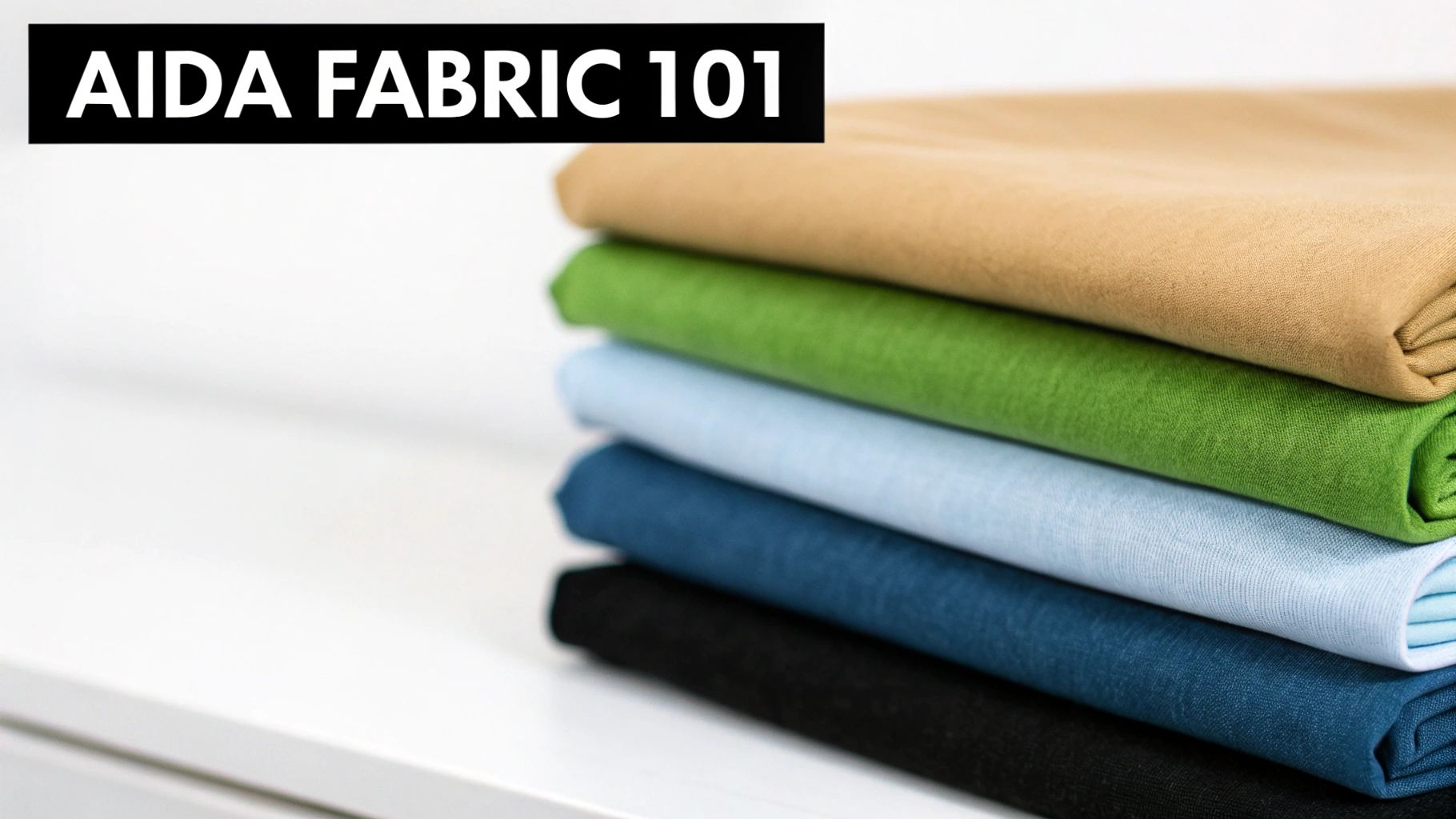
Aida is the trusty sidekick for any cross-stitcher. Invented way back in 1890 by the German company Zweigart, it was designed specifically for counted thread embroidery. The magic is all in its construction. Threads are bundled and woven together to form little squares, and at the corner of each square, there's a tiny, clearly visible hole.
This clever design takes all the guesswork out of stitching. Your needle glides right into the holes, ensuring every "X" is perfectly placed.
Aida gives you a clear roadmap for your needle. Each stitch fits neatly into its own square, which is how you get that clean, professional look, even if you're just starting out.
Understanding Fabric Count
You'll always see Aida fabric described with a number, like "14-count" or "18-count." This "count" simply tells you how many squares (or stitches) fit into one linear inch of the fabric.
Aida comes in a wide range of counts, from a large-grid 6-count all the way up to a tiny 22-count. The most common and versatile options you'll find are 14-count and 16-count, as they offer a great balance between detail and ease of stitching. As you can find in this Aida cloth guide, knowing the count is key to figuring out the final size of your finished piece.
To help you get a clearer picture, here's a quick summary of what makes Aida so special.
Aida Fabric at a Glance
| Characteristic | Description | Best For |
|---|---|---|
| Material | Typically 100% cotton | Durability and a soft, natural feel. |
| Weave | A precise grid of woven blocks with holes at each corner. | Counted cross-stitch and other gridded embroidery. |
| Stiffness | Often starched for easier handling without a hoop. | Beginners who need a stable canvas. |
| Count System | Number of squares per linear inch (e.g., 14-count = 14 stitches/inch). | Projects of all sizes, from simple kits to complex patterns. |
This table should give you a solid foundation as you head out to choose the perfect fabric for your next project.
Decoding the Aida Weave and Fabric Count
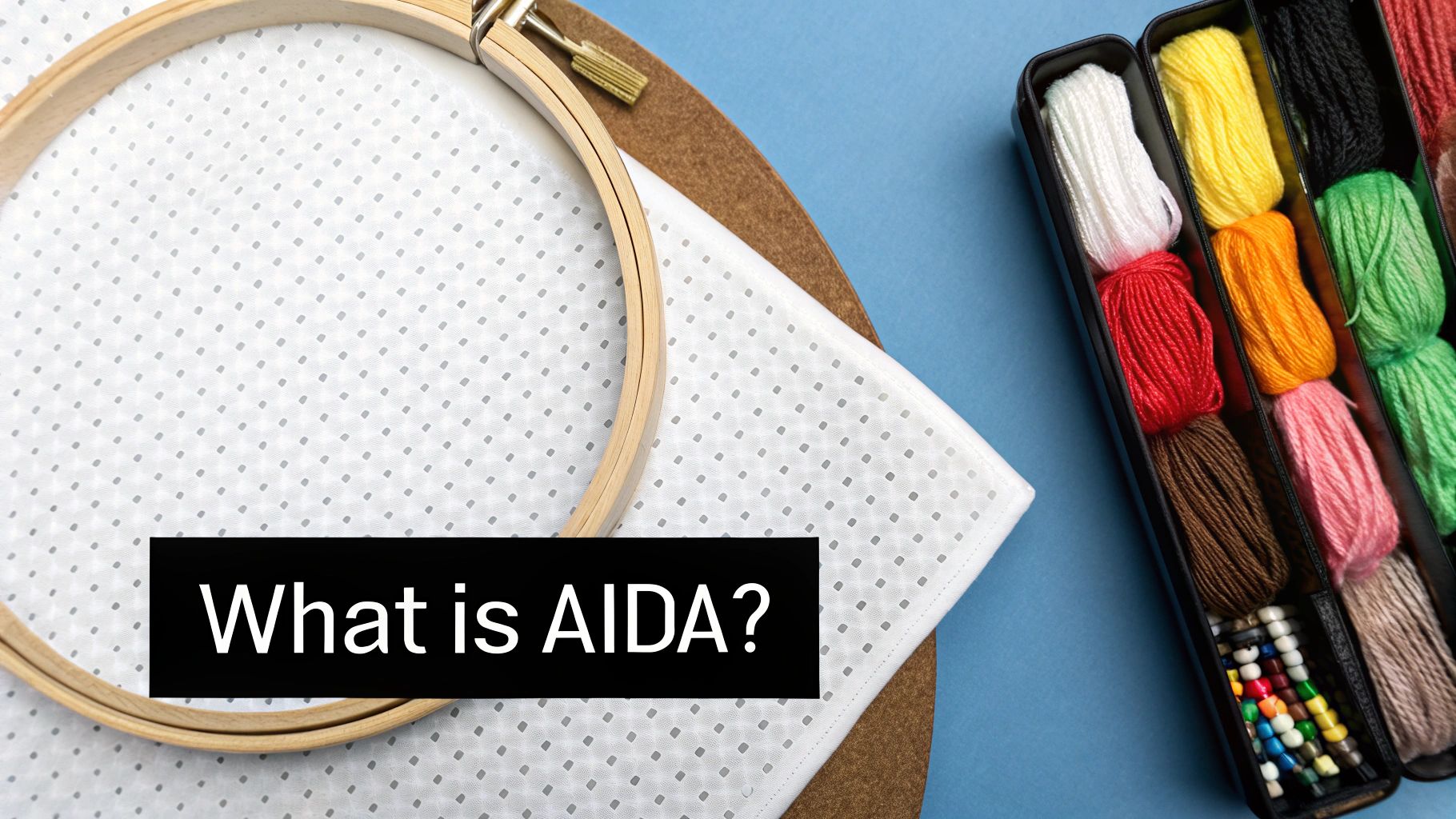
The secret to Aida's popularity in the cross-stitch world comes down to its special weave and something we call "fabric count." Once you get a handle on these two things, you'll have complete control over how your projects turn out.
If you look closely at Aida, you'll see it’s not just a flat piece of cloth. It’s a grid. It's woven with little bundles of thread that form perfect squares, and right at the corner of each square is a tiny, convenient hole. This genius design guides your needle to the exact right spot every time, which is why Aida is the go-to fabric for perfectly uniform "X" stitches.
What Is Fabric Count?
The term fabric count might sound a bit technical, but it's really simple. It just tells you how many of those little squares (or stitches) fit into one inch of the fabric. You'll see Aida labeled as 14-count, 16-count, or 18-count, and that number is your key piece of information.
A lower count number means bigger squares and, consequently, a larger final design. On the other hand, a higher count means the squares are much smaller and packed together, which lets you cram a ton more detail into the same area.
- 11-Count Aida: With only 11 big squares per inch, this is fantastic for kids, beginners, or any project where you want large, easy-to-see stitches.
- 14-Count Aida: This is the workhorse of the cross-stitch world. Its 14 squares per inch offer a great middle-ground between easy stitching and good detail.
- 18-Count Aida: When you want your work to look almost like a painting, the 18 tiny squares per inch on this fabric allow for incredibly fine, detailed results.
The fabric count has a huge impact on the final size of your stitched piece. For example, a design that is 100 stitches wide will measure about 7.1 inches on 14-count Aida but only 5.5 inches on 18-count Aida.
The count also gives you a clue about how many strands of floss to use. For a lower count like 11, you might want three strands to make sure the stitches look full. For a higher count like 18, one or two strands is usually plenty to keep the stitches from looking bulky in those tiny squares.
If you're ever unsure about how big your finished project will be, a good cross-stitch calculator is a lifesaver. Getting comfortable with fabric count is the first real step to taking your stitching from a hobby to an art form.
How to Choose the Right Aida Count for Your Project
Picking the right Aida count is one of those decisions that can truly make or break your project. It’s about more than just fabric; it’s about balancing the detail in your pattern with how you want to experience the stitching process itself. Think of it like choosing the right canvas for a painting.
If you’re just starting out, I always recommend sticking with a lower count. Something like an 11-count or the classic 14-count Aida is the perfect training ground. The holes are bigger and easier to see, which is a lifesaver for your eyes and helps you get into a comfortable rhythm. These counts are brilliant for projects with a bold, almost graphic look—think kids' designs or punchy quotes where the "X" of the stitch is part of the charm.
Once you’ve got a few projects under your belt, you’ll probably start eyeing those patterns with tons of detail. That’s when you’re ready to move up.
Matching Count to Detail
Higher counts, like 16-count and 18-count, are where the magic happens for intricate designs. Because the squares are smaller, you can pack in more stitches per inch. This creates a beautifully smooth, almost seamless finish that makes your work look less like individual stitches and more like a high-resolution picture. If you're stitching a portrait or a detailed landscape with lots of subtle shading, a higher count is definitely the way to go.
Here's the simple takeaway: lower count = larger stitches and less detail, while higher count = smaller stitches and more detail. This one choice really sets the tone for your entire piece.
This image shows exactly how the fabric weave changes with the count. You can see how much tighter it gets as the numbers go up.
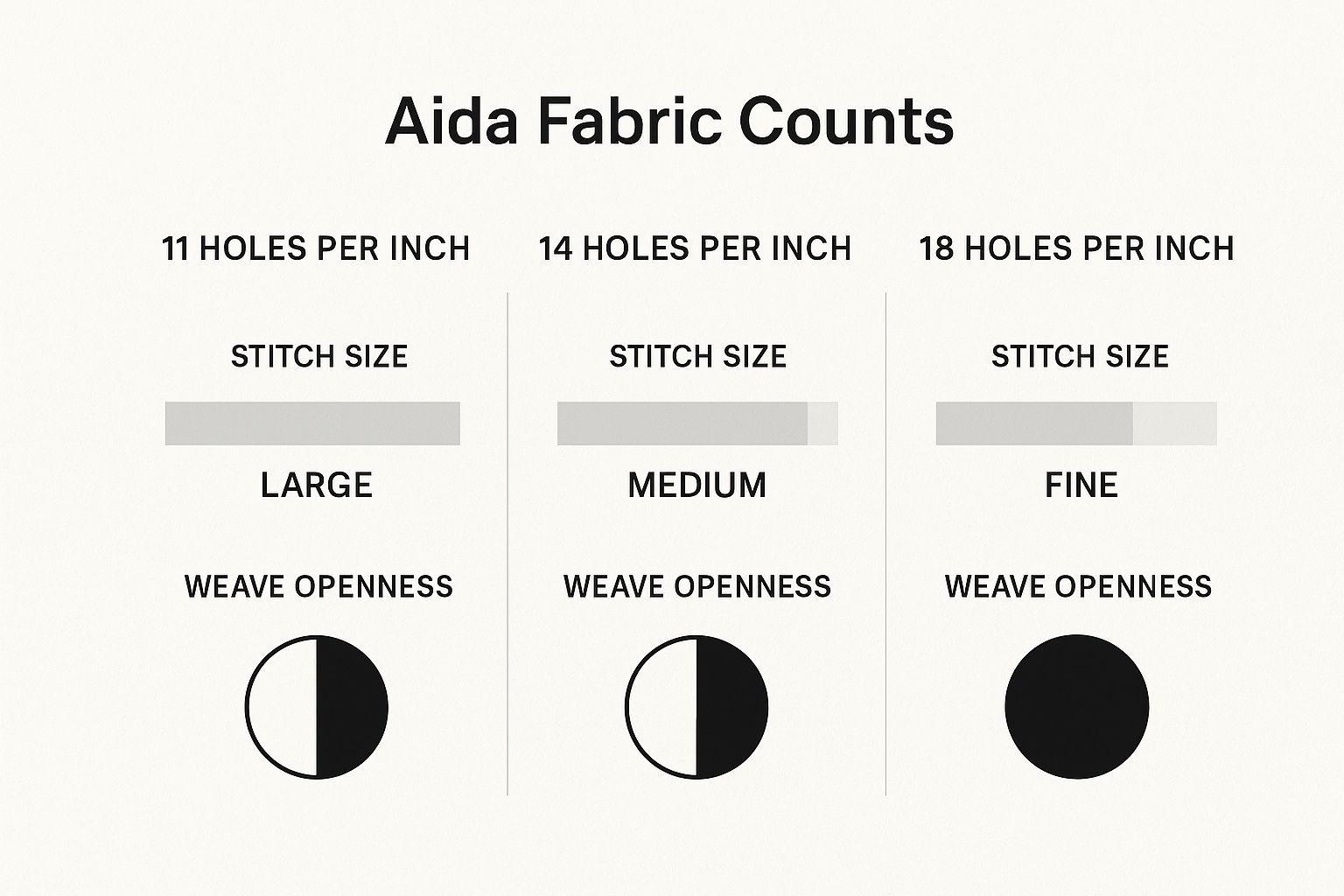
As you can tell, the higher the count, the more delicate the weave and the tinier your stitches will be.
To help you visualize what this means for your next project, I've put together a quick comparison of the most common Aida counts.
Aida Count Comparison Guide
| Aida Count | Stitches Per Inch | Ideal For | Pros | Cons |
|---|---|---|---|---|
| 11-count | 11 | Kids' crafts, quick projects, stitchers with vision issues. | Very easy to see, stitches up quickly. | Can look blocky, requires more floss for coverage. |
| 14-count | 14 | The go-to for most kits, beginners, and general projects. | Great balance of detail and ease of stitching. | Not ideal for super fine, intricate patterns. |
| 16-count | 16 | Intermediate stitchers, projects with more detail. | Gives a smoother finish than 14-count. | Holes are smaller and can be harder to see. |
| 18-count | 18 | Experienced stitchers, highly detailed photorealistic art. | Excellent detail, fabric is less visible. | Can be tough on the eyes, requires precision. |
Ultimately, there’s no single right answer. The best way to find your favorite is to try a few different counts and see what feels best in your hands. Everyone’s eyes and preferences are different!
For a more comprehensive look at all your material options, be sure to check out our guide on selecting the best fabric for cross stitch.
The Good and the Not-So-Good of Aida Fabric
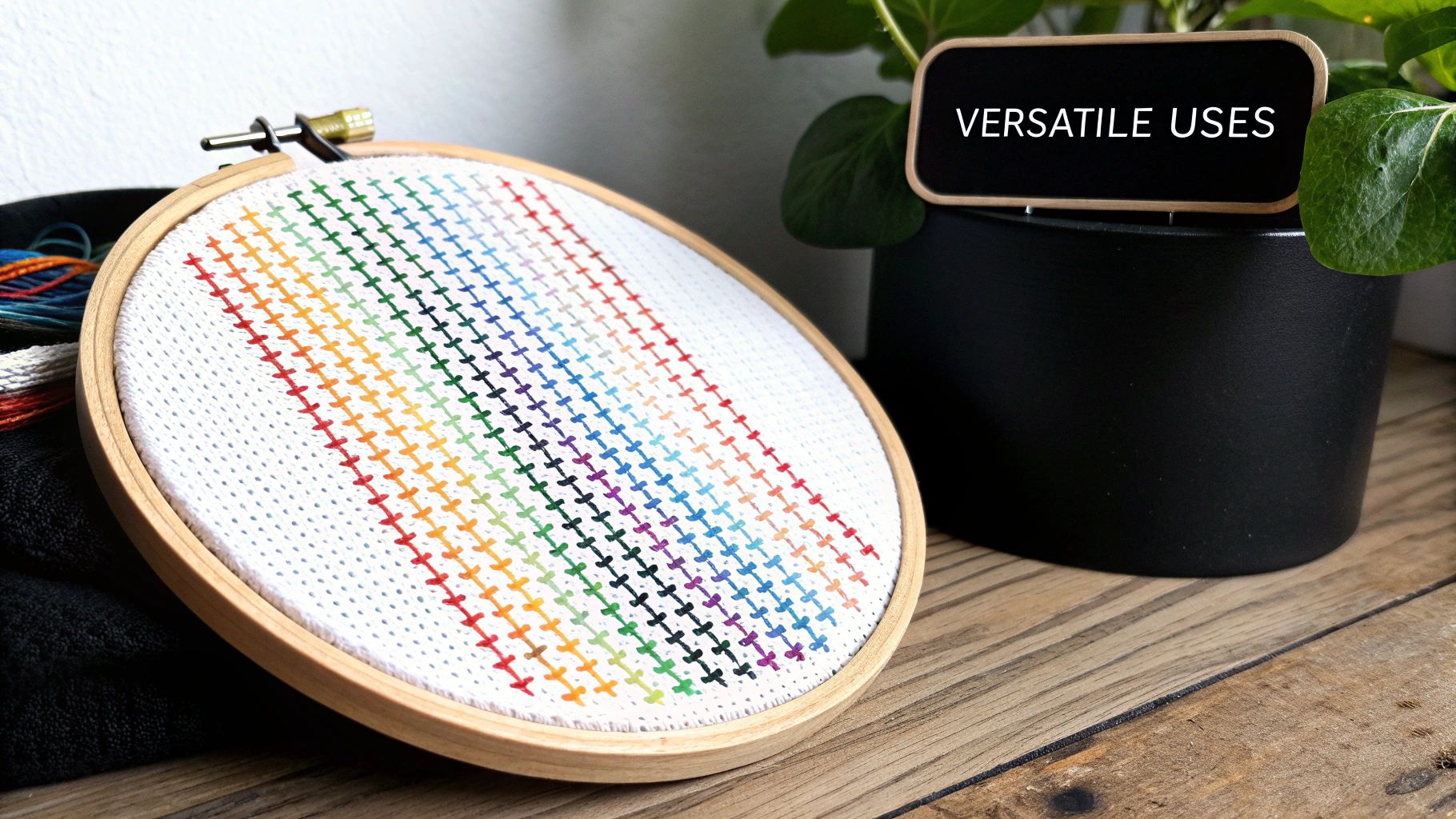
If you've ever dipped your toes into cross-stitch, you’ve almost certainly run into Aida. It’s the go-to fabric for a reason. Its clever grid-like weave practically guides your needle, turning what could be a tricky process into something almost as simple as coloring in a coloring book.
For anyone just starting out, Aida is a lifesaver. Those perfectly spaced holes make counting a breeze, which means you can relax and enjoy the rhythm of stitching without constantly worrying you’ve made a mistake.
Think of a 14-count Aida, for instance. You get exactly 14 perfect little squares to stitch in every inch. This structure is what gives your finished project that classic, uniform look with beautifully formed "X" stitches.
Why Stitchers Love Aida
It’s hard to beat Aida for its straightforward, no-fuss nature. The benefits are pretty clear right from the first stitch.
- Easy to Count: The holes are distinct and easy to see, so you’ll never lose your place.
- Uniform Stitches: The even weave ensures every single stitch looks neat and tidy.
- Stiff and Sturdy: It often has enough body that you can stitch on it without a hoop, especially for smaller projects.
- Great for Blocky Designs: It’s the perfect canvas for projects with large areas of color or bold, graphic patterns.
The Other Side of the Coin
But, like anything, Aida isn't perfect for every single project. That same grid that makes it so beginner-friendly can sometimes be a little too obvious, especially in designs with a lot of empty space around the stitching. The blocky texture can sometimes detract from very delicate or intricate patterns.
When you get into more advanced techniques like fractional stitches or graceful, swooping backstitches, Aida can feel a bit restrictive. The fabric's rigid structure just wasn't designed for the subtle nuances that a softer evenweave or linen can handle.
"Aida’s structured grid is a fantastic starting point for beginners, but it can feel a bit limiting when you want to tackle more advanced techniques."
Here are a few things to keep in mind:
- The visible grid can sometimes interrupt the flow of minimalist or modern designs.
- Placing fractional stitches (like quarter or three-quarter stitches) can be awkward.
- It doesn’t drape as softly as linen, which might matter for things like tablecloths or clothing.
Ultimately, knowing the trade-offs is what helps you make the right choice. If your pattern is full of crisp, defined shapes, Aida is your best friend. But if you’re aiming for something with photorealistic shading or an heirloom feel, you might want to reach for linen or another evenweave fabric instead.
Aida vs. Linen: A Quick Comparison
It really boils down to what your project needs. A quick look at the two side-by-side makes the choice clearer.
| Feature | Aida | Linen |
|---|---|---|
| Grid Visibility | Obvious and easy to see | Subtle and integrated |
| Ease of Stitching | Very beginner-friendly | Can be challenging; a hoop is a must |
| Best For | Full-coverage, blocky patterns | Delicate designs, heirloom pieces |
This isn't about one being "better" than the other—it's about picking the right tool for the job. Remember that the fabric count will have a huge impact on your final design size, so always double-check your math.
My best advice? If you're unsure, just grab a small swatch of each and do a few test stitches. There's nothing like feeling the fabric in your own hands to know what will work for you and your project. Happy stitching
A Look Back at Aida's Role in Crafting
Every craft has its own history, and for cross-stitch, the story of Aida fabric is a huge part of it. Before Aida came along, stitchers had to work with linen or other evenweave fabrics. This meant painstakingly counting individual threads, a task that demanded a ton of skill and patience. That all changed in 1890 when a German textile company called Zweigart introduced something new.
They engineered a fabric specifically for counted cross-stitch, and it was a total game-changer. The genius was its simple grid-like structure, which made counting stitches practically foolproof. Suddenly, cross-stitch wasn't just for experts anymore; it became something anyone could pick up and enjoy. This single innovation helped turn a specialized skill into the massive global hobby we know today.
How It Became the Go-To Fabric
Aida’s popularity didn't happen overnight, but it steadily grew throughout the 20th century, eventually becoming the standard for most cross-stitch kits and patterns. This was especially true in Europe and North America. As an example of this growth, sales of crafting supplies, including cross-stitch materials, jumped by 17% in the UK between 2009 and 2010. You can dig deeper into this trend by exploring the history of cross-stitch on Wikipedia.
By creating a simple and reliable canvas, manufacturers like Zweigart didn't just sell fabric; they helped build a worldwide community of crafters who could share patterns and techniques with confidence.
So, when you pick up a piece of Aida today, you’re holding more than just cotton. You're connecting with over a century of crafting history. Your project becomes another link in a long chain of creativity, passed down through generations of stitchers who fell in love with this wonderfully straightforward fabric.
Essential Care Tips For Your Aida Fabric Projects
Taking good care of your Aida fabric is just as important as the stitching itself. A little attention before and after your project goes a long way toward preserving stitches and colors.
Many stitchers debate whether to pre-wash their fabric. Washing in cool water with a drop of mild soap can soften the weave and lift off any factory starch. However, do not pre-wash if you’re using hand-dyed cloth—those rich hues might bleed.
- Softens fibers and removes production residue
- Helps threads glide through the holes
- Skip this step for hand-dyed Aida to avoid color run
Preparing Your Fabric For Stitching
Ironing before you begin pays dividends down the road. Set your iron to a medium-heat cotton setting and always slide a pressing cloth across the fabric to guard against scorching.
To stop the edges from fraying as you stitch, choose one of these simple methods:
- Serge the edges with a serger
- Wrap masking tape around the perimeter
- Hand-sew a whip stitch border
Taking a few minutes at the start—ironing out creases and securing edges—prevents snags later on and keeps your canvas looking crisp.
Once your masterpiece is complete, natural oils and dust will cling to the surface. A gentle hand-wash revives the brightness and preps it for framing. For a detailed walkthrough on this process, check out our guide on how to clean a cross-stitch project.
A Few Common Questions About Aida
Even with a fabric as straightforward as Aida, a few questions always pop up. Let's tackle some of the most common ones so you can feel more confident picking up your needle.
To Wash or Not to Wash Before Stitching?
This is probably the number one question stitchers have! Generally, giving your Aida a quick wash in cool water with a tiny bit of gentle soap can really soften it up, making it much nicer to work with.
But there's a big exception: if you've got a beautifully vibrant, hand-dyed Aida, it's best to skip the wash. You don't want to risk any of that gorgeous color bleeding before you've even made a single stitch.
What if My Aida Is Super Stiff?
Sometimes, a new piece of Aida feels like stitching on cardboard. If it's too rigid for your liking, washing it (as long as it’s not hand-dyed) is a great first step.
Another simple trick is to just... handle it. Gently roll and flex the fabric in your hands for a few minutes. The warmth and movement will help break down some of that initial starchiness without needing a full wash.
A Little Pro Tip: If your Aida is so stiff it's fighting you when you try to put it in a hoop, don't force it. Try stitching "in hand" (without a hoop) for a bit. The heat and oils from your hands will naturally soften the fabric, making it much more cooperative.
Aida vs. Evenweave or Linen—What's the Real Difference?
It all comes down to the weave. Think of Aida as a grid—it has that very clear block-and-hole pattern that makes counting stitches a breeze. It's designed specifically for cross-stitch.
Evenweave and linen, on the other hand, have a smoother, flatter surface. Their single-thread weave is more traditional and gives you the flexibility for more advanced techniques, like tiny fractional stitches that just aren't possible on Aida's blocky grid.
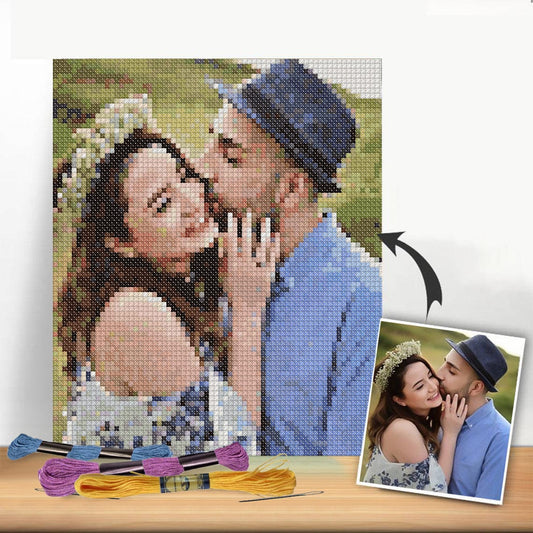
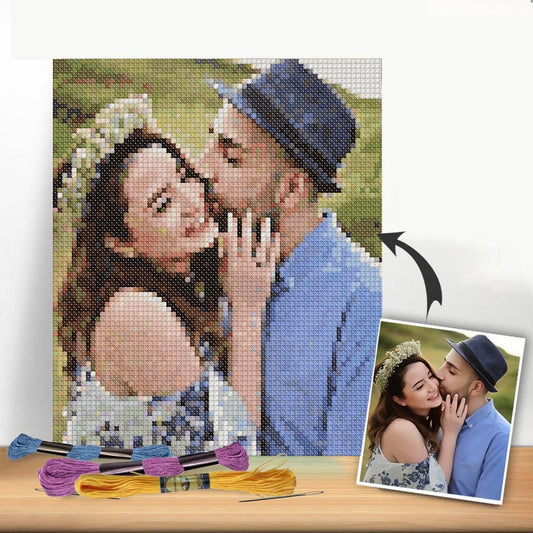
Ready to turn your favorite memories into a beautiful cross-stitch masterpiece? At Cross Stitched, you can upload any photo and receive a complete, custom kit with everything you need. Start creating your personalized artwork today