
How to Read a Cross Stitch Pattern: Complete Beginner's Guide
Learn to decode cross stitch charts, symbols, and keys. Master pattern reading in minutes and start stitching with confidence.
Cross stitch patterns might look like confusing grids of symbols at first glance, but they're actually simple maps that guide every stitch. Once you understand how to read them, you'll be able to tackle any cross stitch project with ease. This guide breaks down everything you need to know about reading cross stitch patterns.
Parts of a Cross Stitch Pattern
Every cross stitch pattern contains several key components that work together to tell you exactly what to stitch and where. Understanding these parts is the foundation of pattern reading.
The Grid
The grid is the foundation of every pattern. Each square represents one cross stitch on your fabric. The grid lines correspond to the holes in your Aida cloth or the threads in evenweave fabric.
Symbols
Symbols fill the grid squares and tell you which color thread to use. Each unique symbol represents a different thread color. Common symbols include X, O, /, \, +, and various geometric shapes.
Symbol Key (Legend)
The key decodes every symbol in the pattern. It lists each symbol alongside its corresponding thread color, usually with the DMC number, color name, and sometimes a small color swatch.
Center Marks
Most patterns include arrows or lines marking the horizontal and vertical center. These help you align the pattern center with the center of your fabric.
Backstitch Lines
Thin lines running along grid edges (not through squares) indicate backstitching. These outlines add detail and definition to your finished piece.
Special Stitch Markers
Small dots, asterisks, or other markers indicate French knots, beads, or other specialty stitches. These are usually explained in the pattern key.
Understanding the Symbol Key
The symbol key is your decoder ring for the entire pattern. Learning to read it quickly will make your stitching much more efficient.
What a Typical Key Contains
Key Reading Tips
- DMC Numbers: The most common thread coding system. DMC 310 is always black, DMC B5200 is always bright white.
- Stitch Counts: Use these to estimate how much thread you need and plan your stitching order.
- Color Swatches: Helpful but may not print accurately. Always verify against actual thread.
- Blended Colors: Some patterns combine two thread colors (e.g., "1 strand 321 + 1 strand 498"). Blend them in your needle.
Key Variations You May Encounter
Color-Coded Keys
Instead of symbols, squares are filled with actual colors. Easier to visualize but harder to distinguish similar shades.
Symbol + Color Keys
Combines colored squares with overlaid symbols. Best of both worlds for easier reading.
Anchor/Other Brands
Some patterns use Anchor numbers instead of DMC. Use a conversion chart if needed.
Finding the Center: Step-by-Step
Starting from the center ensures your design is properly positioned on your fabric with even margins all around. Here's exactly how to do it.
Find the Pattern Center
Look for arrows on the edges of your pattern pointing inward. Where these arrows meet (or would meet if extended) is the center. Some patterns mark this with a small symbol or crosshairs.
Count to Verify
If there are no center marks, count the total squares across and down. Divide by 2 to find the center point. For odd numbers, the center falls on a square; for even numbers, between squares.
Fold Your Fabric
Fold your fabric in half lengthwise, then in half again widthwise. Where the folds intersect is your fabric center. Gently crease or mark this point with a removable marker.
Mark or Grid (Optional)
For complex patterns, consider gridding your fabric in 10x10 sections using washable markers or thread. This makes counting much easier and helps prevent mistakes.
Begin Stitching
Start your first stitch at or near the center of the design, matching it to the center of your fabric. Work outward from there in whatever direction feels comfortable.
Counting Stitches: Essential Tips
Accurate counting is crucial in cross stitch. One miscount can throw off an entire section. Here's how to count confidently.
Count in Groups of 10
Most patterns have bold lines every 10 squares. Use these divisions to count quickly: "10, 20, 30..." rather than counting each square individually.
Use a Ruler or Needle
Place a ruler or needle along your pattern row to keep your place. This prevents your eyes from jumping rows, especially in busy sections.
Mark as You Go
For printed patterns, use a highlighter to mark completed rows. For digital patterns, zoom in and use the app's marking feature if available.
Count Twice, Stitch Once
Before stitching a new color section, count from a known reference point twice. It's much easier to recount than to remove incorrect stitches.
Work in Sections
Complete one 10x10 grid section before moving to another. This minimizes long jumps across your fabric and makes counting more manageable.
Use Reference Stitches
When starting a new area, count from your existing stitches rather than from scratch. Your completed work becomes your map.
Common Counting Mistakes to Avoid
- Counting holes vs. squares: Count the fabric squares (the spaces between holes), not the holes themselves.
- Skipping grid lines: The bold 10-square grid lines are guides, not stitches. Don't count them as extra spaces.
- Losing your place: If interrupted, mark exactly where you stopped before stepping away.
- Miscounting diagonal jumps: When counting diagonally, move one square over AND one square up/down for each count.
Reading Backstitching Instructions
Backstitching adds outlines and fine details to your cross stitch. It's typically done last, after all cross stitches are complete.
How Backstitching Appears on Patterns
Backstitches shown as lines along grid edges
Reading Backstitch Notation
- Solid lines: Indicate standard backstitching in the color specified
- Dashed lines: May indicate a different color or optional stitching
- Line thickness: Thicker pattern lines sometimes mean use more strands
- Color coding: Different colored lines in the pattern indicate different thread colors for backstitching
Backstitch Key Example
French Knots and Special Stitches on Patterns
Beyond basic cross stitches and backstitching, patterns may include specialty stitches for added texture and detail.
French Knots
Shown as small dots or filled circles on the pattern. Used for eyes, flower centers, and small details. The key specifies the thread color and number of wraps.
Beads
Often marked with a "B" or specific bead symbol. The key will list the bead type, size (often Mill Hill codes), and color. Attach with half stitches.
Quarter/Three-Quarter Stitches
Create smoother curves and edges. Shown as triangular shapes filling part of a square. One leg goes to the center, the other to a corner.
Half Stitches
Just the first leg of a cross stitch, creating a lighter effect. Shown as diagonal lines through squares. Used for shading and backgrounds.
Long Stitches
Straight stitches spanning multiple squares. Shown as lines crossing through multiple grid squares. Used for whiskers, grass, and other linear elements.
Lazy Daisy
Loop stitches for flower petals and leaves. Often shown as small oval outlines. Creates raised, petal-like shapes on fabric.
Digital vs Printed Patterns: Key Differences
Both formats have their advantages. Understanding how each works helps you choose what's right for your project.
Digital Pattern Tips
- Download apps like Pattern Keeper or Markup R-XP for automatic symbol marking
- Keep screen brightness comfortable for long sessions
- Use a tablet stand to keep hands free
- Back up your files to cloud storage
Printed Pattern Tips
- Print in color if possible for easier reading
- Use a clear acetate sheet over pattern for wet-erase marking
- Enlarge complex sections when printing
- Keep original file as backup
Common Pattern Symbols Reference
While every pattern designer uses their own symbols, certain conventions are widely used. Here's a reference guide to common symbols you'll encounter.
Cross Stitch Symbols
Special Stitch Symbols
Pattern Markings
Frequently Asked Questions
What does "14 count" mean on a pattern?
The count refers to how many stitches fit per inch of fabric. 14-count means 14 stitches per inch. Higher counts (16, 18, 22) create smaller stitches and more detailed results but require finer needles and better lighting. Lower counts (11, 8) create larger stitches, ideal for beginners or designs meant to be viewed from afar.
Do I have to use DMC thread colors?
No, but DMC is the most common and widely available brand. Most patterns specify DMC numbers because they're consistent worldwide. You can substitute other brands (Anchor, Weeks Dye Works, Sullivans) using conversion charts, or choose your own colors entirely for creative projects.
What if my pattern spans multiple pages?
Multi-page patterns include overlap sections (usually labeled with letters/numbers like A1, A2, B1, B2). Match the overlapping symbols exactly to align pages. Many stitchers tape pages together or use digital versions that display seamlessly.
What do blank/empty squares mean?
Empty squares typically mean "no stitch" - leave the fabric bare. However, always check the key. Some patterns use a specific symbol for "no stitch" and leave squares empty for a particular color (often white or the lightest color).
How do I know how many strands to use?
Most patterns specify this, typically: 2 strands for cross stitches on 14-count, 1 strand for backstitching. If not specified, 2 strands is standard for 14-count Aida. Use 3 strands for 11-count, or 1 strand for 18-count and higher for good coverage without bulk.
Can I start from a corner instead of the center?
Yes, some stitchers prefer this method. Make sure to calculate your margins first: if your design is 100 stitches wide and your fabric is 150 stitches wide, leave 25 stitches of margin on each side. Starting from center is generally more forgiving of counting errors.
What does "full coverage" mean?
Full coverage patterns have stitches in every square - no fabric shows through. These take longer but create stunning, painting-like results. Partial coverage patterns leave some fabric visible, which can be intentional for designs with white or light backgrounds.
How do I read confetti stitches on a pattern?
"Confetti" refers to scattered single stitches of different colors. Read these carefully using the grid and key. Many stitchers work confetti areas last, using the parking method (leaving needle with thread at each stitch location) to minimize thread changes.
Ready to Start Stitching?
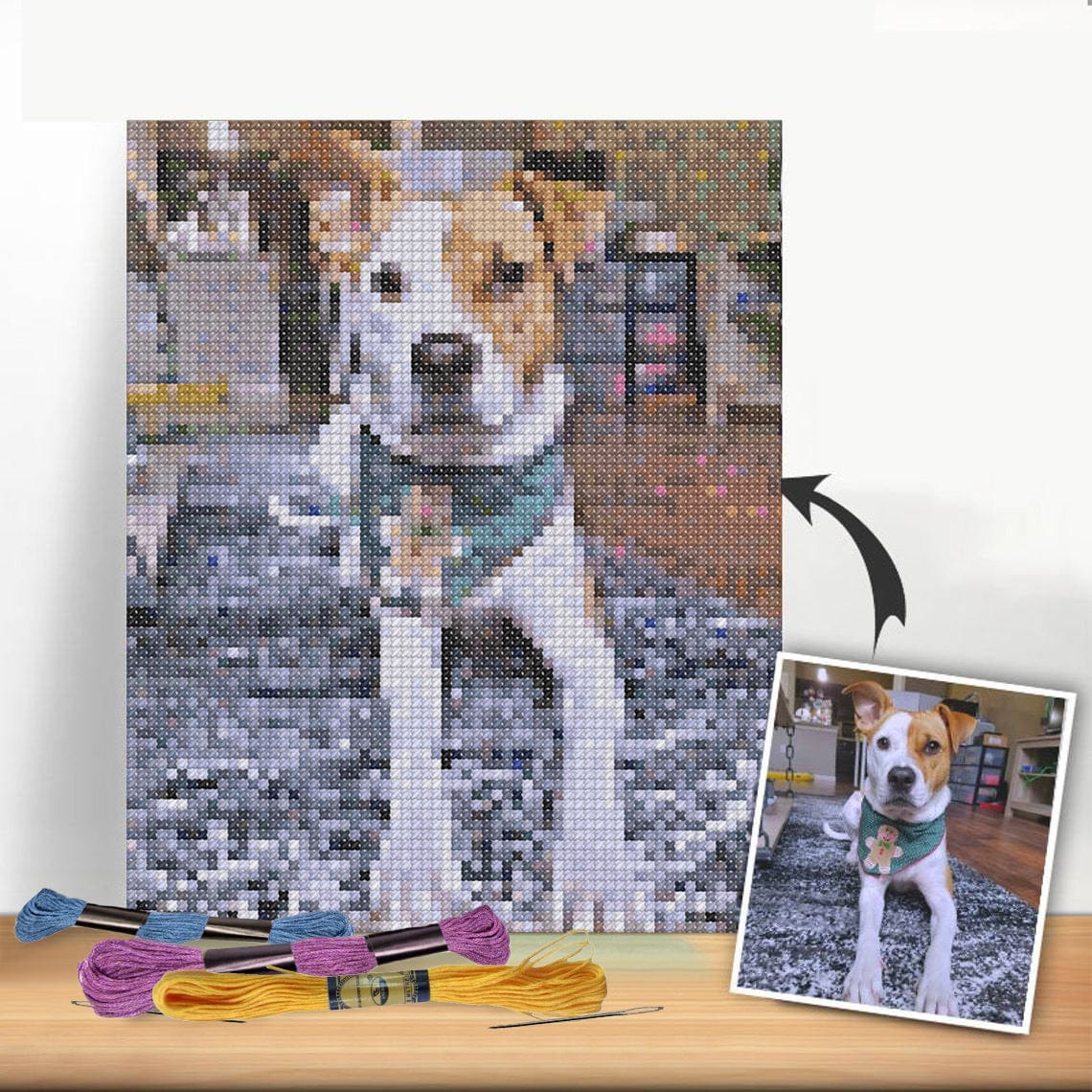
Now that you know how to read cross stitch patterns, put your skills to use! Create a custom pattern from your favorite photo or explore our beginner-friendly kits.