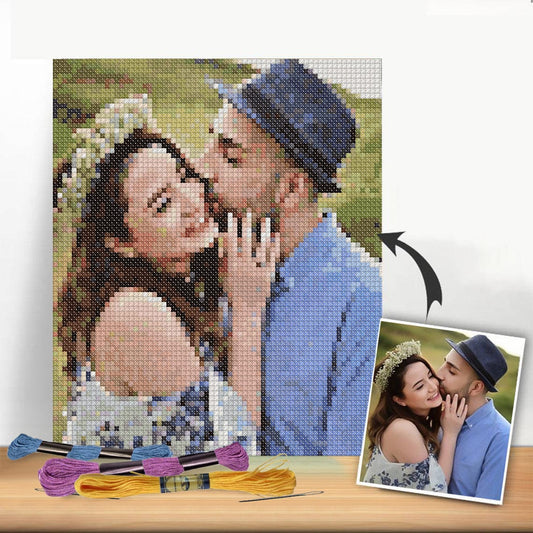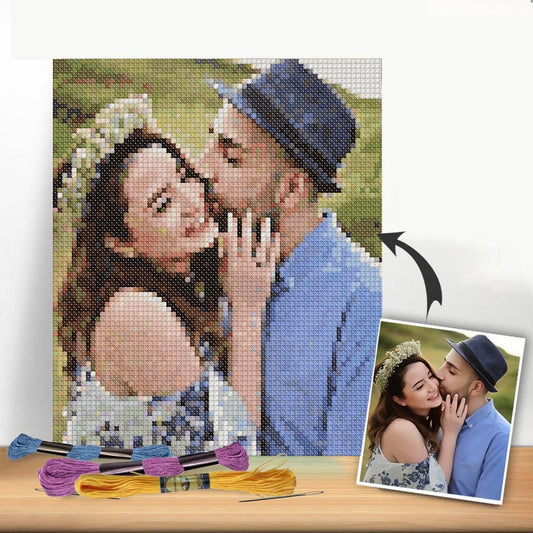
So, is counted cross stitch hard? The short answer? Not at all. Honestly, if you can count and you can make an 'X' with a needle and thread, you've already mastered the core skills. Most people are surprised to find that the biggest hurdle isn't the technique itself—it's having a bit of patience.
Why Cross Stitch Is So Beginner Friendly

Think of counted cross stitch as painting by numbers, but with thread. You get a gridded pattern, called a chart, that shows you precisely where to place each stitch and what colour to use. There's no guesswork, which makes it one of the most approachable needlecrafts out there.
The whole craft is built on simplicity. You don't need a studio full of expensive, complicated tools to dive in. A simple kit—fabric, thread, a needle, and a pattern—is all you need to start creating something beautiful. That low barrier to entry is a huge part of its charm.
Beyond that, the simple, repetitive motion of stitching is incredibly calming. It's no wonder the craft is seeing a huge comeback as people look for a relaxing, screen-free hobby that gives you a real, tangible piece of art at the end. You can read more about the growing popularity of cross stitch on thefreshcrossstitch.com if you're curious!
The Real Difficulty Breakdown
When people talk about cross stitch being "hard," they're almost always talking about project management, not the physical act of stitching. It’s more about keeping track of where you are than performing a difficult skill.
Here’s a quick look at the skills you need versus the potential hurdles for a complete beginner.
Counted Cross Stitch Difficulty Breakdown
| Core Skill | Why It's Easy for Beginners | Potential Hurdle (and Solution) |
|---|---|---|
| The Stitch | You only need to learn one simple stitch: the 'X'. You can pick it up in about five minutes, and it's all you'll use for most basic patterns. | Messy stitches. Consistency is key! Make sure the top leg of your 'X' always goes in the same direction for a neat, uniform look. |
| The Counting | This is the "counted" part of the name. You just look at the chart, count the squares, and replicate that on your blank fabric. | Losing your place. This is the most common frustration! Use a highlighter on your paper chart (or a marker on a digital one) to track your progress. |
| The Patience | The craft is slow and methodical. It takes time for the image to emerge, which is part of the magic. | Getting discouraged. Start small! A tiny project you can finish in a weekend provides a huge confidence boost and keeps you motivated. |
As you can see, the challenges are all about process, not some innate artistic talent.
Once you get into a rhythm, the counting becomes second nature. The real "test" is just giving yourself the time to watch your creation come to life, one tiny 'X' at a time. And trust me, that final result is always worth it.
So, How Does Counted Cross Stitch Actually Work?
The word "counted" can sound a little intimidating at first, but it’s actually the key to what makes this craft so simple and satisfying.
Unlike stamped cross stitch where the design is pre-printed on the fabric, in counted cross stitch, you start with a blank piece of fabric and a separate pattern, called a chart. Think of the chart as your treasure map and the fabric as the empty island.
Your fabric is essentially a grid of tiny squares, and your chart is a matching grid on paper. Each symbol on the chart shows you exactly where to place a single 'X' stitch and which thread color to use. You simply count the squares on your chart and then stitch the corresponding 'X' onto your fabric. That’s it! One symbol on the map equals one stitch on the fabric.
This method is what gives you the ultimate control and precision, and it’s the secret behind those incredibly detailed, photorealistic pieces you might have admired. If you can follow a simple recipe—add this, then stir that—you can absolutely read a cross stitch chart. You're just following a visual recipe to create something beautiful.
The Grid Is Your Guide
This whole grid system is what makes cross stitch so incredibly beginner-friendly. There's no need for any natural artistic talent or freehand drawing skills.
The real magic of counted cross stitch is how it breaks down a complex image into simple, bite-sized steps. By focusing on just one 'X' at a time, anyone can create a work of art without feeling overwhelmed by the big picture.
Historically, this is why the craft became so popular across all walks of life. Its straightforward, structured nature makes it easy for anyone to pick up. Its universal appeal crosses social and economic lines, though this doesn’t always speak to its perceived difficulty. You can find more fascinating tidbits about the history of cross stitch on lordlibidan.com.
This structured process is the heart and soul of the craft. If you want to dive a bit deeper, you can learn more about what counted cross stitch is in our detailed guide.
What Makes a Cross Stitch Project Easy or Hard?
The basic “X” stitch itself is always the same. It never gets harder. So what’s the difference between a simple little bookmark and a giant, photorealistic masterpiece? It’s all about the project’s complexity.
Even though you’re making the same stitch over and over, a tiny monochrome design feels worlds apart from a detailed portrait. Learning to spot what makes a pattern simple or challenging is the secret to picking projects that are fun, not frustrating.
Let’s break down the five big things that determine a project's difficulty: fabric count, pattern complexity, the number of colors, thread types, and the overall size.
This flowchart gives you a bird's-eye view of how these pieces fit together.

As you can see, everything flows from your pattern (the map) to your fabric (the canvas) and finally to the stitches themselves. Each choice you make along the way impacts how easy or tough the journey will be.
Fabric Count and Project Size
The "count" of your fabric simply means how many stitches fit into one inch of material. Aida cloth is the go-to for beginners, and 14-count Aida is the absolute sweet spot for your first project. The weave is open and the holes are big enough to see easily, which saves you a lot of headaches and eye strain.
As the count number goes up—say, to 18-count or 28-count—the stitches get smaller and tighter. This creates a beautifully detailed, almost pixel-perfect image, but it demands much more precision and can be a real challenge to work with. Stick with 14-count to start. You’ll build confidence and actually enjoy the process.
It sounds obvious, but the size of the piece matters, too. A small 4x4 inch design can give you that amazing feeling of accomplishment in just a weekend. Biting off more than you can chew with a huge 24x32 inch tapestry is a surefire recipe for burnout.
Pattern and Color Complexity
Think of pattern complexity in terms of how the colors are grouped. An easy pattern has large color blocks, where you get to stitch big patches with the same color. It's fantastic for beginners because you can find a nice, relaxing rhythm.
On the other end of the spectrum are patterns loaded with confetti stitches. Imagine single, isolated stitches of different colors sprinkled all over the fabric—like confetti. This means you’re constantly stopping, starting, and switching your thread for just one or two stitches. It’s tedious and a prime opportunity for miscounting.
The number of colors is a huge factor. A pattern with just 5-10 colors is way more manageable than one calling for 50 or more. Every new color adds another thread to track and manage, which really slows you down.
Finally, think about the thread itself. Standard cotton embroidery floss (like the kind from DMC) is smooth, predictable, and a dream to work with. But specialty threads like slippery metallics, delicate silks, or fuzzy wools can be a nightmare of tangles and knots for a newcomer. Get the hang of the basics with good old cotton floss before you venture into the fancier stuff.
How to Start Your First Project Successfully

The secret to a great first cross stitch experience is starting strong. If you set yourself up for success from the get-go, you'll find the whole process incredibly rewarding. This really just boils down to having the right tools on hand and a few key techniques in your back pocket.
Honestly, the easiest way to dive in is with an all-in-one kit. It takes all the guesswork out of the equation because everything you need is right there in one package: the pattern, the perfect fabric, pre-sorted threads, and a needle. You can just focus on the fun part—the stitching—without stressing about supply runs. We've curated some fantastic beginners cross stitch kits specifically designed to get you started on the right foot.
Mastering the First Stitches
Once you've got your supplies, there are a few simple things you can do to sidestep the most common beginner frustrations. Think of these as the foundational habits that will make your work look clean and polished right from the start.
-
Find Your Center: Before you even thread your needle, find the center of your fabric. Just fold it in half one way, then fold it in half the other way. That little intersection where the creases meet? That's your starting point. This one simple step ensures your design ends up perfectly centered.
-
Mind Your Tension: As you make your stitches, try not to pull the thread too tight. You want your "X"s to lie flat and plump on the fabric, not so tight that they cause the fabric to pucker. It’s like a firm, friendly handshake—not a death grip.
-
Secure Your Ends: Skip the bulky knots. To start and end a thread, just weave the tail under a few stitches on the back of your work. A tidy back isn't just for show; it keeps your stitches from unravelling and helps the finished piece lie flat.
Getting these three habits down—centering your design, keeping your tension even, and securing your threads neatly—is far more important than stitching quickly. They're the bedrock of good technique and will make all the difference in creating a piece you’re truly proud of.
Getting Past Those First Few Stitches
Every new hobby has a learning curve, and cross stitch is no exception. But here’s the good news: the most common frustrations that trip up beginners are actually really simple to fix. Think of them less as "problems" and more as rites of passage on your stitching journey.
The biggest fear I hear from new stitchers is making a mistake counting. It’s going to happen. It happens to me, and I’ve been doing this for years! The real question to ask yourself is: does it matter? If one little stitch is off in a big patch of the same colour, trust me, no one will ever spot it. It’s often better to just move on than to get bogged down unpicking everything.
Keeping Your Stitches Neat and Your Floss Tangle-Free
Ah, the dreaded tangled floss. We've all been there, fighting with a knot that seems to have appeared out of thin air. An easy trick to prevent this is to just let your needle and thread dangle freely every few stitches. You'll see it magically untwist itself. Also, try not to work with a super long piece of thread—a length of about 18 inches is the sweet spot.
Now, for the secret to those beautifully uniform, professional-looking stitches you see online: consistency. That's it. Just decide which direction your top stitch will lie and stick with it. For example, if you make your first leg from bottom-left to top-right (), make the top leg from bottom-right to top-left (/) every single time. This one simple habit makes all the difference.
Remember, every expert was once a beginner who miscounted a stitch or wrestled with a knot. These small challenges are just part of the journey to becoming a confident stitcher.
Learning to troubleshoot these little hurdles is how you build real skill and confidence. And if you want to get ahead of counting mistakes before they even happen, have a look at our guide on how to read cross stitch patterns. It breaks down how to follow the grid like a pro.
Got Questions About Getting Started?
When you're new to any hobby, a few questions always pop up. Let's tackle some of the most common ones so you can feel totally confident picking up that needle for the first time.
How Long Does It Take to Learn Counted Cross Stitch?
Honestly? You can learn the basic ‘X’ stitch in less than 15 minutes. It’s that straightforward. The actual motion of making the stitch is incredibly simple, and once you’ve got it down, you’re ready to start your first pattern right away.
Of course, getting the hang of things like keeping your stitch tension even and picking up speed will come with a bit of practice. A small beginner kit can usually be finished in about 5-10 hours, giving you a fantastic sense of accomplishment that’ll make you want to start another one immediately.
Is Counted Cross Stitch an Expensive Hobby?
Not at all! In fact, it’s one of the most budget-friendly crafts out there, which is a big reason so many people love it. The easiest way to start is with an all-in-one beginner kit, since it bundles everything you need—fabric, thread, needle, and pattern—all in one place.
Once you have a few basic tools you can use forever, like a good pair of scissors and an embroidery hoop, starting new projects is incredibly cheap. All you'll need is fabric and thread, which costs very little. This makes cross stitch a wonderfully affordable hobby for the long run.
What's the Difference Between Counted Cross Stitch and Embroidery?
This is a great question. The easiest way to think about it is that counted cross stitch is a specific type of embroidery. It’s a fantastic gateway into the world of needlecrafts because its structure makes it so simple to learn.
-
Counted Cross Stitch: This is all about making uniform ‘X’ stitches on a special gridded fabric (like Aida). You follow a chart that looks a lot like a pixel map, and this grid system creates a beautiful, pixelated-style image. That grid is your best friend—it tells you exactly where to put every single stitch.
-
General Embroidery: This is often called surface embroidery, and it’s much more freeform. Think of it as drawing or painting with thread. You use a whole library of different stitches (like satin stitch, French knots, and chain stitch) to create designs on pretty much any kind of fabric.
So, the key difference is the system. Counted cross stitch is built on a simple, repeatable grid, while general embroidery is a broader, more free-flowing art form.
Ready to turn your favorite photos into timeless keepsakes? At Cross Stitched, our Pic2Pat tool and all-in-one custom kits make it easy to start your first project. Create your personalized cross stitch kit today!